Research Guides
Wolverine Research Guide: BPC-157 + TB-500 Blend Science
By NUPEPS Research TeamOctober 20, 2026
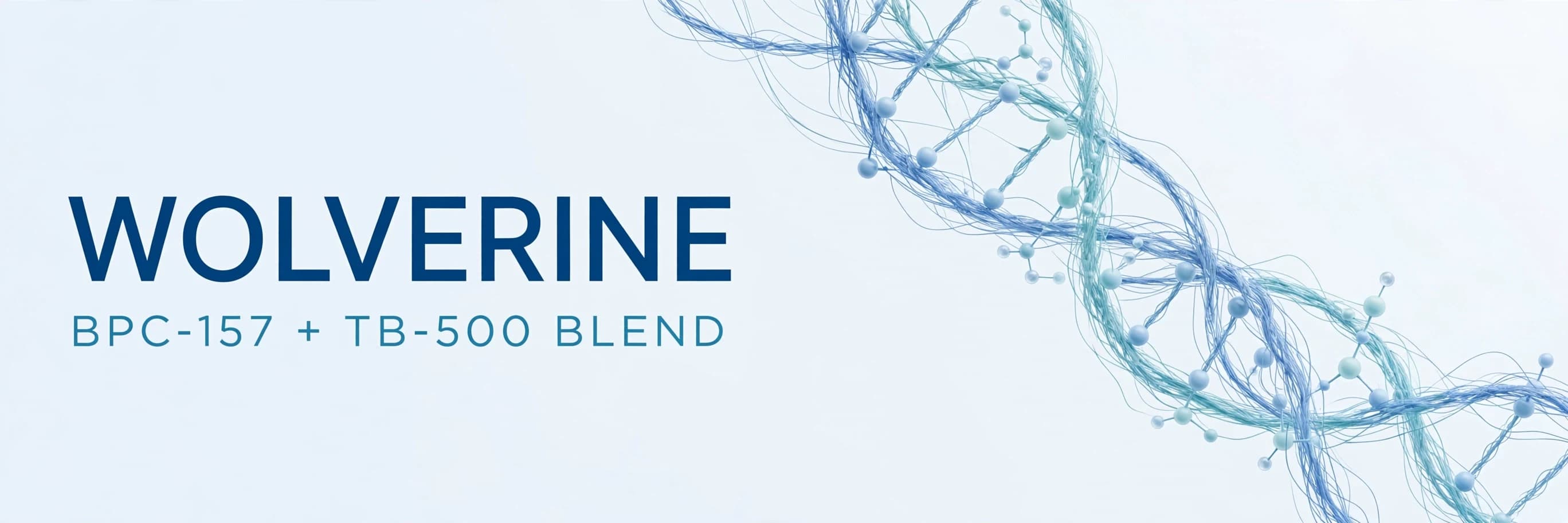
The Wolverine blend pairs two of the most studied tissue-repair research peptides — BPC-157 and TB-500 — in a single vial. BPC-157 is a fifteen-amino-acid peptide derived from a gastric protection protein, studied mainly in tendon, ligament and angiogenesis models. TB-500 is a short synthetic fragment of thymosin beta-4, the 43-amino-acid actin-binding protein whose repair literature spans dermal wounds, cell migration and cardiac models. Researchers study the two together because their published mechanisms describe different, potentially complementary parts of the repair process — growth-factor signaling and cell survival on one side, actin dynamics and cell movement on the other.
One boundary belongs at the top of any honest blend guide: the published record studies BPC-157 and TB-500 (and its parent protein, thymosin beta-4) separately. No published study tests this exact combination, so nothing in the single-compound literature, on its own, establishes what the blend does. This guide reviews what each component's literature actually shows, why researchers pair them, and where the evidence stops. Readers new to the components should also see our guides to what BPC-157 is, what TB-500 is, and their head-to-head comparison.
What Is the Wolverine Blend?
The blend combines equal amounts of the two peptides in one lyophilized vial. NUPEPS supplies it in two sizes: 10MG of BPC-157 with 10MG of TB-500, and 15MG of BPC-157 with 15MG of TB-500.
- Component 1: BPC-157 — pentadecapeptide, sequence Gly-Glu-Pro-Pro-Pro-Gly-Lys-Pro-Ala-Asp-Asp-Ala-Gly-Leu-Val (GEPPPGKPADDAGLV), molecular weight approximately 1,419.5 g/mol
- Component 2: TB-500 — synthetic fragment of thymosin beta-4, sequence Ac-LKKTETQ (residues 17–23 of the parent protein), molecular weight approximately 889 g/mol, CAS 885340-08-9
- Blend sizes: 10MG + 10MG (20MG total) and 15MG + 15MG (30MG total)
- Category: Peptide blend for laboratory research
The TB-500 component requires one clarification, because the names are routinely conflated. TB-500 is not thymosin beta-4. It is a seven-residue synthetic fragment reproducing the parent protein's actin-binding motif — the short stretch of sequence through which thymosin beta-4 grips actin monomers. The full-length protein has additional regions and additional reported functions, and findings from full-length thymosin beta-4 studies do not automatically describe the fragment. This guide keeps the two distinct throughout, and flags which molecule each cited study actually used.
Why Researchers Study the Two Together
The pairing logic is mechanistic, and it is best stated as the literature supports it: as a hypothesis about complementary models, not as a demonstrated synergy. In the published work, BPC-157 is studied largely through growth-factor pathways — VEGFR2 activation, focal-adhesion signaling, and cell survival under stress — in tendon fibroblasts, endothelial cells and rodent injury models. Thymosin beta-4, and by extension its actin-binding fragment, is studied largely through the cytoskeleton: it is the cell's principal actin-monomer buffer, and its repair literature runs through cell migration, angiogenesis and matrix deposition. A tendon or wound model involves both kinds of biology — cells must survive, migrate into the defect, and lay down organized matrix — which is why the two compounds so often appear side by side in repair research, and why a combined research material exists. Whether the combination outperforms either component in any model is a question the published record has not yet answered experimentally.
The standard models make the complementarity concrete. In a full-thickness wound, the endpoints researchers actually measure — re-epithelialization speed, angiogenesis, collagen deposition, keratinocyte migration — are precisely the endpoints of the Malinda thymosin beta-4 study, while the survival of stressed cells at the wound margin and the activation of VEGFR2-driven vessel growth are BPC-157 readouts from the Chang and Hsieh work. In a transected tendon, the Staresinic and Chang experiments track fibroblast outgrowth and migration along the repair front, processes that depend on the actin dynamics thymosin beta-4 regulates. A blend experiment, properly designed, therefore does not need new endpoints: it runs the established single-compound models with a combination arm added, and lets the established readouts judge whether the pairing adds anything. That experiment, notably, remains to be published.
What the BPC-157 Literature Shows
The most-cited BPC-157 repair model is the transected rat Achilles tendon. Staresinic and colleagues reported that BPC-157 accelerated healing of the transected tendon in rats and stimulated the growth of tendon cells (tendocytes) in culture:
Citation: Staresinic M, et al. "Gastric Pentadecapeptide BPC 157 Accelerates Healing of Transected Rat Achilles Tendon and In Vitro Stimulates Tendocytes Growth." Journal of Orthopaedic Research. 2003. [PubMed PMID: 14554208]
Chang and colleagues then dissected the tendon mechanism in vitro, reporting that BPC-157 promoted tendon fibroblast outgrowth, improved cell survival under hydrogen-peroxide stress, and accelerated cell migration, with activation of the FAK–paxillin focal-adhesion pathway — while notably not driving cell proliferation directly:
Citation: Chang CH, et al. "The Promoting Effect of Pentadecapeptide BPC 157 on Tendon Healing Involves Tendon Outgrowth, Cell Survival, and Cell Migration." Journal of Applied Physiology. 2011. [PubMed PMID: 21030672]
On the vascular side, Hsieh and colleagues linked BPC-157's pro-angiogenic activity in endothelial models to activation and up-regulation of the VEGF receptor VEGFR2:
Citation: Hsieh MJ, et al. "Therapeutic Potential of Proangiogenic BPC157 Is Associated with VEGFR2 Activation and Up-Regulation." Journal of Molecular Medicine. 2017. [PubMed PMID: 27847966]
The review literature adds necessary restraint. Seiwerth and colleagues' 2021 wound-healing review summarizes a broad preclinical record across tissue types, while Gwyer and colleagues, reviewing musculoskeletal soft-tissue healing specifically, note that the animal findings are consistent but that efficacy has not been confirmed in humans, and that most of the work originates from a limited number of research groups:
Citation: Seiwerth S, et al. "Stable Gastric Pentadecapeptide BPC 157 and Wound Healing." Frontiers in Pharmacology. 2021. [PubMed PMID: 34267654]
Citation: Gwyer D, Wragg NM, Wilson SL. "Gastric Pentadecapeptide Body Protection Compound BPC 157 and Its Role in Accelerating Musculoskeletal Soft Tissue Healing." Cell and Tissue Research. 2019. [PubMed PMID: 30915550]
What the Thymosin Beta-4 / TB-500 Literature Shows
Thymosin beta-4 was established first as a biochemistry story: it is the major actin-sequestering protein in most cells, binding globular actin and controlling how much of it is available to polymerize into filaments. Goldstein, Hannappel and Kleinman reviewed how that single biochemical role extends into dermal and corneal wound repair and into repair of injured solid organs:
Citation: Goldstein AL, Hannappel E, Kleinman HK. "Thymosin Beta4: Actin-Sequestering Protein Moonlights to Repair Injured Tissues." Trends in Molecular Medicine. 2005. [PubMed PMID: 16099219]
The foundational wound study is Malinda and colleagues' full-thickness rat wound model, in which thymosin beta-4 increased re-epithelialization by 42% over saline controls at day four and by as much as 61% at day seven, with increased collagen deposition and angiogenesis in the treated wounds, and a two- to three-fold stimulation of keratinocyte migration in vitro at picogram quantities:
Citation: Malinda KM, et al. "Thymosin Beta4 Accelerates Wound Healing." Journal of Investigative Dermatology. 1999. [PubMed PMID: 10469335]
The link to the TB-500 fragment specifically runs through the actin-binding site. Philp and colleagues showed that the actin-binding domain of thymosin beta-4 — the LKKTETQ motif that TB-500 reproduces — is itself sufficient to promote angiogenesis, identifying this short region as a functional center of the parent protein's vascular activity:
Citation: Philp D, et al. "The Actin Binding Site on Thymosin Beta4 Promotes Angiogenesis." The FASEB Journal. 2003. [PubMed PMID: 14500546]
Thymosin beta-4's survival signaling was mapped in the heart. Bock-Marquette and colleagues showed that it forms a functional complex with PINCH and integrin-linked kinase, activating the survival kinase Akt, and that after coronary artery ligation in mice it enhanced early cardiomyocyte survival and improved cardiac function:
Citation: Bock-Marquette I, et al. "Thymosin Beta4 Activates Integrin-Linked Kinase and Promotes Cardiac Cell Migration, Survival and Cardiac Repair." Nature. 2004. [PubMed PMID: 15565145]
Every study in this section used full-length thymosin beta-4 except Philp's domain study, which isolated the fragment's own motif. The fragment-specific experimental record for TB-500 itself remains thin compared with the parent protein's — an evidence gap researchers should carry into any blend experiment, and one our overview of tissue-repair peptide research also discusses.
The Honest Gap: The Blend Itself Is Untested
Three limits define this research area. First, no published study administers BPC-157 and TB-500 together, so any statement about combined or synergistic effects is an extrapolation from separate literatures, not a finding. Second, the TB-500 side of the blend leans heavily on full-length thymosin beta-4 data; the fragment retains the actin-binding motif, but equivalence has not been demonstrated across the parent protein's reported activities. Third, both literatures are overwhelmingly preclinical — rodent injury models and cell culture — and the most careful BPC-157 reviewers state plainly that human efficacy is unconfirmed. A blend guide that presented the pairing as established would misrepresent all three points.
Research Applications in the Lab
Within the published record, the blend's components appear in several established laboratory roles, which define how the combined material is used in study design:
- Tendon and ligament models — transected-tendon healing in rodents and tendocyte outgrowth, survival and migration assays, following the Staresinic and Chang study designs.
- Wound-closure and matrix assays — re-epithelialization, collagen deposition and wound-chamber endpoints in the tradition of the Malinda full-thickness model.
- Angiogenesis readouts — endothelial tube formation and VEGFR2 signaling assays on the BPC-157 side; actin-motif angiogenesis models on the thymosin side, after Philp and colleagues.
- Cell-migration and cytoskeleton studies — actin dynamics, focal-adhesion (FAK–paxillin) signaling and migration assays where the two compounds' pathways can be measured side by side.
- Combination-design research — factorial experiments that run each component alone against the pair, the design the literature currently lacks and the one needed before any combined-effect claim can be made.
Analytical and Quality Notes
A two-component blend raises the analytical bar: identity and purity must be confirmed for each active separately. Reversed-phase HPLC of a genuine blend shows two resolved main peaks, one per component, and mass spectrometry should confirm both expected masses — approximately 1,419.5 Da for BPC-157 and approximately 889 Da for TB-500 — since a single-peak chromatogram or a single mass cannot verify a two-peptide product. Net content also matters per component: a certificate should support the stated amount of each peptide, not only a total. NUPEPS publishes a batch report for the Wolverine 20MG material (the 10MG + 10MG variant) in its COA library.
Our guide to reading a peptide COA walks through these checks — chromatogram, observed versus expected masses, and batch specificity — in detail.
Conclusion
The Wolverine blend rests on two substantial but separate preclinical literatures: BPC-157's tendon, survival-signaling and VEGFR2 work, and thymosin beta-4's actin biology, wound and cardiac repair record, with the TB-500 fragment carrying the parent protein's actin-binding motif. The rationale for studying them together is a coherent mechanistic hypothesis. What the record does not yet contain is a study of the combination itself, human confirmation for either component, or a fragment-specific evidence base as deep as the parent protein's — and careful researchers will design blend experiments to test, rather than assume, the pairing. Until a factorial study exists, the most defensible role for the blend in research is as the test article inside exactly that comparison: each component alone, the pair together, and the established endpoints deciding.
Before laboratory use, verify that the material shows at least 99% purity by HPLC for each component, that both identities are confirmed by mass spectrometry, and that it is accompanied by a batch-specific certificate of analysis. NUPEPS supplies the Wolverine blend (BPC-157 10MG + TB-500 10MG) and the 15MG + 15MG variant as research materials, with batch documentation available for review, so researchers can confirm identity and purity for the exact lot in hand before designing experiments around it.
Frequently asked questions
Has the Wolverine blend (BPC-157 + TB-500) itself ever been studied?
No published study administers the two peptides together. Everything known about the blend is extrapolated from separate single-compound literatures — BPC-157 tendon and angiogenesis studies on one side, thymosin beta-4 wound and actin-biology studies on the other. Combined or synergistic effects are a hypothesis, not a finding.
Is TB-500 the same thing as thymosin beta-4?
No. TB-500 is a synthetic seven-residue fragment (Ac-LKKTETQ) reproducing thymosin beta-4's actin-binding motif, residues 17–23 of the 43-amino-acid parent protein. Most "TB-500" research actually used full-length thymosin beta-4, and those findings do not automatically describe the fragment.
What sizes does the Wolverine blend come in, and what does its COA cover?
NUPEPS supplies two variants: BPC-157 10MG + TB-500 10MG (20MG total) and BPC-157 15MG + TB-500 15MG (30MG total). A published batch report covers the Wolverine 20MG material; for a two-peptide product, a valid certificate must confirm both components — two HPLC peaks and both expected masses (≈1,419.5 Da and ≈889 Da).
All products are intended strictly for laboratory research and in-vitro use only. Not for human or veterinary consumption, diagnostic, or therapeutic use. Products are not drugs, foods, cosmetics, or dietary supplements and may not be misbranded, misused, or mislabeled.