Peptide Information
BPC-157 vs TB-500: Key Differences in Research Applications
September 28, 2026
By the NUPEPS Research Team · September 2026
At a Glance
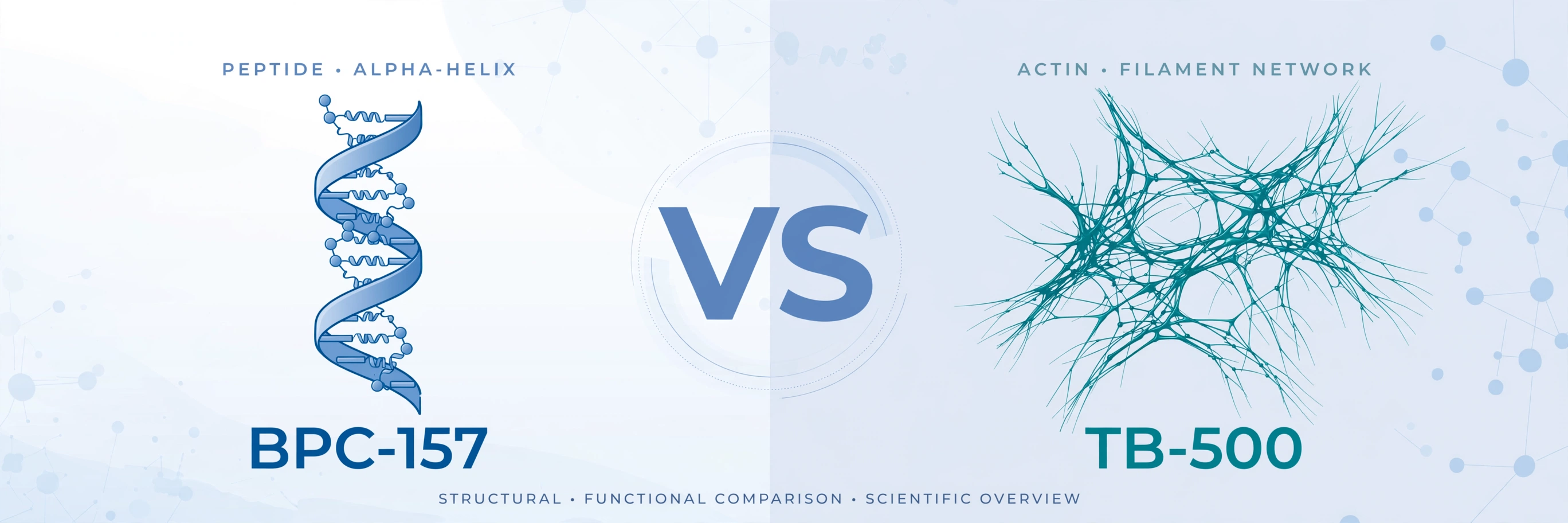
FactDetail ComparisonBPC-157 vs TB-500 (thymosin beta-4 fragment) BPC-157Synthetic 15-amino-acid gastric-derived peptide; MW ~1,419 Da; CAS 137525-51-0 TB-500Synthetic peptide modeled on the active region of thymosin beta-4 (43-aa actin-binding protein); CAS 77591-33-4 Most-studied research area (both)Preclinical tissue-repair models: tendon, muscle, skin, gastrointestinal Key mechanistic distinctionBPC-157: angiogenic / fibroblast / NO-pathway signals reported; TB-500: actin-binding and cell-migration pathways Human dataExtremely limited for both; literature is predominantly preclinical Regulatory statusNeither is FDA approved; both are research-use-only materials Research supplyBPC-157 10 mg and TB-500 10 mg lyophilized powders, for laboratory research use onlyBPC-157 and TB-500 are the two peptides most frequently studied side by side in preclinical tissue-repair literature — but they are entirely different molecules with different origins, structures, and reported mechanisms. BPC-157 is a 15-amino-acid peptide derived from a gastric-juice protein fragment; TB-500 is a synthetic peptide modeled on the active region of thymosin beta-4, a naturally occurring 43-amino-acid actin-regulating protein. This guide compares them strictly on the published research record.
Scope note: Neither compound is approved by the FDA or any regulatory authority for human use. The literature summarized here is predominantly preclinical (animal and cell-culture studies). Nupeps products are sold for in vitro and analytical research only — for laboratory research use only, not for human or veterinary use.
What Are BPC-157 and TB-500?
BPC-157 (Body Protection Compound 157) is a synthetic pentadecapeptide — 15 amino acids, sequence GEPPPGKPADDAGLV, molecular weight ~1,419 daltons — first characterized in the early 1990s from work on cytoprotective peptides in human gastric juice. It is unusually stable in acidic, proteolytic environments, remaining intact in human gastric juice for more than 24 hours in laboratory testing. The published record spans gastrointestinal, musculoskeletal, vascular, and neurological models.
TB-500 is a synthetic peptide modeled on the active region of thymosin beta-4 (Tβ4), a 43-amino-acid protein found in nearly all mammalian cells and body fluids, including wound fluid. Thymosin beta-4 is best known as an actin-sequestering protein: it binds G-actin and regulates cytoskeletal dynamics, which positions it at the center of cell migration, tissue remodeling, and repair cascades. TB-500 is the research compound derived from this parent molecule's active domain.
In short: BPC-157 comes from gastric cytoprotection research; TB-500 comes from cytoskeletal and wound-biology research. They arrived at overlapping research questions from completely different starting points.
How Do BPC-157 and TB-500 Differ Structurally?
PropertyBPC-157TB-500 OriginSynthetic copy of a gastric-juice-derived peptide fragmentSynthetic peptide modeled on the active region of thymosin beta-4 Length15 amino acids (pentadecapeptide)Short synthetic fragment (parent protein: 43 amino acids) Sequence (BPC-157) / parent (TB-500)GEPPPGKPADDAGLVDerived from thymosin beta-4; central actin-binding domain (aa 17–23) carries key activity Molecular weight~1,419 DaVaries by exact fragment construct CAS number137525-51-077591-33-4 Notable stabilityStable in human gastric juice >24 h (in vitro)Standard peptide handling; no unusual acid stability reported Synonyms / codesBepecin, PL 14736Thymosin beta-4 fragmentThe structural difference matters for how researchers think about them: BPC-157 is a complete, defined small molecule with a single known sequence, while "TB-500" refers to a synthetic construct based on the functional core of a larger natural protein.
What Mechanisms Have Researchers Studied?
The exact mechanism of BPC-157 is not fully established, but published studies have repeatedly reported several pathways:
BPC-157: reported pathways
- Angiogenic signaling — upregulation and internalization of VEGFR2 and activation of the VEGFR2–Akt–eNOS axis in muscle and tendon models.
- Fibroblast activity — accelerated tendon fibroblast outgrowth and survival under oxidative stress, reported via the FAK–paxillin pathway.
- Nitric oxide modulation — reported modulation of nitric oxide synthase (NOS) isoforms.
- Repair-gene expression — reported upregulation of VEGFA, NOS3, and ERK1/2 and PI3K–Akt signaling components in wound models.
TB-500 / thymosin beta-4: reported pathways
The thymosin beta-4 literature centers on cytoskeletal and repair biology:
- Actin binding and cell migration — the central actin-binding domain (amino acids 17–23) sequesters G-actin, regulating cytoskeletal remodeling; Philp et al. showed this domain alone carried the activity for metalloproteinase induction.
- Matrix remodeling — reported upregulation of matrix metalloproteinases (MMP-1, MMP-2, MMP-9) in keratinocytes, endothelial cells, and fibroblasts.
- Angiogenesis and keratinocyte migration — increased reepithelialization, collagen deposition, and angiogenesis reported in wound models.
- Anti-inflammatory and anti-apoptotic signals — reported reductions in inflammation and apoptosis markers, plus stem-cell mobilization signals in review literature.
The conceptual contrast: BPC-157's reported literature emphasizes vascular and fibroblast signaling; thymosin beta-4's literature emphasizes cytoskeletal control of cell movement and matrix remodeling.
BPC-157 vs TB-500: Side-by-Side Comparison
FeatureBPC-157TB-500 Molecule class15-aa synthetic gastric peptideSynthetic fragment of thymosin beta-4 Primary research originGastric cytoprotection / ulcer researchCytoskeletal biology / wound repair Most-reported mechanism clusterAngiogenesis, fibroblast migration, NO signalingActin binding, cell migration, MMP-driven remodeling Key animal modelsTendon transection, GI ulcer, anastomosis healing, fractureFull-thickness dermal wounds, corneal repair, incisional wounds Human dataThree small pilot studies; no large trialsTwo small phase 2 trials in cutaneous ulcers; no large trials FDA statusNot approvedNot approved Stability noteGastric-juice stable >24 hNo exceptional stability reported Common research contextStudied alone or alongside TB-500 in tissue-repair modelsStudied alone or alongside BPC-157 in tissue-repair modelsWhat Does the Published Literature Report? Key Studies
Selected peer-reviewed papers frequently cited in the BPC-157 and TB-500 literature:
- Sikiric et al. (2012) — review of stable gastric pentadecapeptide BPC 157: sequence, gastric-juice stability, NO-system interaction, angiogenic signaling, and wound-healing effects across animal models. Current Medicinal Chemistry.
- Sikiric et al. (2007) — BPC-157 improved ileoileal anastomosis healing in rats across macroscopic, histological, and biomechanical measures. Surgery Today.
- Malinda et al. (1999) — thymosin beta-4 increased reepithelialization by up to 61% over controls in a rat full-thickness wound model, with increased collagen deposition, angiogenesis, and keratinocyte migration. Journal of Investigative Dermatology.
- Philp et al. (2006) — thymosin beta-4 increased MMP-1, MMP-2, and MMP-9 expression in wound-relevant cell types; the central actin-binding domain (aa 17–23) carried the activity. Journal of Cellular Physiology.
- Treadwell et al. (2012) — review of thymosin beta-4 in dermal repair: preclinical acceleration of healing across models and two phase 2 trials in stasis and pressure ulcers. Annals of the New York Academy of Sciences.
Why Do Researchers Study BPC-157 and TB-500 Together?
The pairing is a literature phenomenon, not a pharmacological one. Both compounds accumulated large preclinical records in tissue-repair models during the same era, and both are defined, synthesizable peptides — which makes them convenient co-subjects in comparative or parallel-arm wound and tendon studies. Review articles and research suppliers routinely discuss them as a pair because their reported mechanism clusters are complementary on paper: vascular/fibroblast signaling (BPC-157) alongside cytoskeletal/migration control (thymosin beta-4).
For laboratories, the practical point is simpler: they are different tools for probing different parts of repair biology, and the published record for each should be evaluated on its own terms.
Which Compound Has the Larger Published Record?
Both literatures are overwhelmingly preclinical. BPC-157's published record is larger in sheer paper count — decades of work from the Zagreb group spanning GI, tendon, bone, vascular, and CNS models — while thymosin beta-4's record is broader in biological scope (it is an endogenous protein with roles far beyond repair research, including a clinical development history under names like RGN-259 for ophthalmic indications). Neither has completed large, rigorous human trials establishing effects in people, and neither is an approved medicine.
BPC-157 and TB-500 in the Laboratory
Both compounds ship as lyophilized powders and require the same disciplined handling as any research peptide:
- Verify identity and purity against the batch-specific COA before use — our guide on how to read a peptide COA walks through the HPLC and mass-spec sections.
- Store correctly — lyophilized at −20 °C, protected from light and moisture; avoid repeated freeze–thaw of any prepared aliquots. Details in our peptide storage guide.
BPC-157 and TB-500 at Nupeps
Nupeps supplies research-grade BPC-157 10 mg and TB-500 10 mg as lyophilized powders. Every batch is tested for purity, quantity, and sterility, with batch-specific COAs verifying 99%+ purity.
Browse the full catalog of research peptides or see how Nupeps tests every batch.
Frequently Asked Questions
What is the main difference between BPC-157 and TB-500?
They are different molecules from different research origins. BPC-157 is a 15-amino-acid synthetic peptide derived from gastric-juice cytoprotection research; TB-500 is a synthetic peptide modeled on the active region of thymosin beta-4, a 43-amino-acid actin-binding protein studied in cytoskeletal and wound biology.
Do BPC-157 and TB-500 work the same way?
No. Published studies associate BPC-157 with angiogenic, fibroblast, and nitric-oxide-related signaling, while thymosin beta-4 literature centers on actin binding, cell migration, and matrix metalloproteinase-driven remodeling. Both literatures are preclinical.
Is BPC-157 the same as TB-500?
No. They are distinct compounds that are frequently discussed together only because both have large preclinical records in tissue-repair models.
Are BPC-157 or TB-500 FDA approved?
No. As of 2026, neither BPC-157 nor TB-500 is approved by the FDA or any regulatory authority for human use, and no large-scale human clinical trials have been completed for either.
What does TB-500 stand for?
TB-500 is the research designation for the synthetic peptide fragment derived from thymosin beta-4 (Tβ4), the endogenous actin-sequestering protein.
How should BPC-157 and TB-500 be stored in the lab?
Lyophilized vials: freezer (−20 °C), protected from light and moisture. Avoid repeated freeze–thaw cycles of prepared aliquots. See our peptide storage guide.
Key Takeaways
BPC-157 and TB-500 look like a natural pair only because the literature kept placing them side by side. Underneath, they are unrelated molecules: a gastric-derived pentadecapeptide with a vascular/fibroblast research profile, and a thymosin beta-4 fragment rooted in actin and cell-migration biology. Both records remain preclinical, and both compounds are research materials — which is exactly why verified identity and documented purity matter before either one enters an assay.
Common questions about ordering and shipping are answered in our FAQs.
Research Use Only disclaimer: All Nupeps products, including BPC-157 and TB-500, are sold strictly for laboratory and in vitro research use only — for laboratory research use only, not for human or veterinary use. They are not intended for the diagnosis, treatment, cure, or prevention of any disease. This article summarizes published scientific literature for research reference; it does not constitute medical or scientific advice.
Further reading: What Is BPC-157? Complete Research Guide · How to Read a Peptide COA · Peptide Storage Guide
All products are intended strictly for laboratory research and in-vitro use only. Not for human or veterinary consumption, diagnostic, or therapeutic use. Products are not drugs, foods, cosmetics, or dietary supplements and may not be misbranded, misused, or mislabeled.