Peptide Information
What Is BPC-157? Complete Research Guide
September 21, 2026
By the NUPEPS Research Team · September 2026
At a Glance
FactDetail CompoundBPC-157 (Body Protection Compound 157) TypeSynthetic pentadecapeptide — 15 amino acids SequenceGEPPPGKPADDAGLV Molecular weight~1,419 daltons CAS number137525-51-0 Also known asBepecin, PL 14736 FDA statusNot approved for human use Human dataExtremely limited; no large clinical trials completed Research supplyBPC-157 10 mg lyophilized powder, for laboratory research use onlyBPC-157 (Body Protection Compound 157) is a synthetic 15-amino-acid peptide (sequence GEPPPGKPADDAGLV) first characterized in the early 1990s from research on human gastric juice proteins. It has been investigated in dozens of preclinical animal models spanning tendon, muscle, gastrointestinal, and vascular repair. BPC-157 is not approved by the FDA or any regulatory authority for human use, and human data remain extremely limited.
At Nupeps, research-grade BPC-157 is supplied as a lyophilized powder, batch-tested and COA-verified, strictly for laboratory research use.
Scope note: BPC-157 is not approved by the FDA or any regulatory authority for human use. Human data are extremely limited. Nupeps products are sold for in vitro and analytical research only — never for human or veterinary use.
What Does BPC-157 Stand For, and Where Does It Come From?
The "BPC" designation stands for "Body Protection Compound," a series of peptide fractions isolated and screened by Sikiric and colleagues at the University of Zagreb in the early 1990s. The number 157 comes from the numbering used in that screening program, as reported in the peptide literature.
BPC-157 was derived from a protein fragment naturally present in human gastric juice. Fractionation of gastric secretions yielded a family of cytoprotective peptides, and BPC-157 represents the synthetic counterpart of one such sequence. Notably, the peptide is unusually stable under the acidic, proteolytic conditions of the gastric environment — remaining intact in human gastric juice for more than 24 hours in laboratory testing.
Since its initial characterization, BPC-157 has been investigated in a growing body of predominantly preclinical studies spanning gastrointestinal, musculoskeletal, cardiovascular, neurological, and ophthalmic domains.
What Is the Chemical Structure of BPC-157?
BPC-157 is a synthetic pentadecapeptide — a chain of exactly 15 amino acids — with the sequence Gly-Glu-Pro-Pro-Pro-Gly-Lys-Pro-Ala-Asp-Asp-Ala-Gly-Leu-Val (GEPPPGKPADDAGLV) and a molecular weight of approximately 1,419 daltons. It is also known in the literature under the names bepecin and PL 14736.
PropertyDetail Amino acids15 (pentadecapeptide) SequenceGEPPPGKPADDAGLV Molecular weight~1,419 Da CAS number137525-51-0 SynonymsBepecin, PL 14736 StabilityReported stable in gastric juice >24 h (in vitro)What Mechanisms Has BPC-157 Research Reported?
The exact mechanism of action of BPC-157 is not fully established, but published studies have reported several recurring pathways:
- Angiogenesis signaling — studies report upregulation and internalization of vascular endothelial growth factor receptor 2 (VEGFR2) and activation of the VEGFR2–Akt–eNOS pathway, associated with new blood vessel formation in muscle and tendon models.
- Fibroblast migration and survival — in rat Achilles tendon models, BPC-157 accelerated tendon fibroblast outgrowth, increased cell survival under oxidative stress, and promoted migration via the FAK–paxillin pathway.
- Nitric oxide modulation — multiple studies report modulation of nitric oxide synthase (NOS) isoforms, a pathway linked to vascular and tissue responses.
- Collagen and growth-factor signaling — reported upregulation of repair-associated genes including VEGFA, NOS3, and components of the ERK1/2 and PI3K–Akt axes in wound models.
What Is BPC-157 Studied for in Preclinical Research?
Published animal studies have investigated BPC-157 across a wide range of tissue models:
- Tendon and ligament — transected rat Achilles tendon, medial collateral ligament models; reported accelerated healing and improved biomechanical recovery.
- Skeletal muscle — crush and transection injury models; reported improved regeneration.
- Gastrointestinal tract — ulcer models (restraint stress, cysteamine, ethanol), inflammatory bowel models; the original domain of BPC research.
- Bone — fracture and segmental defect models; reported osteogenic effects.
- Skin and cornea — wound closure models.
All of these findings come from animal or in vitro studies. They describe what researchers have observed in controlled experiments — not established effects in humans.
What Is the Difference Between BPC-157 and TB-500?
BPC-157 and TB-500 are frequently studied side by side in tissue-repair literature, but they are distinct molecules. Researchers often compare their reported mechanisms — BPC-157's angiogenic and fibroblast-activity signals versus TB-500's actin-binding and cell-migration pathways. See also our TB-500 research guide.
FeatureBPC-157TB-500 Size15 amino acidsFragment of thymosin beta-4 (a 43-amino-acid protein) OriginGastric-juice-derived peptide sequenceSynthetic fragment of thymosin beta-4 Reported research signalsAngiogenesis, fibroblast migration and survivalActin regulation, cell migration Regulatory statusNot FDA approved; research use onlyNot FDA approved; research use onlyIs BPC-157 Approved for Human Use?
No. To be direct about the evidence gap: human data on BPC-157 are extremely limited. Reviews of the literature identify only a small number of pilot studies in humans — covering areas such as intra-articular knee pain, interstitial cystitis, and intravenous safety/pharmacokinetics. No large, rigorous clinical trials have been completed.
Regulatory status:
- Not FDA approved — BPC-157 is not approved by the FDA or any other drug regulatory agency for human use.
- WADA — the compound was added to the World Anti-Doping Agency's prohibited list in 2022; athletes and researchers should verify its current listing status, as prohibited lists are updated annually.
- Research supply — because it promotes angiogenesis in preclinical models, some reviews note theoretical safety questions that require further investigation, which is part of why controlled research with verified material matters.
What Does the Published Research Show? Key Studies
Selected peer-reviewed studies frequently cited in BPC-157 literature (all preclinical unless noted):
- Seiwerth et al. (2018) — review comparing BPC-157 with standard angiogenic growth factors (EGF, FGF, VEGF) across gastrointestinal healing and tendon, ligament, muscle, and bone models. Current Pharmaceutical Design.
- Cerovecki et al. (2010) — BPC-157 improved medial collateral ligament healing in rats after surgical transection. Journal of Orthopaedic Research.
- Pevec et al. (2010) — BPC-157 improved healing of transected and crushed muscle in rats, including corticosteroid-impaired healing. Medical Science Monitor.
- Bajramagic et al. (2024) — review of BPC-157 in intestinal anastomosis therapy in rats. Pharmaceuticals.
How Is BPC-157 Handled in the Laboratory?
Like most research peptides, BPC-157 ships as a lyophilized powder and requires careful handling:
- Verify identity and purity against the batch-specific COA before use — our guide on how to read a peptide COA walks through the HPLC and mass-spec sections.
- Reconstitute with sterile technique using an appropriate diluent; see our step-by-step reconstitution guide.
- Store correctly — lyophilized at −20 °C long term; reconstituted aliquots refrigerated short term or frozen single-use. Details in our peptide storage guide.
BPC-157 at Nupeps
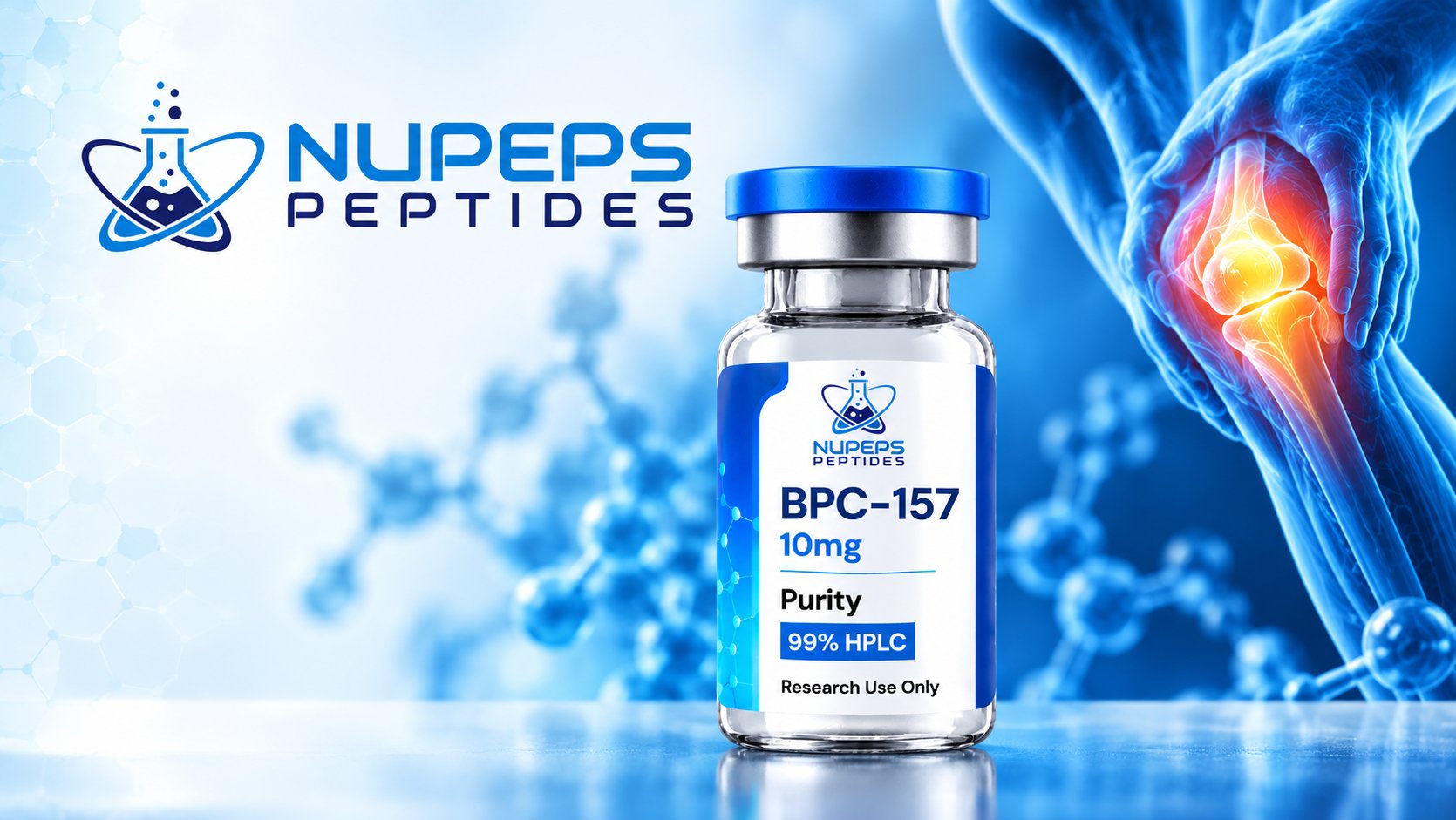
Nupeps supplies research-grade BPC-157 as BPC-157 10 mg. Every batch is tested for purity, quantity, and sterility, with batch-specific COAs verifying 99%+ purity.
Browse the full catalog of research peptides or see how Nupeps tests every batch.
Frequently Asked Questions
What does BPC-157 stand for?
Body Protection Compound 157 — the "157" designation comes from the numbering used in the gastric-juice peptide screening program reported in the literature.
How many amino acids does BPC-157 have?
Fifteen. It is a pentadecapeptide with the sequence GEPPPGKPADDAGLV and a molecular weight of about 1,419 daltons.
Is BPC-157 FDA approved?
No. As of 2026, BPC-157 is not approved by the FDA or any regulatory authority for human use, and no large-scale human clinical trials have been completed.
What is BPC-157 studied for in research?
Preclinical studies have investigated it in models of tendon, muscle, ligament, bone, gastrointestinal, skin, and vascular repair — all in animals or cell culture, not in humans.
What is the difference between BPC-157 and TB-500?
They are different molecules studied in overlapping research areas. BPC-157 is a 15-amino-acid gastric-derived peptide; TB-500 is a fragment of thymosin beta-4 associated with actin regulation and cell migration. A dedicated TB-500 guide is next in this series.
How should BPC-157 be stored in the lab?
Lyophilized vials: freezer (−20 °C) for long-term storage. After reconstitution: refrigerate short term or freeze single-use aliquots; never repeatedly freeze–thaw. See our peptide storage guide.
Key Takeaways
BPC-157 remains one of the most actively investigated peptides in preclinical regenerative research — a small, stable, gastric-derived molecule with a large published record in animal models and a conspicuously small one in humans. For laboratories working with it, the fundamentals decide the quality of the data: verified identity, documented purity, and disciplined handling from vial to assay.
Common questions about ordering and shipping are answered in our FAQs.
Research Use Only disclaimer: All Nupeps products, including BPC-157, are sold strictly for laboratory and in vitro research use only. They are not intended for human or veterinary use, nor for the diagnosis, treatment, cure, or prevention of any disease. This article is for informational purposes only; it does not constitute medical or scientific advice.
Further reading: How to Reconstitute Lyophilized Peptides · Peptide Storage Guide · How to Read a Peptide COA · What Is Retatrutide? NP-III (RT) Triple Agonist Research Guide
All products are intended strictly for laboratory research and in-vitro use only. Not for human or veterinary consumption, diagnostic, or therapeutic use. Products are not drugs, foods, cosmetics, or dietary supplements and may not be misbranded, misused, or mislabeled.
Related research products
Compounds discussed in this guide, available for laboratory research.