Peptide Information
CJC-1295 vs Ipamorelin: GHRH Analog vs Ghrelin Mimetic in GH-Axis Research
October 1, 2026
By the NUPEPS Research Team · September 2026
At a Glance
Comparison: CJC-1295 (GHRH analog) vs ipamorelin (ghrelin-receptor agonist)
CJC-1295: 29-amino-acid synthetic GHRH(1–29) analog; no-DAC form carries 4 substitutions (D-Ala², Gln⁸, Ala¹⁵, Leu²⁷); CAS 863288-34-0
Ipamorelin: 5-amino-acid synthetic pentapeptide (Aib-His-D-2-Nal-D-Phe-Lys-NH₂); MW ~712 Da; selective GHSR agonist
Receptor targets: CJC-1295 → GHRH receptor (GHRHR); ipamorelin → ghrelin receptor (GHSR-1a)
Key distinction: Different receptors, different pulse dynamics: sustained GHRH drive vs discrete ghrelin-mimetic pulses
Human data: CJC-1295: published human PK/PD studies; ipamorelin: limited human data, mostly rodent models
Regulatory status: Neither is FDA approved; both are research-use-only materials
Research supply: CJC-1295 No DAC 10 mg and ipamorelin 10 mg lyophilized powders, for laboratory research use only
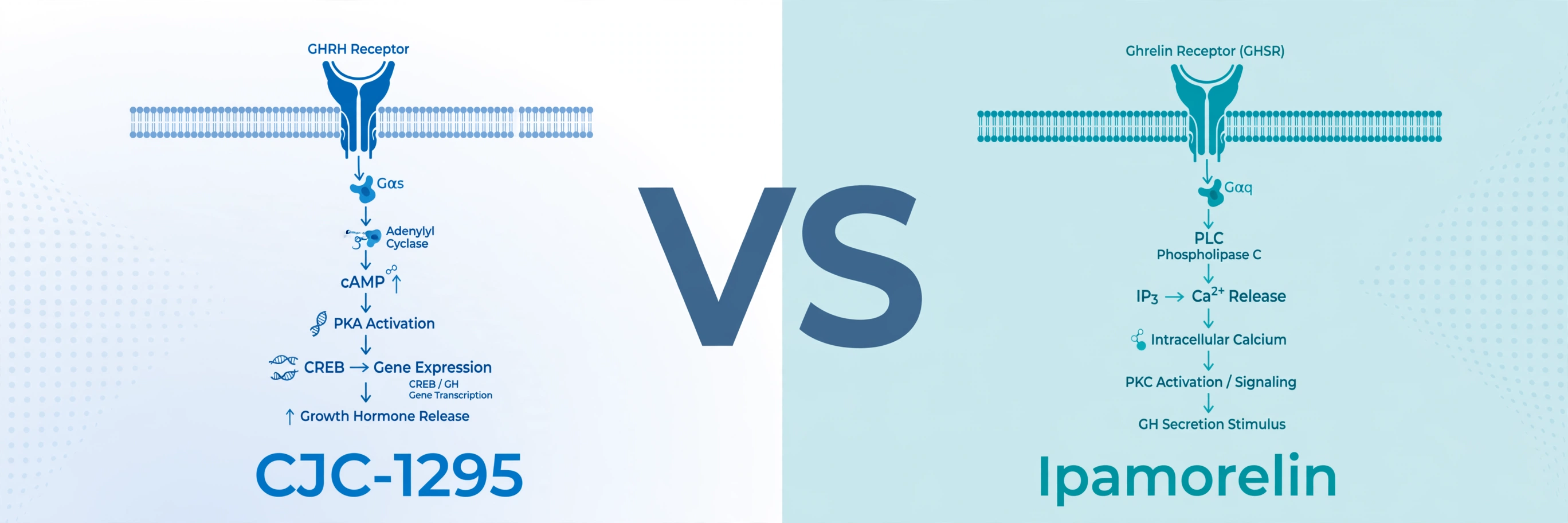
CJC-1295 and ipamorelin are the two most commonly compared growth-hormone-axis research peptides — and the reason is receptor logic. CJC-1295 stimulates the GHRH receptor on pituitary somatotrophs; ipamorelin stimulates the ghrelin receptor (GHSR-1a) on the same cells. Two different receptors, two different signaling routes, one shared downstream readout: pulsatile growth hormone release. This guide compares them on structure, mechanism, and the published record.
Scope note: Neither compound is approved by the FDA or any regulatory authority for human use. Nupeps products are sold for in vitro and analytical research only — for laboratory research use only, not for human or veterinary use.
What Are CJC-1295 and Ipamorelin?
CJC-1295 is a synthetic 29-amino-acid analog of growth hormone–releasing hormone (GHRH 1–29, also called GRF 1–29). It was engineered with amino-acid substitutions that resist enzymatic degradation, extending its activity far beyond native GHRH — whose plasma half-life is measured in minutes. Two forms are discussed in the literature:
- CJC-1295 with DAC (Drug Affinity Complex): carries a maleimide-based moiety that binds covalently to serum albumin after injection, producing a half-life of roughly 6–8 days in human studies.
- CJC-1295 no DAC (often called Modified GRF 1–29): the same substituted 29-aa backbone without the albumin-binding complex — shorter-acting, producing a briefer GH pulse.
Ipamorelin is a synthetic pentapeptide — five amino acids (Aib-His-D-2-Nal-D-Phe-Lys-NH₂), molecular weight ~712 daltons — developed in the late 1990s as a growth hormone secretagogue. In the foundational pharmacology paper, Raun and colleagues described it as the first GHRP-receptor agonist with GH selectivity comparable to GHRH itself: it released GH potently in vitro and in vivo without significantly raising ACTH, cortisol, prolactin, FSH, LH, or TSH — a selectivity profile that distinguished it from earlier secretagogues like GHRP-2 and GHRP-6.
How Do Their Mechanisms Differ?
The difference is best understood at the receptor level:
- CJC-1295 → GHRH receptor (GHRHR). A G-protein-coupled receptor on anterior pituitary somatotrophs. Activation drives GH synthesis and release through the classical GHRH signaling cascade — the same pathway used by endogenous GHRH and by the approved analog tesamorelin.
- Ipamorelin → ghrelin receptor (GHSR-1a). A different GPCR, also expressed on somatotrophs (and in the hypothalamus). Activation amplifies GH pulse amplitude through the ghrelin-mimetic pathway — the same receptor family targeted by GHRP-6, GHRP-2, and hexarelin, but with ipamorelin's notably cleaner selectivity profile.
Downstream, both pathways converge: GH released into circulation stimulates hepatic IGF-1 production, the standard biomarker tracked in GH-axis studies. The published CJC-1295 human studies reported GH elevations of 2- to 10-fold and IGF-1 elevations of roughly 1.5- to 3-fold over baseline, sustained for days after a single administration of the DAC form.
A concept frequently discussed in endocrine literature is that the two pathways are complementary rather than redundant: GHRH-receptor drive sets the secretory capacity, while ghrelin-receptor drive amplifies pulse amplitude. That receptor-level complementarity is the scientific rationale behind studies and research designs that examine both pathways.
CJC-1295 vs Ipamorelin: Side-by-Side Comparison
Molecule class: CJC-1295: 29-aa GHRH analog — Ipamorelin: 5-aa synthetic pentapeptide
Receptor: CJC-1295: GHRH receptor (GHRHR) — Ipamorelin: Ghrelin receptor (GHSR-1a)
Pathway type: CJC-1295: GHRH-mimetic — Ipamorelin: Ghrelin-mimetic (GHRP family)
Key structural feature: CJC-1295: 4 stabilizing substitutions; DAC form adds albumin-binding complex — Ipamorelin: D-amino acids and Aib residue for stability and selectivity
Approx. molecular weight: CJC-1295: ~3,366 Da (no DAC) — Ipamorelin: ~712 Da
CAS number: CJC-1295: 863288-34-0 (no DAC) — Ipamorelin: —
Reported GH profile: CJC-1295: Sustained elevation with preserved pulsatility (DAC form: days) — Ipamorelin: Discrete pulses returning to baseline within hours
Selectivity note: CJC-1295: GHRH-pathway specific by design — Ipamorelin: First GHRP agonist with GHRH-like GH selectivity; no significant ACTH/cortisol at tested doses
Most-studied form: CJC-1295: DAC form in human PK/PD studies — Ipamorelin: Rodent pharmacology; limited human data
FDA status: CJC-1295: Not approved — Ipamorelin: Not approved
What Has Published Research Reported? Key Studies
Selected peer-reviewed papers frequently cited in the CJC-1295 and ipamorelin literature:
- Teichman et al. (2006) — CJC-1295 administration in healthy adults raised mean plasma GH 2- to 10-fold for 6+ days and IGF-1 ~1.5- to 3-fold for 9–11 days after single doses. Journal of Clinical Endocrinology & Metabolism.
- Ionescu & Frohman (2006) — after CJC-1295, GH pulsatility was preserved: pulse frequency and magnitude unchanged, while trough GH rose 7.5-fold and mean GH 46%, with IGF-1 up 45%. Journal of Clinical Endocrinology & Metabolism.
- Raun et al. (1998) — the foundational ipamorelin paper: potent GH release in vitro and in vivo with selectivity for GH over ACTH, cortisol, prolactin, FSH, LH, and TSH — the first GHRP-receptor agonist described with GHRH-like selectivity. European Journal of Endocrinology.
- Johansen et al. (1999) — ipamorelin induced longitudinal bone growth in rats, consistent with sustained GH-axis engagement. Growth Hormone & IGF Research.
- Sigalos & Pastuszak (2018) — review of growth hormone secretagogues covering GHRH analogs and ghrelin mimetics, their mechanisms, and the state of the evidence. Sexual Medicine Reviews.
Why Are CJC-1295 and Ipamorelin Studied Together?
The pairing follows directly from the receptor logic above. Because CJC-1295 and ipamorelin act on different receptors on the same target cells, research designs examining both pathways can probe GH-axis signaling more completely than either pathway alone. Published commentary on GH secretagogues has long noted that combined GHRH-receptor and ghrelin-receptor stimulation produces a larger GH response than either stimulus in isolation — a synergy first characterized with native GHRH plus GHRP compounds, and the conceptual basis for the CJC-1295/ipamorelin research pairing.
For laboratories, the practical distinction: CJC-1295 is the tool for studying sustained GHRH-receptor drive; ipamorelin is the tool for studying selective ghrelin-receptor-mediated GH pulses.
What Does DAC vs No DAC Mean for CJC-1295 Research?
This is the most common point of confusion in CJC-1295 literature, so it deserves a direct answer:
- With DAC = the albumin-binding modification. This is the form used in the published human studies (Teichman 2006; Ionescu & Frohman 2006), with a measured half-life of 6–8 days and multi-day GH/IGF-1 elevation from a single administration.
- No DAC = Modified GRF(1–29), the substituted backbone alone. Shorter-acting; produces a briefer, more pulse-like GH signal.
When reading CJC-1295 papers, checking which form was used is essential — the pharmacokinetic profiles are entirely different, and results from one form do not transfer to the other.
CJC-1295 and Ipamorelin in the Laboratory
Both compounds ship as lyophilized powders and require the same disciplined handling as any research peptide:
- Confirm which form you have — especially for CJC-1295 (DAC vs no DAC), since the forms are not interchangeable in research designs. Verify against the batch-specific COA and our guide on how to read a peptide COA.
- Store correctly — lyophilized at −20 °C, protected from light and moisture; avoid repeated freeze–thaw of any prepared aliquots. Details in our peptide storage guide.
CJC-1295 and Ipamorelin at Nupeps
Nupeps supplies research-grade CJC-1295 No DAC 10 mg and Ipamorelin 10 mg as lyophilized powders. Every batch is tested for purity, quantity, and sterility, with batch-specific COAs verifying 99%+ purity.
Browse the full catalog of research peptides or see how Nupeps tests every batch.
Frequently Asked Questions
What is the difference between CJC-1295 and ipamorelin?
They act on different receptors. CJC-1295 is a GHRH analog that stimulates the GHRH receptor; ipamorelin is a pentapeptide ghrelin mimetic that stimulates the ghrelin receptor (GHSR-1a). Both pathways converge on pituitary GH release.
What does DAC mean in CJC-1295?
DAC (Drug Affinity Complex) is an albumin-binding modification that extends CJC-1295's half-life to roughly 6–8 days. The no-DAC form (Modified GRF 1–29) lacks it and is shorter-acting. The published human studies used the DAC form.
Why is ipamorelin called selective?
In its foundational pharmacology study, ipamorelin released GH potently without significantly raising ACTH, cortisol, prolactin, or gonadotropins — unlike earlier secretagogues such as GHRP-2 and GHRP-6, which raised ACTH and cortisol. It was described as the first GHRP-receptor agonist with GHRH-like selectivity.
Are CJC-1295 or ipamorelin FDA approved?
No. As of 2026, neither CJC-1295 nor ipamorelin is approved by the FDA or any regulatory authority for human use.
Can CJC-1295 and ipamorelin be studied together?
They are frequently examined in parallel research designs because they target different receptors on the same pituitary cells — the scientific rationale for the well-known pairing. Each compound's published record should still be evaluated on its own terms.
How should CJC-1295 and ipamorelin be stored in the lab?
Lyophilized vials: freezer (−20 °C), protected from light and moisture. Avoid repeated freeze–thaw cycles of prepared aliquots. See our peptide storage guide.
Key Takeaways
CJC-1295 and ipamorelin are a natural comparison because they illuminate the GH axis from two sides: sustained GHRH-receptor drive versus selective ghrelin-receptor pulses. CJC-1295 brings published human pharmacology (in its DAC form); ipamorelin brings a landmark selectivity profile from foundational animal pharmacology. Neither is an approved medicine, and both are research tools — which is why confirming the exact form (DAC vs no DAC especially) and verifying batch purity belong at the start of any work with them.
Common questions about ordering and shipping are answered in our FAQs.
Research Use Only disclaimer: All Nupeps products, including CJC-1295 and ipamorelin, are sold strictly for laboratory and in vitro research use only — for laboratory research use only, not for human or veterinary use. They are not intended for the diagnosis, treatment, cure, or prevention of any disease. This article summarizes published scientific literature for research reference; it does not constitute medical or scientific advice.
Further reading: What Is Tesamorelin? A GHRH Analog Research Guide · How to Read a Peptide COA · Peptide Storage Guide
All products are intended strictly for laboratory research and in-vitro use only. Not for human or veterinary consumption, diagnostic, or therapeutic use. Products are not drugs, foods, cosmetics, or dietary supplements and may not be misbranded, misused, or mislabeled.