
Research Guides
Semax Research Guide: ACTH Fragment, BDNF and Lab Use
By NUPEPS Research TeamOctober 19, 2026
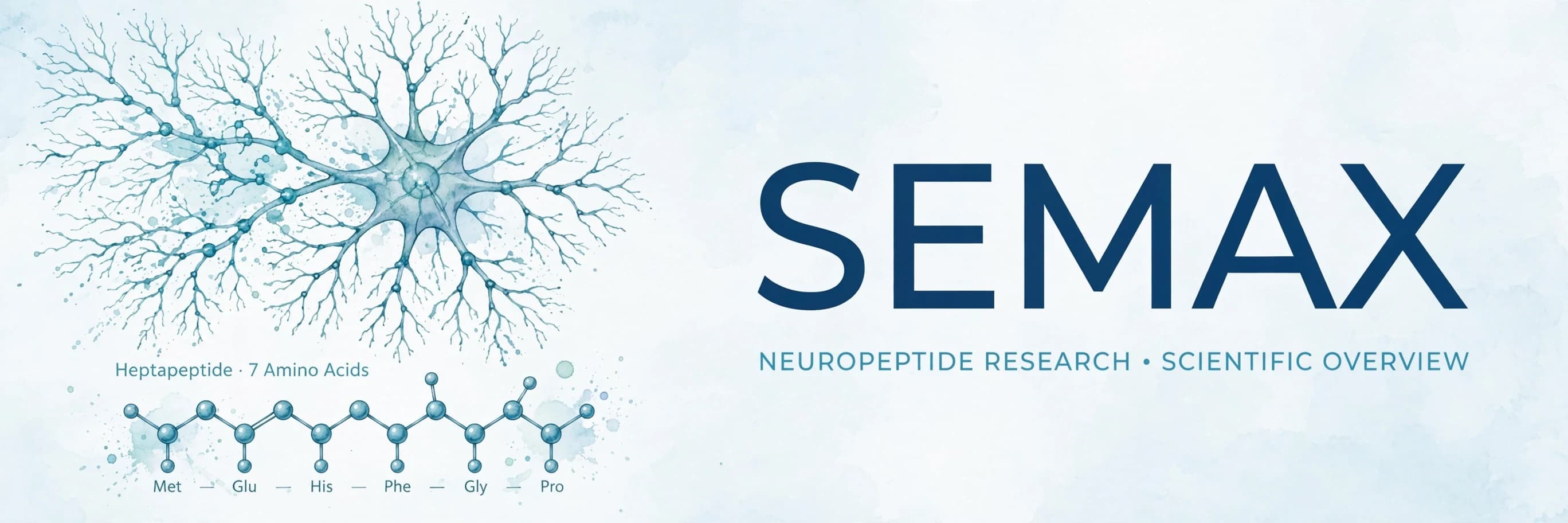
Semax is a synthetic heptapeptide with the sequence Met-Glu-His-Phe-Pro-Gly-Pro (MEHFPGP), developed in Russia as a stabilized analog of the adrenocorticotropic hormone fragment ACTH(4–10). It is one of the most extensively published compounds in the Russian neuropeptide literature, with a research record spanning design work in the 1980s, receptor-level binding studies, neurotrophin experiments in rat brain, genome-wide transcription studies in ischemia models, and a distinctive body of metal-coordination chemistry.
Two features make Semax especially instructive for laboratory researchers. First, it was deliberately engineered to separate one part of ACTH biology from another: the parent hormone's effects on learning and behavior in experimental models, without its steroidogenic, hormonal activity. Second, after more than four decades of work, its precise molecular target is still incompletely defined — the literature documents downstream effects on brain-derived neurotrophic factor (BDNF), gene transcription, and copper chemistry more firmly than it identifies a single receptor. This guide reviews what Semax is, how it was designed, what the primary literature actually demonstrates, and how researchers evaluate Semax research material in the laboratory. Readers interested in its modified descendant should also see our Adamax research guide, which examines what changes — and what evidence does not transfer — when the Semax scaffold is altered.
What Is Semax?
Semax is a heptapeptide: seven amino acids in the sequence Met-Glu-His-Phe-Pro-Gly-Pro. The first four residues reproduce ACTH(4–7), the core of the ACTH(4–10) fragment studied for its behavioral activity in animal models. The final three residues, Pro-Gly-Pro (PGP), are not part of ACTH at all — they are a stabilizing extension added by design, discussed below. Semax is supplied for laboratory research as a lyophilized synthetic peptide.
- Sequence: Met-Glu-His-Phe-Pro-Gly-Pro (MEHFPGP)
- Structure: ACTH(4–7) core plus a C-terminal Pro-Gly-Pro extension
- Molecular formula: C37H51N9O10S
- Molecular weight: Approximately 813.9 g/mol
- CAS number: 80714-61-0
- Family: Melanocortin-derived research peptide, engineered to lack ACTH's hormonal activity
That last point deserves emphasis. ACTH is a melanocortin, and the His-Phe motif in Semax derives from that family's core sequence. But Semax was specifically built to be non-hormonal, and its reported effects in the literature are not adequately explained by classical melanocortin-receptor agonism. Researchers should therefore treat "melanocortin-derived" as a statement about the molecule's ancestry, not about its mechanism.
Origin and Design: From ACTH Fragments to a Stabilized Analog
Semax was developed in the 1980s at the Institute of Molecular Genetics of the Russian Academy of Sciences, in a program associated with Igor Ashmarin and later Nikolai Myasoedov. The starting observation came from mid-twentieth-century work showing that ACTH and its N-terminal fragments influenced learning and behavior in experimental models independently of the hormone's action on steroid production. That behavioral activity was localized to the ACTH(4–10) region.
The design problem was stability. Short native fragments are cleaved rapidly by peptidases, which limits their usefulness as research tools and shortens any observed effect. The Russian program's solution was to append the Pro-Gly-Pro tripeptide to the ACTH(4–7) core. Proline-rich termini resist several classes of peptidases, so the extension was expected to prolong the molecule's life — and PGP later proved interesting in its own right, because it is also a principal degradation product of Semax detected in brain tissue, with transcriptional activity of its own in ischemia models. A 1997 design-history paper by Ashmarin and colleagues reviewed the first fifteen years of this program:
Citation: Asmarin IP, et al. "A Nootropic Adrenocorticotropin Analog 4-10-Semax (15 Years Experience in Its Design and Study)." Zhurnal Vysshei Nervnoi Deiatelnosti Imeni I P Pavlova. 1997. [PubMed PMID: 9173745]
Semax went on to be registered as a medicine in Russia and studied there for decades, largely in cerebral ischemia models. The great majority of that literature is preclinical, and much of it appeared in Russian-language journals — context that matters when weighing how far any single finding has been independently replicated.
Studied Mechanisms in the Published Literature
Neurotrophin signaling: BDNF and TrkB
The most frequently cited mechanistic finding for Semax is its effect on brain-derived neurotrophic factor and its receptor TrkB in rat brain. Dolotov and colleagues reported that a single application of Semax in rats raised hippocampal BDNF protein levels (approximately 1.4-fold), increased TrkB phosphorylation (approximately 1.6-fold), and increased BDNF exon III and TrkB messenger RNA (approximately 3-fold and 2-fold respectively), alongside changes in conditioned avoidance behavior:
Citation: Dolotov OV, et al. "Semax, an Analog of ACTH(4–10) with Cognitive Effects, Regulates BDNF and TrkB Expression in the Rat Hippocampus." Brain Research. 2006. [PubMed PMID: 16996037]
In a companion study, the same group demonstrated specific, calcium-dependent, reversible binding of radiolabeled Semax to rat basal forebrain membranes, with a dissociation constant of approximately 2.4 nM, together with a rapid rise in BDNF protein in that region. The study is evidence for discrete binding sites — but the molecular identity of those sites was not resolved, and it should not be cited as the identification of a Semax receptor:
Citation: Dolotov OV, et al. "Semax, an Analogue of Adrenocorticotropin (4–10), Binds Specifically and Increases Levels of Brain-Derived Neurotrophic Factor Protein in Rat Basal Forebrain." Journal of Neurochemistry. 2006. [PubMed PMID: 16635254]
Monoamine systems in rodents
Eremin and colleagues examined Semax against dopaminergic and serotoninergic readouts in rodents. In that work, Semax was reported to increase serotonin metabolite (5-HIAA) measures in striatum, while Semax alone did not alter dopamine or its metabolites — although pretreatment modified the dopamine release evoked by D-amphetamine in the same model. Read precisely, the paper supports serotonin-turnover modulation and an interaction effect in rodents, not a direct dopamine increase by Semax alone:
Citation: Eremin KO, et al. "Semax, an ACTH(4–10) Analogue with Nootropic Properties, Activates Dopaminergic and Serotoninergic Brain Systems in Rodents." Neurochemical Research. 2005. [PubMed PMID: 16362768]
Gene transcription in ischemia models
In rat permanent middle cerebral artery occlusion models, Semax and its PGP fragment activated transcription of neurotrophin and receptor genes (Bdnf, Ngf, Nt-3, TrkA, TrkB, TrkC) in ischemic cortex, with Semax's profile partly distinct from that of PGP alone:
Citation: Dmitrieva VG, et al. "Semax and Pro-Gly-Pro Activate the Transcription of Neurotrophins and Their Receptor Genes after Cerebral Ischemia." Cellular and Molecular Neurobiology. 2010. [PubMed PMID: 19633950]
A genome-wide follow-up found that the dominant Semax signature in ischemic rat cortex was immunological and vascular: altered expression of immunoglobulin and chemokine genes, plus vascular-system genes involved in endothelial development and vasculogenesis:
Citation: Medvedeva EV, et al. "The Peptide Semax Affects the Expression of Genes Related to the Immune and Vascular Systems in Rat Brain Focal Ischemia: Genome-Wide Transcriptional Analysis." BMC Genomics. 2014. [PubMed PMID: 24661604]
More recent transcriptome work extended this picture. Filippenkov and colleagues used RNA sequencing in a rat ischemia-reperfusion model and reported several hundred differentially expressed genes in Semax-treated ischemic brain compared with saline controls, with inflammation-related expression suppressed and neurotransmission-related expression activated — the opposite pattern to ischemia-reperfusion alone in that model:
Citation: Filippenkov IB, et al. "Novel Insights into the Protective Properties of ACTH(4–7)PGP (Semax) Peptide at the Transcriptome Level Following Cerebral Ischaemia-Reperfusion in Rats." Genes. 2020. [PubMed PMID: 32580520]
Metal coordination chemistry
Semax's histidine residue gives it notable coordination chemistry. Tabbì and colleagues showed that Semax binds copper(II) with high affinity, characterized the predominant complex species across pH, and reported protection against metal-induced toxicity in neuronal and endothelial cell lines in vitro:
Citation: Tabbì G, et al. "Semax, an ACTH4-10 Peptide Analog with High Affinity for Copper(II) Ion and Protective Ability against Metal Induced Cell Toxicity." Journal of Inorganic Biochemistry. 2015. [PubMed PMID: 25310602]
Later biophysical work extended this chemistry to copper–amyloid interaction models, where Semax interfered with copper-induced amyloid-beta aggregation in artificial membrane systems — an in vitro finding that belongs to coordination chemistry, not to any clinical claim:
Citation: Sciacca MFM, et al. "Semax, a Synthetic Regulatory Peptide, Affects Copper-Induced Abeta Aggregation and Amyloid Formation in Artificial Membrane Models." ACS Chemical Neuroscience. 2022. [PubMed PMID: 35080861]
Semax and Selank: Two Russian Heptapeptides, Different Lineages
Semax is often discussed alongside Selank, and the comparison is instructive precisely because the two molecules share a design language but not an ancestry. Both are synthetic heptapeptides developed at the Institute of Molecular Genetics, and both carry the same C-terminal Pro-Gly-Pro stabilizing extension. Their N-terminal cores, however, come from entirely different biology: Semax from the ACTH melanocortin fragment, Selank from tuftsin, an immunoglobulin-derived tetrapeptide. Their literatures reflect that split — Semax research centers on neurotrophins, ischemia transcription, and copper chemistry, while Selank research centers on enkephalin-degrading enzymes, GABAergic gene expression, and immune readouts. Our Selank research guide covers that record in full, and the pair are best read as parallel examples of one institute's peptide-design strategy rather than as interchangeable compounds.
Research Applications in the Lab
Within the published record, Semax appears in the laboratory in several established roles:
- Neurotrophin-pathway assays — BDNF and TrkB expression and phosphorylation readouts in neuronal culture and rodent brain tissue, following the Dolotov study designs.
- Ischemia-model transcription studies — gene-expression profiling of neurotrophin, immune, and vascular gene sets in rodent focal ischemia tissue, including RNA-sequencing workflows.
- Binding-site characterization — radioligand binding work in membrane preparations, where Semax remains a tool for probing its still-unidentified basal forebrain binding sites.
- Metal coordination and amyloid-interaction chemistry — copper(II) speciation, spectroscopy, and membrane-model aggregation assays built on the Tabbì and Sciacca work.
- Analog and stability research — Semax is the reference parent for modified derivatives such as Adamax, and for structure–activity comparisons across terminal modifications; see our overview of peptides in neuroprotection research for the wider context.
- Metabolite studies — PGP, its C-terminal fragment, is itself transcriptionally active in ischemia models, making Semax a useful system for studying peptide metabolite activity.
Analytical and Quality Notes
For any research peptide, identity and purity rest on two complementary measurements: reversed-phase HPLC, which separates the main peak from related impurities and yields a purity percentage, and mass spectrometry, which confirms that the material's molecular weight matches the specified structure. For Semax, the expected mass is approximately 813.9 Da for the free peptide, and researchers should confirm that the certificate of analysis refers to the same form — free peptide or salt — as the material supplied, since salt forms change the reported composition.
Researchers should inspect the underlying data, not just the headline number: the chromatogram itself (a single dominant peak with resolved minor impurities), the observed mass against the expected mass, and a certificate of analysis specific to the batch in hand rather than a generic representative document. Our guide to reading a peptide COA walks through these checks in detail.
Conclusion
Semax is a deliberately engineered molecule with a genuinely deep research record: an ACTH(4–7) core stabilized by a Pro-Gly-Pro extension, documented effects on BDNF and TrkB expression in rat hippocampus, specific binding to basal forebrain membranes whose molecular identity remains unresolved, broad transcriptional signatures in ischemia models, and well-characterized copper coordination chemistry. Its limitations are equally well defined — a literature concentrated in one research tradition, predominantly rodent and in vitro data, and no single identified receptor mechanism. Researchers who hold both halves of that picture are using the compound exactly as the evidence supports.
Before laboratory use, verify that the material shows at least 99% purity by HPLC, that its identity is confirmed by mass spectrometry against the 813.9 Da heptapeptide structure, and that it is accompanied by a batch-specific certificate of analysis matching the lot supplied. NUPEPS supplies Semax 10MG as a research material with batch documentation available for review, so researchers can confirm identity and purity for the exact lot in hand before designing experiments around it.
Frequently asked questions
What is Semax, and how was it designed from ACTH?
Semax is a synthetic heptapeptide with the sequence Met-Glu-His-Phe-Pro-Gly-Pro (MEHFPGP), a molecular weight of approximately 813.9 g/mol, and CAS number 80714-61-0, developed in Russia in the 1980s. Its first four residues reproduce ACTH(4–7), the core of the ACTH(4–10) fragment studied for its behavioral activity in animal models, and a C-terminal Pro-Gly-Pro extension was appended to resist peptidase cleavage. The guide stresses that Semax was engineered to be non-hormonal: it was built to separate the fragment's research-relevant activity from ACTH's steroidogenic, hormonal activity.
What did the Dolotov studies find about Semax, BDNF and TrkB?
Dolotov and colleagues reported that a single application of Semax in rats raised hippocampal BDNF protein levels (approximately 1.4-fold), increased TrkB phosphorylation (approximately 1.6-fold), and increased BDNF exon III and TrkB messenger RNA (approximately 3-fold and 2-fold respectively). In a companion study, the same group demonstrated specific, calcium-dependent, reversible binding of radiolabeled Semax to rat basal forebrain membranes, with a dissociation constant of approximately 2.4 nM. The guide notes this is evidence for discrete binding sites, but the molecular identity of those sites was not resolved.
Why is Semax studied in copper coordination chemistry?
Semax's histidine residue gives it notable coordination chemistry. Tabbì and colleagues showed that Semax binds copper(II) with high affinity, characterized the predominant complex species across pH, and reported protection against metal-induced toxicity in neuronal and endothelial cell lines in vitro. Later biophysical work extended this chemistry to copper–amyloid interaction models, where Semax interfered with copper-induced amyloid-beta aggregation in artificial membrane systems — an in vitro finding that belongs to coordination chemistry, not to any clinical claim.
All products are intended strictly for laboratory research and in-vitro use only. Not for human or veterinary consumption, diagnostic, or therapeutic use. Products are not drugs, foods, cosmetics, or dietary supplements and may not be misbranded, misused, or mislabeled.