
Research Guides
LL-37 Research Guide: Cathelicidin, Immunity and Lab Use
By NUPEPS Research TeamOctober 19, 2026
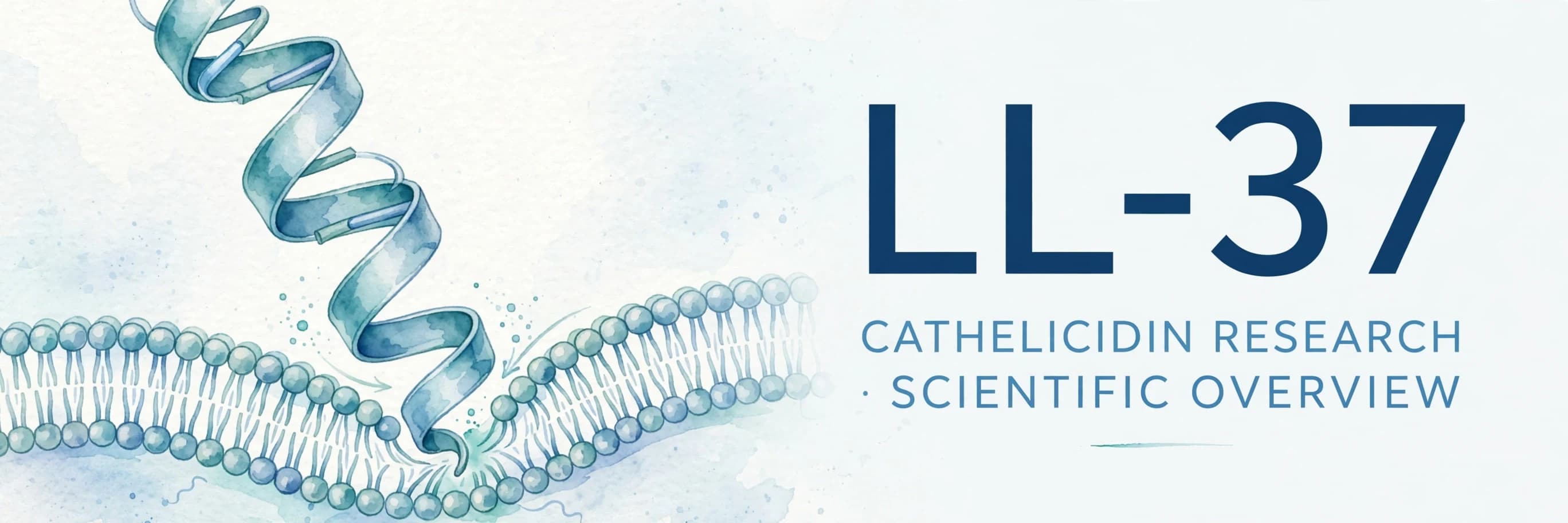
LL-37 is the only human cathelicidin antimicrobial peptide: a 37-amino-acid, alpha-helical peptide cleaved from the precursor protein hCAP18, encoded by the CAMP gene. It was identified in the mid-1990s by two Swedish research groups working on human neutrophils, and it has since become one of the most studied host-defense peptides in the laboratory — not only for its direct antimicrobial activity in vitro, but for a second, equally documented identity as a signaling molecule that interacts with specific cell-surface receptors.
That dual identity is the key to reading the LL-37 literature accurately. At higher concentrations in experimental systems, LL-37 disrupts microbial membranes. At lower concentrations in cell models, it chemoattracts immune cells, modulates inflammatory signaling, and influences processes such as angiogenesis and wound re-epithelialization through receptor-mediated pathways. Concentrations, model systems, and salt conditions strongly affect which behavior dominates, which is why this guide separates the membrane literature from the receptor literature and reports each finding inside the model that produced it.
What Is LL-37?
LL-37 is a 37-residue peptide beginning with two leucine residues — hence the name: LL for the opening leucines, 37 for its length. It is not synthesized as a standalone molecule in the body. Instead, cells produce a larger precursor, human cationic antimicrobial protein 18 (hCAP18), consisting of a conserved N-terminal cathelin domain and the C-terminal LL-37 sequence. Proteolytic cleavage releases the active peptide when and where it is needed.
- Sequence: LLGDFFRKSKEKIGKEFKRIVQRIKDFLRNLVPRTES
- Length: 37 amino acids
- Gene: CAMP (cathelicidin antimicrobial peptide)
- Precursor: hCAP18, cleaved extracellularly, principally by proteinase 3 in neutrophils
- Molecular formula: C205H340N60O53
- Molecular weight: Approximately 4,493.3 g/mol
- CAS number: 154947-66-7
- Structure: Amphipathic alpha-helix in membrane-like environments; net positive (cationic) charge
Humans have exactly one cathelicidin, which makes LL-37 a unusually clean research system: unlike species with large cathelicidin families, there is no second human paralog to confound attribution. The mouse ortholog, CRAMP, is the corresponding tool in murine models, and researchers should keep the two distinct when comparing studies across species.
Discovery and Processing: From hCAP18 to LL-37
The human cathelicidin was identified in 1995, when Agerberth and colleagues cloned a bone-marrow cDNA encoding a 170-amino-acid cathelin-like precursor and its predicted C-terminal peptide, FALL-39 — a 39-residue, cysteine-free peptide whose synthetic form showed activity against test bacteria in vitro, with the gene expressed mainly in bone marrow and testis. Subsequent processing work established that the mature peptide recovered from human neutrophils is the 37-residue LL-37, cleaved from that same precursor, hCAP18:
Citation: Agerberth B, et al. "FALL-39, a Putative Human Peptide Antibiotic, Is Cysteine-Free and Expressed in Bone Marrow and Testis." Proceedings of the National Academy of Sciences of the United States of America. 1995. [PubMed PMID: 7529412]
Early structural work then explained a behavior that runs through the whole LL-37 literature: Johansson and colleagues showed that LL-37 is disordered in water and adopts its alpha-helical conformation in the presence of anions and through oligomerisation, and that this helicity correlates with antibacterial activity in vitro — the peptide's structure, and therefore its activity, depends on its environment:
Citation: Johansson J, et al. "Conformation-Dependent Antibacterial Activity of the Naturally Occurring Human Peptide LL-37." Journal of Biological Chemistry. 1998. [PubMed PMID: 9452503]
How the precursor becomes the peptide was settled by Sørensen and colleagues, who showed that hCAP18 is processed extracellularly after neutrophil exocytosis: proteinase 3, released from the same granule system, was alone responsible for the cleavage among the azurophil-granule proteases tested. That extracellular timing matters experimentally — it means LL-37 appears at sites of neutrophil activation rather than circulating as a free peptide under resting conditions:
Citation: Sørensen OE, et al. "Human Cathelicidin, hCAP-18, Is Processed to the Antimicrobial Peptide LL-37 by Extracellular Cleavage with Proteinase 3." Blood. 2001. [PubMed PMID: 11389039]
Mechanism 1: Membrane Interaction and Direct Antimicrobial Activity
LL-37's sequence folds into an amphipathic alpha-helix: one face is rich in positively charged residues (arginine and lysine), the other in hydrophobic residues. That architecture explains its membrane behavior. The cationic face is attracted to negatively charged microbial membrane surfaces; the hydrophobic face then inserts into the lipid bilayer, disrupting membrane integrity in model systems. Biophysical studies in artificial membranes and microbiological assays against a broad range of bacteria — and, in published in vitro work, certain fungi and enveloped viruses — form the core of this literature.
Two experimental cautions run through it. First, LL-37's antimicrobial activity in vitro is strongly salt- and media-dependent: physiological salt concentrations reduce activity against several organisms compared with low-salt assay conditions, so assay conditions are part of any result. Second, activity in a culture dish is a property of the peptide–membrane system under those conditions; it is not, by itself, evidence about the peptide's role in a whole organism, where binding proteins, proteases, and compartmentalization all intervene. The standard review of this first identity, and of the peptide's biology overall, remains Dürr and colleagues:
Citation: Dürr UH, Sudheendra US, Ramamoorthy A. "LL-37, the Only Human Member of the Cathelicidin Family of Antimicrobial Peptides." Biochimica et Biophysica Acta. 2006. [PubMed PMID: 16716248]
Mechanism 2: Receptor-Mediated Immunomodulation
The second LL-37 literature began when researchers found effects at concentrations well below those needed for membrane disruption — effects with the signature of receptor signaling rather than detergent-like action. The landmark result was chemoattraction: De Yang and colleagues showed that LL-37 chemoattracts human neutrophils, monocytes, and T cells through formyl peptide receptor-like 1 (FPRL1, now also termed FPR2), a defined G-protein-coupled receptor:
Citation: De Yang, et al. "LL-37, the Neutrophil Granule- and Epithelial Cell-Derived Cathelicidin, Utilizes Formyl Peptide Receptor-Like 1 (FPRL1) as a Receptor to Chemoattract Human Peripheral Blood Neutrophils, Monocytes, and T Cells." Journal of Experimental Medicine. 2000. [PubMed PMID: 11015447]
Subsequent cell-biology work added further receptor systems, including P2X7 interactions in monocytes and macrophages and epidermal growth factor receptor transactivation in epithelial systems, alongside reported modulation of Toll-like receptor signaling and cytokine production in immune cell cultures. Vandamme and colleagues reviewed this receptor literature comprehensively, and their summary captures the field's consensus framing: LL-37 is a multifunctional host-defense peptide whose immunomodulatory activities are exercised through specific molecular targets, not only through membranes:
Citation: Vandamme D, et al. "A Comprehensive Summary of LL-37, the Factotum Human Cathelicidin Peptide." Cellular Immunology. 2012. [PubMed PMID: 23246832]
Published Research Highlights: Repair and Vascular Models
Re-epithelialization in human skin wound models
Heilborn and colleagues examined LL-37 in human skin wounds using an ex vivo model, and reported that the peptide was present in wound epithelium during healing but lacking in the epithelium of chronic ulcers in their samples, and that blocking or supplementing it in the model system correspondingly altered re-epithelialization. The study is a human-tissue model result — stronger than a cell-line finding, and still a model, not a treatment trial:
Citation: Heilborn JD, et al. "The Cathelicidin Anti-Microbial Peptide LL-37 Is Involved in Re-Epithelialization of Human Skin Wounds and Is Lacking in Chronic Ulcer Epithelium." Journal of Investigative Dermatology. 2003. [PubMed PMID: 12603850]
Angiogenesis in model systems
The review literature also summarizes reports that LL-37 stimulates angiogenesis in in vitro and in vivo model systems, mediated by FPRL1 expressed on endothelial cells — extending the same receptor identified in the chemoattraction work into vascular biology, and supporting the reviews' framing of LL-37 as a peptide with a second, receptor-driven role beyond its antimicrobial activity. Researchers tracing that specific claim should follow it through the primary sources collected in the Dürr and Vandamme reviews cited above.
Together with the membrane literature, these studies define the working picture researchers actually use: one peptide, two mechanistic regimes, with concentration and context deciding which regime an experiment observes. That picture also connects LL-37 to neighboring innate-immunity peptides studied for epithelial and inflammatory signaling, such as the subject of our KPV research guide, and to the broader survey in our guide to immunity and anti-inflammation peptide research.
Experimental Variables That Shape LL-37 Results
LL-37 is unusually sensitive to experimental conditions, and the reviews cited above return to the same set of variables repeatedly. Researchers designing or interpreting LL-37 experiments account for at least four of them.
- Ionic strength and media composition. Antimicrobial activity measured in low-salt buffers can fall substantially at physiological salt concentrations, and serum components bind the peptide and change its effective free concentration. Two studies reporting different potency values are often reporting different assay conditions rather than different biology.
- Proteolytic environment. LL-37 is itself a protease product, and it is also a protease substrate: in protease-rich environments it is further processed into shorter fragments, several of which retain membrane activity while losing receptor activity, or the reverse. The fragment profile of a sample is therefore part of its identity.
- Concentration regime. Membrane disruption and receptor signaling occupy different concentration ranges in model systems. An experiment designed around one regime cannot be used to confirm or refute the other, and dose–response design in cell models should state explicitly which regime it is probing — as a design question, not as a usage recommendation.
- Peptide handling and aggregation. As an amphipathic, highly charged helix, LL-37 aggregates and adsorbs to surfaces more readily than short unstructured peptides. Stock preparation, container materials, and freeze–thaw history can all shift the concentration actually delivered to an assay, which is one reason the field's reviews insist on analytical confirmation of the material in hand.
These variables also explain a recurring pattern in the literature: LL-37 findings replicate most cleanly when papers report full assay conditions, and apparent contradictions between groups frequently resolve into differences in salt, serum, or fragment composition once methods are compared in detail.
Research Applications in the Lab
- Antimicrobial assay work — defined in vitro systems for membrane-disruption activity, where salt and media composition are controlled and reported as part of the result.
- Membrane biophysics — artificial bilayer, liposome, and spectroscopy studies of amphipathic helix insertion, using LL-37 as a reference cationic helical peptide.
- Chemotaxis and receptor pharmacology — FPRL1/FPR2-mediated migration assays in neutrophils, monocytes, and T cells, following the De Yang experimental design.
- Immunomodulation studies — cytokine and Toll-like receptor signaling readouts in monocyte, macrophage, and epithelial cultures, including P2X7-pathway work.
- Wound and epithelial models — ex vivo human skin and epithelial culture systems studying re-epithelialization, following Heilborn and colleagues.
- Angiogenesis models — endothelial-cell assays of FPRL1-mediated vessel formation, as summarized in the Dürr and Vandamme reviews.
- Fragment and analog research — truncated and modified LL-37 derivatives used to map which regions of the 37-residue sequence carry membrane versus receptor activity.
Analytical and Quality Notes
LL-37 is a larger, more complex synthetic peptide than the heptapeptides elsewhere in this series, and its quality control deserves correspondingly closer attention. Identity should be confirmed by mass spectrometry against the expected mass of approximately 4,493.3 Da for the full 37-residue sequence. Truncated sequences are the characteristic failure mode in long-peptide synthesis, and several LL-37 fragments are themselves biologically active in published work — so a preparation contaminated with fragments is not merely impure, it is a different experimental system. Reversed-phase HPLC should show a single dominant peak, and researchers working on receptor assays in particular should confirm that the material is the full-length peptide rather than a fragment mixture.
As with every compound in this series, the operative document is a batch-specific certificate of analysis reporting HPLC purity and mass-spectrometry identity for the exact lot supplied. Our guide to reading a peptide COA explains how to evaluate these documents field by field.
Conclusion
LL-37 occupies a unique position in human biology: the sole human cathelicidin, released from hCAP18 by proteinase 3 at sites of neutrophil activation, and documented in the laboratory in two distinct mechanistic regimes — direct, concentration-dependent membrane disruption in antimicrobial assay systems, and receptor-mediated signaling through FPRL1/FPR2, P2X7, and related pathways in immune, epithelial, and endothelial models, including human ex vivo wound tissue. Few peptides illustrate as clearly why model, concentration, and conditions must be reported as part of any result.
Before laboratory use, verify that the material shows at least 99% purity by HPLC, that its identity is confirmed by mass spectrometry against the full-length 4,493.3 Da sequence, and that it is accompanied by a batch-specific certificate of analysis matching the lot supplied. NUPEPS supplies LL-37 10MG as a research material with batch documentation available for review, so researchers can confirm identity and purity for the exact lot in hand before designing experiments around it.
Frequently asked questions
What is LL-37, and where does it come from in the body?
LL-37 is the only human cathelicidin antimicrobial peptide: a 37-amino-acid, alpha-helical peptide with a molecular weight of approximately 4,493.3 g/mol and CAS number 154947-66-7, encoded by the CAMP gene. It is not synthesized as a standalone molecule; cells produce a larger precursor, human cationic antimicrobial protein 18 (hCAP18), and proteolytic cleavage releases the active peptide. Sørensen and colleagues showed that hCAP18 is processed extracellularly after neutrophil exocytosis, with proteinase 3 alone responsible for the cleavage among the azurophil-granule proteases tested.
How do LL-37's two mechanisms of action differ?
At higher concentrations in experimental systems, LL-37 disrupts microbial membranes: its cationic face is attracted to negatively charged microbial membrane surfaces and its hydrophobic face inserts into the lipid bilayer. At lower concentrations in cell models, it acts through receptors — De Yang and colleagues showed that LL-37 chemoattracts human neutrophils, monocytes, and T cells through formyl peptide receptor-like 1 (FPRL1, now also termed FPR2) — alongside reported P2X7 interactions and epidermal growth factor receptor transactivation in other systems. The guide stresses that which behavior dominates depends on concentration, model system, and salt conditions.
Why does LL-37 need especially careful quality control?
Truncated sequences are the characteristic failure mode in long-peptide synthesis, and several LL-37 fragments are themselves biologically active in published work, so a preparation contaminated with fragments is not merely impure — it is a different experimental system. The guide advises confirming identity by mass spectrometry against the expected mass of approximately 4,493.3 Da for the full 37-residue sequence, checking that reversed-phase HPLC shows a single dominant peak, and requiring a batch-specific certificate of analysis reporting HPLC purity and mass-spectrometry identity for the exact lot supplied.
All products are intended strictly for laboratory research and in-vitro use only. Not for human or veterinary consumption, diagnostic, or therapeutic use. Products are not drugs, foods, cosmetics, or dietary supplements and may not be misbranded, misused, or mislabeled.