Research Guides
AHK-Cu Research Guide: Copper Tripeptide Science and Lab Use
By NUPEPS Research TeamOctober 20, 2026
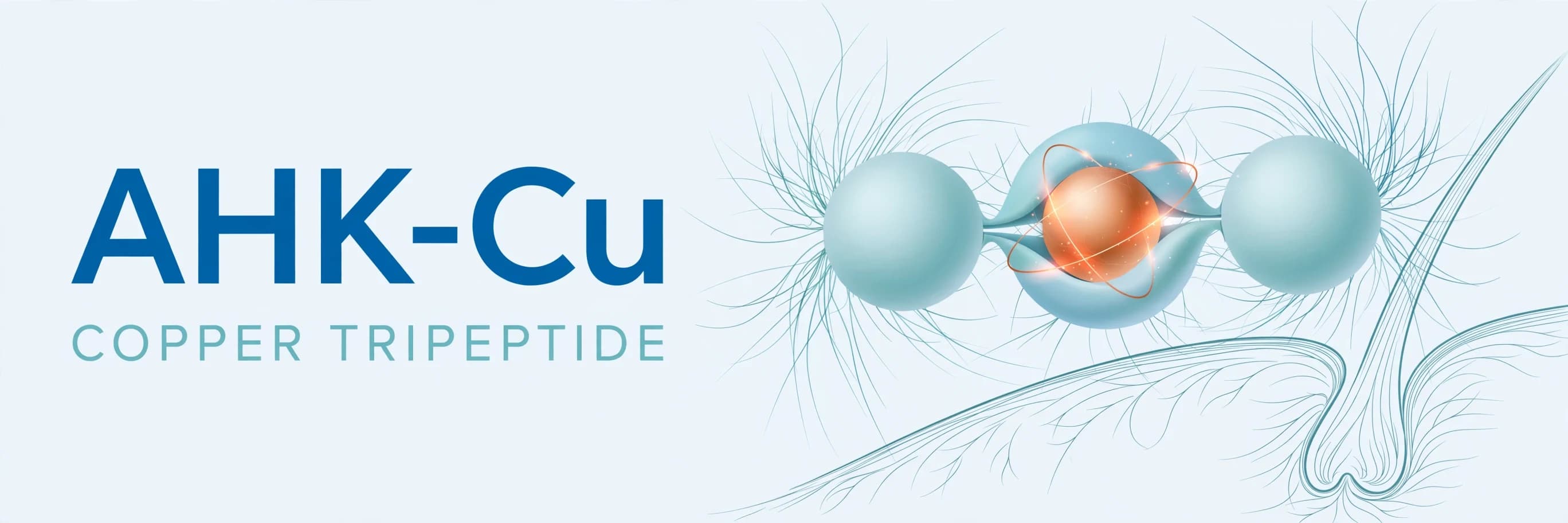
AHK-Cu is a copper-binding tripeptide — L-alanyl-L-histidyl-L-lysine complexed with a copper(II) ion — studied in skin and hair-follicle research. It belongs to the same copper-tripeptide family as the far better-known GHK-Cu, differing from it by a single N-terminal amino acid: alanine in place of glycine. That small structural change makes AHK-Cu a distinct molecule with its own, much thinner evidence base, and an honest guide has to keep the two records separate: exactly one primary study examines AHK-Cu itself, while the surrounding copper-peptide literature — fibroblast collagen work, glycosaminoglycan studies, keratinocyte stem-cell markers, and genome-wide expression data — was generated with GHK-Cu.
This guide reviews the chemistry that makes copper tripeptides interesting, the single direct AHK-Cu study in hair-follicle models, the wider GHK-Cu record that frames the family's research questions, and the evidence gap between the two molecules. Our dedicated guide to GHK-Cu skin research covers the better-documented relative in full.
What Is AHK-Cu?
AHK-Cu is the copper(II) complex of the tripeptide Ala-His-Lys. The histidine residue at the center of the sequence provides the imidazole side chain that coordinates the metal ion, while the terminal amino group and the backbone amide nitrogens complete a tight, square-planar binding arrangement typical of this peptide family. The result is a small, defined metallopeptide — a peptide and a metal ion behaving as one molecule.
- Sequence: Ala-His-Lys (AHK), supplied as its copper(II) complex
- Structure: Tripeptide–Cu(II) chelate; histidine imidazole anchors the metal
- Molecular weight: Approximately 417 g/mol (copper complex, supplier specification)
- CAS number: 130120-57-9
- Family: Copper-binding tripeptide; cosmetic-peptide research compound
AHK-Cu is a synthetic research and cosmetic-ingredient compound, developed and studied principally by Korean dermatology and cosmetic-science groups. Unlike GHK, which occurs naturally in human plasma, AHK has no known endogenous source — a distinction that shapes how the two molecules' literatures should be read.
Copper-Peptide Chemistry: Why the Metal Matters
Copper is an essential trace element and a required cofactor for enzymes involved in connective-tissue maturation, including lysyl oxidase, which cross-links collagen and elastin. Free copper ions, however, are reactive and tightly controlled in biology; the research interest in copper peptides is that a peptide chelate can carry copper in a defined, soluble, cell-compatible form. The foundational experiment for the family showed that the plasma tripeptide GHK facilitates copper uptake into cells, proposing the peptide as a physiological copper-delivery vehicle:
Citation: Pickart L, Freedman JH, Loker WJ, Peisach J, Perkins CM, Stenkamp RE, Weinstein B. "Growth-Modulating Plasma Tripeptide May Function by Facilitating Copper Uptake into Cells." Nature. 1980. [PubMed PMID: 7453802]
AHK-Cu shares the His-Lys core and the same chelation chemistry, so the copper-delivery rationale frames research on both molecules. Chelation also has an analytical consequence: the identity of a copper tripeptide is not just its amino-acid sequence but its metal content and binding state, which is why the quality-control section below treats copper verification as part of identity testing.
The chelate framing also explains the concentration ranges that recur throughout this literature. The fibroblast and follicle effects described below appear at picomolar-to-nanomolar concentrations — far below the amounts at which copper salts are typically added to culture systems — which is consistent with a delivery-and-signaling role for the peptide rather than a bulk nutritional effect of the metal. It also means the peptide component cannot be treated as an inert carrier: in these models the complex is the active species, and changing the peptide sequence, as AHK does relative to GHK, changes the molecule under study even when the metal and the binding motif are preserved.
AHK-Cu vs GHK-Cu: Same Family, Different Molecules
The comparison is legitimate because the molecules are close — and important because they are not interchangeable. Both are tripeptide–copper(II) complexes built on a His-Lys core. They differ at the first residue: glycine in GHK, alanine in AHK. Alanine's methyl side chain makes the N-terminus slightly bulkier and more hydrophobic, which can alter metal-binding geometry, stability and interaction with cells. Their origins differ as well: GHK is an endogenous plasma peptide whose levels decline with age, while AHK is a synthetic analog with no known natural source. And their literatures differ most of all — GHK-Cu has been studied since the 1970s across hundreds of experiments, whereas AHK-Cu's direct record is essentially the single follicle study reviewed next. Findings from GHK-Cu experiments define the family's research questions; they do not constitute evidence about AHK-Cu.
What the Studies Show
The direct AHK-Cu evidence: hair-follicle models
The one primary study of AHK-Cu itself comes from Pyo and colleagues, who tested the complex on human hair follicles in organ culture and on cultured dermal papilla cells — the mesenchymal signaling cells at the follicle base that regulate hair growth. AHK-Cu, at picomolar-to-nanomolar concentrations, promoted elongation of the follicles ex vivo and stimulated proliferation of dermal papilla cells in vitro. At the molecular level, AHK-Cu raised the Bcl-2/Bax ratio — a shift away from programmed cell death — and reduced the cleaved, active forms of caspase-3 and PARP, two execution markers of apoptosis:
Citation: Pyo HK, Yoo HG, Won CH, Lee SH, Kang YJ, Eun HC, Cho KH, Kim KH. "The Effect of Tripeptide-Copper Complex on Human Hair Growth In Vitro." Archives of Pharmacal Research. 2007. [PubMed PMID: 17703734]
Pyo and colleagues framed their experiment explicitly against the GHK-Cu background — the study's premise was that a related copper tripeptide might show similar follicle activity — and the apoptosis-marker data give AHK-Cu a specific, citable result of its own. What the study does not provide is equally clear: it is a single in-vitro and ex-vivo investigation, without in-vivo or clinical follow-up in the published record.
The wider copper-tripeptide record (GHK-Cu)
The family's matrix biology was established by the Reims group in the late 1980s. Maquart and colleagues reported that GHK-Cu stimulated collagen synthesis in fibroblast cultures, with the effect beginning at picomolar concentrations and peaking in the nanomolar range, independent of any change in cell number:
Citation: Maquart FX, Pickart L, Laurent M, Gillery P, Monboisse JC, Borel JP. "Stimulation of Collagen Synthesis in Fibroblast Cultures by the Tripeptide-Copper Complex Glycyl-L-Histidyl-L-Lysine-Cu2+." FEBS Letters. 1988. [PubMed PMID: 3169264]
The same group showed that GHK-Cu increased synthesis of sulfated glycosaminoglycans — preferentially dermatan sulfate and heparan sulfate — in cultured human fibroblasts:
Citation: Wegrowski Y, Maquart FX, Borel JP. "Stimulation of Sulfated Glycosaminoglycan Synthesis by the Tripeptide-Copper Complex Glycyl-L-Histidyl-L-Lysine-Cu2+." Life Sciences. 1992. [PubMed PMID: 1522753]
And in the family's key in-vivo experiment, GHK-Cu injected into rat wound chambers increased extracellular-matrix accumulation in a concentration-dependent manner — more collagen, total protein, DNA and glycosaminoglycans — with type I and type III collagen messenger RNA increased while TGF-beta messenger RNA was not:
Citation: Maquart FX, et al. "In Vivo Stimulation of Connective Tissue Accumulation by the Tripeptide-Copper Complex Glycyl-L-Histidyl-L-Lysine-Cu2+ in Rat Experimental Wounds." Journal of Clinical Investigation. 1993. [PubMed PMID: 8227353]
On the epidermal side, Kang and colleagues reported that copper-GHK increased keratinocyte proliferation in skin-equivalent models, with basal cells becoming more cuboidal, and increased expression of the integrins alpha6 and beta1, of proliferating cell nuclear antigen, and of p63 — a marker associated with basal stem-cell survival:
Citation: Kang YA, et al. "Copper-GHK Increases Integrin Expression and p63 Positivity by Keratinocytes." Archives of Dermatological Research. 2009. [PubMed PMID: 19319546]
The modern reviews synthesize this record, including the angiogenesis angle — stimulation of blood-vessel outgrowth attributed to GHK-Cu in repair models — and genome-wide data in which GHK shifted the expression of a substantial fraction of measured human genes. Both reviews are explicitly about GHK and GHK-Cu, and are cited here as family context, not as AHK-Cu evidence:
Citation: Pickart L, Vasquez-Soltero JM, Margolina A. "GHK Peptide as a Natural Modulator of Multiple Cellular Pathways in Skin Regeneration." BioMed Research International. 2015. [PubMed PMID: 26236730]
Citation: Pickart L, Margolina A. "Regenerative and Protective Actions of the GHK-Cu Peptide in the Light of the New Gene Data." International Journal of Molecular Sciences. 2018. [PubMed PMID: 29986520]
The Evidence Gap, Stated Plainly
AHK-Cu's direct literature consists of one in-vitro/ex-vivo study from 2007. There are no published AHK-Cu angiogenesis experiments, no AHK-Cu gene-expression datasets, no animal wound studies, and no clinical trials — each of those exists, if at all, only for GHK-Cu. The single amino-acid difference between the two molecules is small, but small sequence changes routinely change peptide behavior, so GHK-Cu results cannot be assumed to transfer. Researchers choosing AHK-Cu are working with a promising but sparsely documented compound, and study designs should treat its effects as open questions to be measured, not as family findings to be relied on.
Research Applications in the Lab
Within the published record, AHK-Cu and its family appear in several established laboratory roles:
- Hair-follicle organ culture — follicle elongation endpoints in ex-vivo human follicle culture, following the Pyo study design.
- Dermal papilla cell assays — proliferation readouts and apoptosis-marker panels (Bcl-2/Bax ratio, cleaved caspase-3, cleaved PARP) in cultured papilla cells.
- Fibroblast matrix assays — collagen and glycosaminoglycan synthesis endpoints, the family's classic in-vitro systems from the Maquart and Wegrowski work.
- Keratinocyte and skin-equivalent models — integrin alpha6/beta1, p63 and proliferation readouts in reconstructed epidermis, after Kang and colleagues.
- Sequence-comparison studies — AHK-Cu versus GHK-Cu run side by side in the same assay, the direct way to test whether the Ala-for-Gly substitution changes activity.
- Copper-chelation analytics — speciation and metal-content work on peptide–Cu(II) complexes, where the chelate itself is the object of study.
Analytical and Quality Notes
For a metallopeptide, quality control has three parts rather than two. Reversed-phase HPLC establishes purity — a single dominant peak against related impurities. Mass spectrometry confirms the complex's expected mass (approximately 417 Da as supplied). And copper content should be verified as part of identity: material that has lost its copper, or that contains free copper salt contamination, is not the specified chelate, and the difference will not always show on a chromatogram. The complex's blue color is a useful rough indicator that copper is bound, but it is not a measurement. Researchers should confirm that the certificate of analysis is specific to the batch in hand and addresses the complex, not only the peptide sequence.
Our guide to reading a peptide COA walks through these checks — chromatogram, observed versus expected mass, and batch specificity — in detail.
Conclusion
AHK-Cu is a well-defined copper tripeptide with one genuinely interesting result to its name — promotion of human hair-follicle elongation and dermal papilla cell proliferation in vitro, with a measurable shift in apoptosis markers — set inside a large, older GHK-Cu literature that belongs to a different, if closely related, molecule. Read with that separation kept clear, AHK-Cu is a legitimate object of skin- and follicle-research interest. Read without it, the compound borrows evidence it has not earned. The most valuable next experiments are also the simplest: AHK-Cu run head-to-head against GHK-Cu in the follicle, fibroblast and keratinocyte assays where the family made its name, with the Pyo apoptosis-marker panel replicated by an independent group, so that the analog's own record can finally grow beyond a single study.
Before laboratory use, verify that the material shows at least 99% purity by HPLC, that its identity is confirmed by mass spectrometry against the copper-complex mass, and that it is accompanied by a batch-specific certificate of analysis. NUPEPS supplies AHK-Cu 50MG as a research material, with batch documentation available for review, so researchers can confirm identity and purity for the exact lot in hand before designing experiments around it.
Frequently asked questions
How is AHK-Cu different from GHK-Cu?
By one amino acid: AHK-Cu is Ala-His-Lys complexed with copper(II); GHK-Cu is Gly-His-Lys. GHK is an endogenous human plasma peptide studied since the 1970s; AHK is a synthetic analog with no known natural source. They are different molecules, and GHK-Cu findings do not automatically describe AHK-Cu.
What evidence exists for AHK-Cu specifically?
One primary study: Pyo et al. (2007) found AHK-Cu promoted human hair-follicle elongation ex vivo and dermal papilla cell proliferation in vitro at picomolar-to-nanomolar concentrations, while raising the Bcl-2/Bax ratio and reducing cleaved caspase-3 and PARP. There are no published AHK-Cu angiogenesis studies, animal wound studies, or clinical trials.
Why does the copper content matter when checking an AHK-Cu COA?
AHK-Cu is a metallopeptide: the specified material is the peptide–copper complex, not the peptide alone. A complete certificate should confirm purity by HPLC, the complex's expected mass (≈417 Da) by mass spectrometry, and copper content — material that lost its copper, or carries free copper salt contamination, is not the specified chelate.
All products are intended strictly for laboratory research and in-vitro use only. Not for human or veterinary consumption, diagnostic, or therapeutic use. Products are not drugs, foods, cosmetics, or dietary supplements and may not be misbranded, misused, or mislabeled.