
Research Guides
DSIP Research Guide: Sleep Peptide History and Lab Use
By NUPEPS Research TeamOctober 20, 2026
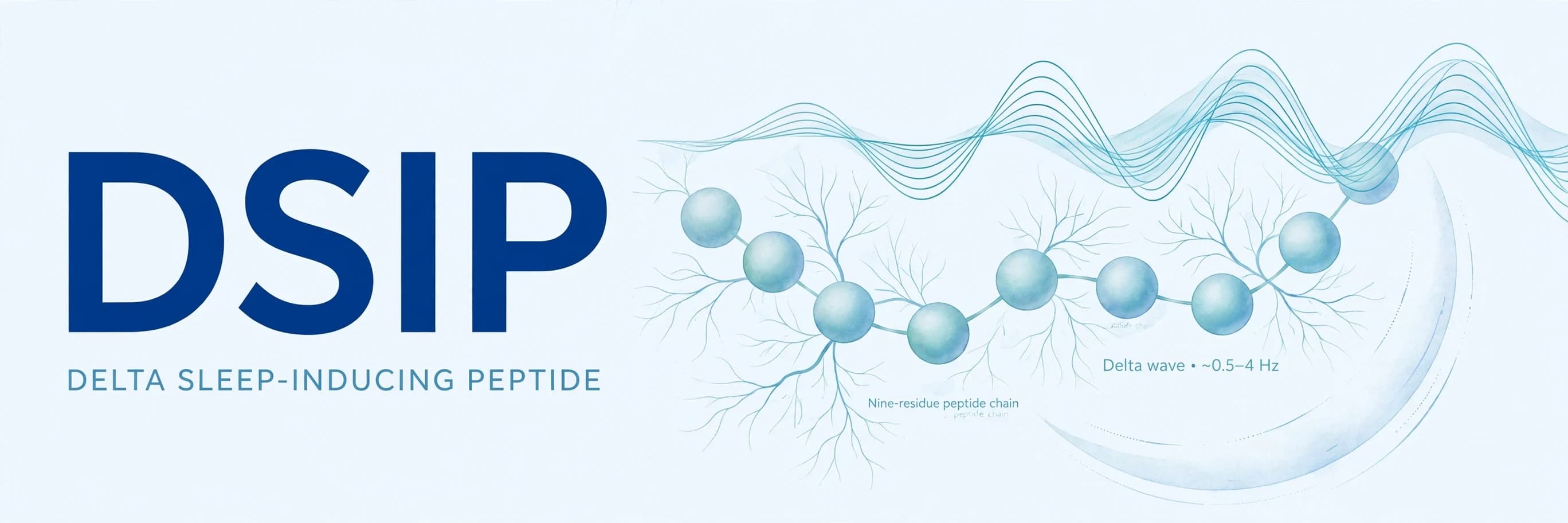
DSIP — delta sleep-inducing peptide — is a nonapeptide with the sequence Trp-Ala-Gly-Gly-Asp-Ala-Ser-Gly-Glu (WAGGDASGE), first isolated in the 1970s from the cerebral venous blood of rabbits during induced sleep. It became one of the most intensively studied "sleep factors" of its era, generating human sleep-laboratory studies, stress-physiology work, and mitochondrial and neuroprotection research. It is also one of the most instructive cases in peptide science, because nearly fifty years after its discovery, no gene encoding DSIP has ever been found — a fact any honest guide has to place at the center of the story.
This guide reviews what DSIP is, how it was discovered, what the sleep-architecture and human studies actually showed, the stress and neuromodulation angles the literature pursued, and the unresolved identity problem that researchers working with DSIP material need to understand. Our earlier overview, DSIP and sleep quality, covers the peptide's popular framing; this guide focuses on the primary literature and its limits.
What Is DSIP?
DSIP is a linear nonapeptide: nine amino acids, with a tryptophan at the N-terminus and a glutamate at the C-terminus. It was characterized chemically in 1977, and synthetic DSIP — identical in sequence to the isolated material — became the standard research form. Unlike most neuropeptides, DSIP is not known to be cleaved from a larger precursor protein, because no precursor gene has ever been identified.
- Sequence: Trp-Ala-Gly-Gly-Asp-Ala-Ser-Gly-Glu (WAGGDASGE)
- Structure: Linear nonapeptide, nine residues
- Molecular formula: C35H48N10O15
- Molecular weight: Approximately 848.8 g/mol
- CAS number: 62568-57-4
- Family: Sleep-factor candidate neuropeptide; endogenous regulator still unconfirmed
That final line is the one that matters most. DSIP's amino-acid sequence is not in dispute — synthetic DSIP is a defined, reproducible molecule. What remains unresolved is whether the sequence corresponds to a genuine endogenous peptide produced by a dedicated gene, or whether the biological activity tracked in the early experiments belonged partly to related, still-uncharacterized material. Both things can be true at once: the synthetic peptide is real and assayable, and its natural history is unfinished.
Discovery: The Basel Sleep-Factor Program
DSIP emerged from a deliberate hunt for a humoral sleep factor. In the 1970s, Guido Schoenenberger and Marcel Monnier at the University of Basel reasoned that if sleep is partly regulated by circulating substances, then blood draining the brain during sleep should carry them. They collected cerebral venous blood from rabbits in which sleep had been induced by electrical stimulation, fractionated it, and tested the fractions for sleep-inducing activity. One fraction consistently produced delta-wave-rich sleep in recipient animals, and the active component was isolated and sequenced in 1977:
Citation: Schoenenberger GA, Monnier M. "Characterization of a Delta-Electroencephalogram (-Sleep)-Inducing Peptide." Proceedings of the National Academy of Sciences of the USA. 1977. [PubMed PMID: 265572]
The characterization paper reported the nine-residue sequence and showed that the synthetic replica reproduced the delta- and spindle-promoting electroencephalogram pattern of the natural isolate. The name followed the assay: the peptide was defined by what it did to the sleeping brain's electrical signature, specifically its ability to increase slow-wave (delta) activity. Within a few years, DSIP had moved from rabbit experiments into human sleep laboratories, and its discoverers were reporting effects that extended well beyond sleep itself.
What the Sleep Studies Show
Animal work and the antiserum experiments
The strongest mechanistic evidence that DSIP-like activity participates in normal sleep physiology came from immunoneutralization. Iyer, Marks, Kastin and McCann reported that administering antiserum raised against DSIP to rats reduced slow-wave sleep in the hours after sleep deprivation and blunted the rebound release of growth hormone that normally follows deprivation:
Citation: Iyer KS, Marks GA, Kastin AJ, McCann SM. "Evidence for a Role of Delta Sleep-Inducing Peptide in Slow-Wave Sleep and Sleep-Related Growth Hormone Release in the Rat." Proceedings of the National Academy of Sciences of the USA. 1988. [PubMed PMID: 3368469]
Read carefully, that study shows that something recognized by an anti-DSIP antibody contributes to post-deprivation slow-wave sleep and to sleep-linked growth-hormone release in rats. It does not, by itself, prove the antibody's target was DSIP and nothing else — a distinction that becomes central in the identity discussion below.
The human sleep-laboratory studies
The Basel group moved DSIP into small human studies in the early 1980s. In patients with disturbed sleep, Schneider-Helmert and Schoenenberger reported longer sleep and a normalizing influence on disrupted sleep architecture after synthetic DSIP:
Citation: Schneider-Helmert D, Schoenenberger GA. "The Influence of Synthetic DSIP (Delta-Sleep-Inducing-Peptide) on Disturbed Human Sleep." Experientia. 1981. [PubMed PMID: 7028502]
A broader 1983 review of five human studies from the same program described properties that went beyond sleep induction — including increased stress tolerance and performance under strain — and framed DSIP as a multifunctional regulatory peptide rather than a simple hypnotic:
Citation: Schneider-Helmert D, Schoenenberger GA. "Effects of DSIP in Man. Multifunctional Psychophysiological Properties Besides Induction of Natural Sleep." Neuropsychobiology. 1983. [PubMed PMID: 6689058]
The most rigorous human test came a decade later, and its results were considerably cooler. In a double-blind study of sixteen chronic insomniac patients, Bes and colleagues found that DSIP's effects on sleep were weak, that part of the apparent benefit was also present in the placebo group, and that short-term treatment was not likely to be of major therapeutic benefit:
Citation: Bes F, Hofman W, Schuur J, Van Boxtel C. "Effects of Delta Sleep-Inducing Peptide on Sleep of Chronic Insomniac Patients. A Double-Blind Study." Neuropsychobiology. 1992. [PubMed PMID: 1299794]
That arc — striking early reports, a multifunctional expansion of claims, and a restrained double-blind result — is the human DSIP record in miniature, and it is why the peptide is best described as a research compound with a contested physiological role, not as an established sleep treatment.
Beyond Sleep: Stress, Mitochondria and Neuroprotection Models
DSIP research did not stop at sleep architecture. The stress-tolerance findings in the human studies encouraged work on stress physiology and on the hypothalamic–pituitary–adrenal axis, where DSIP was investigated as a modulator of stress responses rather than a sedative. A separate line of work, from Russian groups, examined DSIP at the level of cellular energy metabolism. Khvatova and colleagues reported that DSIP pretreatment fully blocked the fall in mitochondrial respiration activity that experimental hypoxia otherwise produced in rat brain mitochondria, and described a stress-protective potency under oxygen deprivation:
Citation: Khvatova EM, Samartzev VN, Zagoskin PP, Prudchenko IA, Mikhaleva II. "Delta Sleep Inducing Peptide (DSIP): Effect on Respiration Activity in Rat Brain Mitochondria and Stress Protective Potency under Experimental Hypoxia." Peptides. 2003. [PubMed PMID: 12668217]
More recently, DSIP has appeared in focal-stroke models: Tukhovskaya and colleagues reported that DSIP-treated rats recovered motor function significantly faster on the rotarod test after focal stroke, although the reduction in infarct volume in the same study did not reach significance:
Citation: Tukhovskaya EA, et al. "Delta Sleep-Inducing Peptide Recovers Motor Function in SD Rats after Focal Stroke." Molecules. 2021. [PubMed PMID: 34500605]
These findings keep DSIP scientifically alive, but they share the field's structural weakness: they demonstrate effects of the synthetic peptide in animal and in-vitro systems without identifying the receptor or pathway through which it acts, and they have not been followed by confirmatory human trials.
The Open Problem: DSIP-Like Peptides and the Missing Gene
Every peptide with a confirmed endogenous role eventually yields its gene. DSIP never did. In a widely cited 2006 assessment, Kovalzon and Strekalova laid out the problem directly: despite decades of searching, neither a DSIP gene, nor a precursor protein, nor a specific DSIP receptor has been isolated, and they proposed that the field may have been studying a family of DSIP-like peptides rather than a single defined molecule:
Citation: Kovalzon VM, Strekalova TV. "Delta Sleep-Inducing Peptide (DSIP): A Still Unresolved Riddle." Journal of Neurochemistry. 2006. [PubMed PMID: 16539679]
Part of the caution comes from immunoreactivity. Many DSIP findings rest on antibodies, and antibody signal — "DSIP-like immunoreactivity" — does not guarantee the nine-residue sequence. The structural literature illustrates the trap: when Seidel and colleagues solved the solution structure of porcine DSIP-immunoreactive peptide, a 77-residue protein detected by DSIP antibodies, its sequence proved unrelated to DSIP, and the protein turned out to be a homolog of the Drosophila shortsighted gene product:
Citation: Seidel G, Adermann K, Schindler T, Ejchart A, Jaenicke R, Forssmann WG, Rösch P. "Solution Structure of Porcine Delta Sleep-Inducing Peptide Immunoreactive Peptide. A Homolog of the Shortsighted Gene Product." Journal of Biological Chemistry. 1997. [PubMed PMID: 9388238]
For laboratory researchers, the practical consequences are concrete. Antibody-based detection of "DSIP" in a sample should be reported as DSIP-like immunoreactivity unless mass spectrometry confirms the actual sequence. And claims about endogenous DSIP levels, in any tissue, should be read with the missing gene in mind.
None of this makes synthetic DSIP an invalid research tool — it defines what kind of tool it is. The synthetic nonapeptide is a chemically certain substance: its sequence, mass and purity can be verified exactly, and its effects in a given assay can be measured and replicated regardless of how the endogenous question is eventually settled. What the riddle governs is interpretation. A result obtained with synthetic DSIP demonstrates what the WAGGDASGE molecule does in that system; it does not, without further evidence, demonstrate what an endogenous DSIP system does in the body, because that system's existence is the very point still in dispute. Careful papers in this field write their conclusions in the first register, and the distinction is worth preserving in any new study design.
Research Applications in the Lab
Within the published record, synthetic DSIP serves several established laboratory roles:
- Sleep-architecture models — EEG delta- and spindle-activity readouts in rodent sleep studies, following the design of the original Basel characterization work.
- Immunoneutralization studies — anti-DSIP antiserum paradigms probing sleep rebound and sleep-linked growth-hormone release, after Iyer and colleagues.
- Stress-axis research — HPA-axis and stress-tolerance readouts in animal models, reflecting the multifunctional profile described in the human-study literature.
- Mitochondrial respiration assays — brain-mitochondria respiration measurements under hypoxic challenge, following Khvatova and colleagues.
- Neuroprotection screening — motor-recovery and infarct endpoints in rodent focal-stroke models, as in the 2021 Molecules study.
- Analytical reference work — synthetic DSIP is the definitive standard against which DSIP-like immunoreactivity in biological samples can be compared, and the benchmark for testing whether a detection method truly measures the WAGGDASGE sequence.
Analytical and Quality Notes
Identity and purity for DSIP rest on the standard pair of measurements: reversed-phase HPLC, which separates the main peak from related impurities and yields a purity percentage, and mass spectrometry, which confirms the molecular weight — approximately 848.8 Da for the free nonapeptide. For DSIP, the mass-spectrometry step carries unusual weight: because the wider literature is complicated by DSIP-like material that is not DSIP, a certificate based on chromatography alone says less than it would for a less contested peptide. Researchers should confirm that the observed mass matches the WAGGDASGE sequence and that the certificate of analysis is specific to the batch in hand.
Our guide to reading a peptide COA walks through these checks — chromatogram, observed versus expected mass, and batch specificity — in detail.
Conclusion
DSIP is a defined synthetic molecule wrapped around an unresolved biological question. The sequence is certain; the sleep-architecture effects in animals are documented; the early human reports were striking and the best-controlled human study was restrained; and the gene, precursor and receptor that would settle the peptide's endogenous status have never been found. Researchers who hold both halves of that picture — a real, assayable nonapeptide and an honestly unfinished story — are using DSIP exactly as the evidence supports.
Before laboratory use, verify that the material shows at least 99% purity by HPLC, that its identity is confirmed by mass spectrometry against the 848.8 Da nonapeptide, and that it is accompanied by a batch-specific certificate of analysis. NUPEPS supplies DSIP 10MG as a research material, with a published batch certificate of analysis available for review, so researchers can confirm identity and purity for the exact lot in hand before designing experiments around it.
Frequently asked questions
Has the gene for DSIP ever been found?
No. Despite decades of searching, no DSIP gene, precursor protein, or specific receptor has ever been isolated. In their 2006 assessment, Kovalzon and Strekalova described DSIP as "a still unresolved riddle" and proposed that part of the field may have been studying a family of DSIP-like peptides rather than one defined endogenous molecule.
What did the human DSIP sleep studies actually show?
Early open studies from the Basel group reported longer, more normalized sleep in patients with disturbed sleep. The most rigorous test — a 1992 double-blind study of 16 chronic insomniac patients (Bes et al.) — found the effects weak, partly matched by the placebo group, and concluded short-term treatment was unlikely to be of major therapeutic benefit.
What is "DSIP-like immunoreactivity" and why does it matter in the lab?
Many DSIP findings rest on antibody detection, and antibodies can cross-react with unrelated material. When the structure of porcine DSIP-immunoreactive peptide was solved in 1997, its 77-residue sequence proved unrelated to DSIP. Antibody signal should therefore be reported as DSIP-like immunoreactivity unless mass spectrometry confirms the actual WAGGDASGE sequence.
All products are intended strictly for laboratory research and in-vitro use only. Not for human or veterinary consumption, diagnostic, or therapeutic use. Products are not drugs, foods, cosmetics, or dietary supplements and may not be misbranded, misused, or mislabeled.