Peptide Comparisons
Semaglutide vs Tirzepatide: GLP Research Compared
October 5, 2026
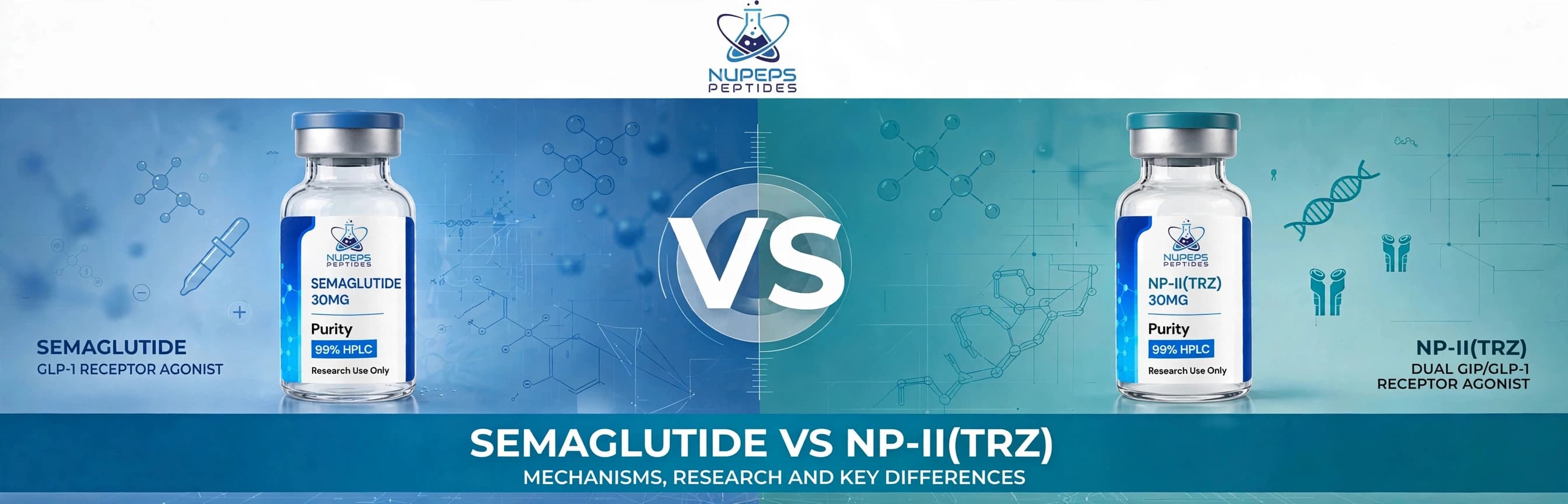
Two incretin-pathway compounds dominate the metabolic research literature: semaglutide, a selective GLP-1 receptor agonist, and tirzepatide, a dual GIP/GLP-1 receptor agonist. Both are among the most published peptide compounds of the last decade, and both are studied in overlapping — but distinct — research programs.
This guide compares the two compounds strictly through the lens of published research: their mechanisms, structural differences, the trial programs that define each, and the questions laboratories are investigating today.
Research use only. This article is an educational overview of published literature. NUPEPS PEPTIDES supplies compounds strictly as laboratory research materials — not for human or veterinary use, and not as drugs, foods, or supplements.
The Core Difference: One Receptor vs. Two
The fundamental distinction between the two compounds is the number of incretin receptors they engage.
Semaglutide is a selective agonist of the glucagon-like peptide-1 (GLP-1) receptor. It mimics the action of native GLP-1, an incretin hormone released by the gut after eating. GLP-1 receptor activation is studied for its effects on glucose-dependent insulin secretion, glucagon suppression, gastric emptying rates, and appetite-signaling circuits in preclinical models.
Tirzepatide is a dual agonist of both the GLP-1 receptor and the glucose-dependent insulinotropic polypeptide (GIP) receptor — a profile that earned it the nickname "twincretin" in the literature. It is a 39-amino-acid synthetic peptide engineered from the GIP sequence and modified to also activate the GLP-1 receptor.
What makes tirzepatide pharmacologically unusual is not just that it hits two receptors, but how it engages them. Signaling studies have shown that tirzepatide is an imbalanced and biased dual agonist: at the GIP receptor it closely mimics native GIP, while at the GLP-1 receptor it favors cAMP generation over β-arrestin recruitment — a signaling bias associated with reduced receptor internalization compared with native GLP-1 (PMID: 32730231).
Structural Comparison
- Peptide length — 31 amino acids (GLP-1 analog) — 39 amino acids (GIP-based)
- Half-life extension — Fatty diacid side chain (albumin binding) — C20 fatty diacid side chain (albumin binding)
- Administration in trials — Once weekly — Once weekly
- Signaling character — Full GLP-1 receptor agonism — Biased GLP-1 agonism + full GIP agonism
Both compounds use fatty-acid conjugation to bind albumin and extend circulating half-life — the strategy that overcame the minutes-long half-life of native incretin hormones. Tirzepatide's C20 fatty diacid side chain supports its approximately five-day half-life in pharmacokinetic studies.
What the Published Trial Programs Show
The two compounds have been studied in large, parallel clinical trial programs that make direct comparison possible — a rarity in peptide research.
Semaglutide's program includes the SUSTAIN trials (type 2 diabetes), the PIONEER trials (oral formulation), and the STEP trials (weight management). The STEP 1 trial reported mean body-weight reduction of approximately 14.9% at 68 weeks. The SELECT trial demonstrated a 20% reduction in major adverse cardiovascular events in adults with established cardiovascular disease and overweight or obesity — the first such outcome data for a GLP-1 compound in that population.
Tirzepatide's program includes the SURPASS trials (type 2 diabetes) and the SURMOUNT trials (weight management). The SURMOUNT-1 trial reported mean body-weight reductions of 15.0%, 19.5%, and 20.9% at the 5 mg, 10 mg, and 15 mg doses respectively over 72 weeks. The SURPASS-2 trial compared tirzepatide directly against semaglutide 1 mg in type 2 diabetes, with tirzepatide showing greater reductions in both glycated hemoglobin and body weight.
The SURMOUNT-5 trial — the first randomized head-to-head comparison of the two compounds for weight management — reported mean weight reduction of 20.2% with tirzepatide versus 13.7% with semaglutide at 72 weeks.
A review of tirzepatide's cardiovascular effects noted that while GLP-1 receptor agonists have an established cardiovascular evidence base, tirzepatide's dual-agonist cardiovascular profile remains an active area of investigation (PMID: 37800107).
Research Areas Under Active Investigation
- Appetite and satiety circuits — GLP-1R-mediated mechanisms well mapped — Dual-pathway appetite signaling under study
- Cardiovascular endpoints — SELECT trial: MACE reduction demonstrated — Preclinical + early clinical data; CVOT ongoing
- Adipose-tissue biology — Depot-specific remodeling under investigation — Ectopic fat reduction reported in trials
- Neuroinflammation models — Preclinical neuroprotection studies published — Emerging preclinical interest
- Liver-metabolism models — NAFLD/NASH research programs active — NASH investigation ongoing
- Receptor pharmacology — Reference single-agonist comparator — Biased agonism / imbalanced dual agonism characterized
A comprehensive review of semaglutide's expanding research footprint covers its investigation across glucose homeostasis, weight regulation, cardiovascular protection, renal endpoints, and emerging neuroendocrine models (PMID: 40620322). A parallel review of tirzepatide summarizes its phase 1–3 data on glycemic control, lipid metabolism, insulin sensitivity, and dose-dependent body-weight effects (PMID: 35593668).
Key Differences for Researchers
1. Mechanistic complexity. Semaglutide is the cleaner pharmacological tool for isolating GLP-1 receptor effects. Tirzepatide's dual engagement makes it the compound of choice for studying incretin-pathway interactions — but also makes it harder to attribute any single observation to one receptor.
2. Biased signaling. Tirzepatide's reduced β-arrestin recruitment at the GLP-1 receptor is a distinctive pharmacological property with no direct counterpart in semaglutide's profile. Laboratories studying receptor desensitization and trafficking dynamics treat this as a key differentiator.
3. Evidence maturity. Semaglutide has a longer publication history and the only completed cardiovascular-outcomes trial of the two. Tirzepatide's evidence base is newer but includes the only head-to-head trial between the compounds.
4. Comparator role. In dual-agonist research programs, semaglutide frequently serves as the single-incretin control arm — the benchmark against which dual-pathway effects are measured.
Research Materials at NUPEPS PEPTIDES
NUPEPS PEPTIDES supplies dual-incretin research materials under the NP-II(TRZ) designation. NP-II(TRZ) 1 is NUPEPS PEPTIDE's product designation for a research reference material containing GLP-II (TRZ).
Available formats for comparative incretin research:
- NP-II (TRZ) 30MG — standard format for initiating dual-agonist research programs
- NP-II (TRZ) 60MG — extended format for chronic study designs
- NP-II(TRZ) 40MG — mid-size format for receptor-binding panels and signaling assays
All materials are verified at ≥ 99% purity by HPLC and mass spectrometry, with batch-specific Certificates of Analysis. For laboratory research use only.
For researchers building broader metabolic programs, see also Metabolic Peptides in Weight Management Research and The Dual Receptor Agonist Mechanism of Tirzepatide.
Frequently Asked Questions
What is the main mechanistic difference between semaglutide and tirzepatide?
Semaglutide is a selective GLP-1 receptor agonist — it engages a single incretin pathway. Tirzepatide is a dual GIP/GLP-1 receptor agonist that engages two incretin pathways simultaneously, with biased signaling properties at the GLP-1 receptor.
Is tirzepatide just a stronger version of semaglutide?
No. Tirzepatide is a different molecule (39 amino acids, GIP-based) with a distinct pharmacological profile — imbalanced dual-receptor engagement and biased GLP-1 signaling. Its effects cannot be reduced to "more GLP-1 agonism."
Which compound has more published clinical trial data?
Semaglutide has the longer publication history, including the SUSTAIN, PIONEER, STEP, and SELECT trial programs. Tirzepatide's program (SURPASS, SURMOUNT) is newer but includes the only head-to-head trial between the two compounds (SURMOUNT-5).
Does NUPEPS PEPTIDES sell semaglutide?
No. NUPEPS PEPTIDES does not offer semaglutide as a product. The dual-incretin research line is supplied as NP-II(TRZ), which is NUPEPS PEPTIDE's product designation for a research reference material containing GLP-II (TRZ).
What does "biased agonism" mean in tirzepatide research?
Biased agonism refers to tirzepatide's tendency to favor cAMP signaling over β-arrestin recruitment at the GLP-1 receptor. This signaling bias is associated with reduced receptor internalization in cell-based studies and is a key subject of receptor-pharmacology research.
Are these compounds for human use?
No. All NUPEPS PEPTIDES materials are strictly for laboratory research use only — not for human or veterinary consumption, diagnostic, or therapeutic use.
References
- Willard FS, et al. "Tirzepatide is an imbalanced and biased dual GIP and GLP-1 receptor agonist." JCI Insight. PMID: 32730231
- Sinha R, et al. "The Cardiovascular Effect of Tirzepatide: A Glucagon-Like Peptide-1 and Glucose-Dependent Insulinotropic Polypeptide Dual Agonist." J Lipid Atheroscler. PMID: 37800107
- Chavda VP, et al. "Tirzepatide - a dual GIP/GLP-1 receptor agonist - a new antidiabetic drug with potential metabolic activity in the treatment of type 2 diabetes." PMID: 35593668
- Mahmoud AM, et al. "The expanding role of semaglutide: beyond glycemic control." PMID: 40620322
All products are intended strictly for laboratory research and in-vitro use only. Not for human or veterinary consumption, diagnostic, or therapeutic use. Products are not drugs, foods, cosmetics, or dietary supplements and may not be misbranded, misused, or mislabeled.