Peptide Comparisons
Tesamorelin vs Ipamorelin: Growth Hormone Secretagogues Compared
October 5, 2026
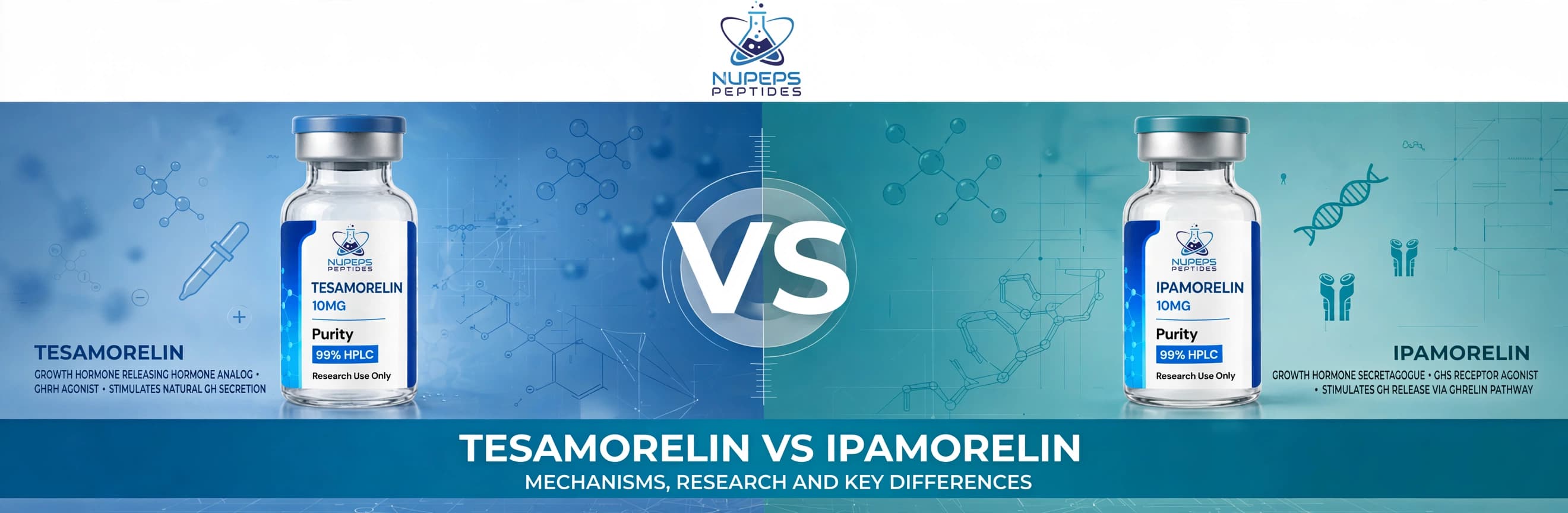
Tesamorelin and ipamorelin are two of the most studied growth hormone (GH) secretagogues in peptide research. Both stimulate the release of endogenous growth hormone from the anterior pituitary — but they do so through entirely different receptor pathways. Understanding these mechanistic differences matters for any laboratory designing GH-axis research, because the choice of secretagogue shapes which downstream signaling, feedback loops, and tissue-level readouts a study can meaningfully investigate.
This guide compares tesamorelin and ipamorelin strictly from the published research record. All products discussed are supplied for laboratory research use only.
Why Compare GH Secretagogues in Research?
Growth hormone secretagogues are not interchangeable research tools. Because tesamorelin and ipamorelin engage different receptors, they produce different patterns of downstream signaling: GHRH-receptor activation drives cAMP-mediated GH transcription, while ghrelin-receptor activation works through phospholipase C and intracellular calcium mobilization. For laboratories mapping GH-axis biology — whether in endocrine signaling models, metabolic research, or tissue-level regeneration studies — the choice of secretagogue determines which feedback circuits are engaged and which confounders must be controlled.
The comparison is also instructive because the two compounds sit at opposite ends of the evidence-maturity spectrum. Tesamorelin anchors the well-validated end: randomized trials, regulatory approval, and meta-analytic confirmation. Ipamorelin represents a mechanistically elegant but less extensively trialed alternative whose value lies in receptor selectivity. Reviewing them side by side gives researchers a framework for weighing evidentiary weight against mechanistic precision when selecting reference materials.
Two Pathways, One Axis
The pituitary somatotroph releases growth hormone in response to two principal upstream signals: growth hormone-releasing hormone (GHRH), which binds the GHRH receptor (GHRHR), and ghrelin, which binds the growth hormone secretagogue receptor (GHS-R1a). Tesamorelin works through the first; ipamorelin works through the second.
Tesamorelin: a GHRH Analog
Tesamorelin is a synthetic 44-amino-acid analog of human growth hormone-releasing hormone (GHRH 1-44), modified with a trans-3-hexenoyl group at the N-terminus to resist proteolytic degradation and extend its activity in vivo. By binding the GHRH receptor on pituitary somatotrophs, it stimulates pulsatile GH secretion in a pattern that closely resembles the body's own GHRH-driven release — the endogenous somatostatin "brake" remains intact, so secretion stays pulsatile rather than continuous.
Tesamorelin is one of the very few peptides in this space with full FDA approval: it was approved in 2010 (as Egrifta) for the reduction of excess visceral abdominal fat in adults with HIV-associated lipodystrophy. A 2026 meta-analysis of five randomized controlled trials confirmed significant reductions in visceral adipose tissue (mean difference −27.71 cm²), trunk fat (−1.18 kg), and hepatic fat percentage (−4.28%), alongside an increase in lean body mass (+1.42 kg) — all without serious adverse events or significant glucose perturbation in the studied populations PMID: 41545261. A separate 2026 systematic review of four RCTs (909 patients) reached consistent conclusions PMID: 42538058.
Beyond body composition, tesamorelin has been investigated in cognitive research: a trial by Baker et al. (2012) examined GHRH effects on cognitive function in adults with mild cognitive impairment and healthy older adults, adding a neurological dimension to the GHRH-axis research literature. Stanley et al. (2014) further reported tesamorelin's effects on visceral and liver fat in HIV-infected patients with abdominal fat accumulation, published in JAMA — reinforcing the compound's position as the most evidence-backed GHRH analog in metabolic research.
Researchers studying the GHRH pathway can explore Tesamorelin 10MG as a reference material.
Ipamorelin: a Selective Ghrelin Receptor Agonist
Ipamorelin is a synthetic pentapeptide (Aib-His-D-2-Nal-D-Phe-Lys-NH2; CAS 170851-70-4; molecular weight ~711.85 Da) that acts as a selective agonist of the ghrelin receptor GHS-R1a. It is the smallest growth hormone secretagogue in its class and was described in the peer-reviewed literature as "the first GHRP receptor agonist with a selectivity for GH release similar to that of GHRH" PMID: 9849822.
Its defining research characteristic is selectivity. In the landmark Raun et al. (1998) study published in the European Journal of Endocrinology, ipamorelin released growth hormone from primary rat pituitary cells with potency comparable to GHRP-6 — but unlike GHRP-2 and GHRP-6, it did not significantly elevate ACTH or cortisol, even at concentrations more than 200-fold above the ED50 for GH release. That narrow stimulatory fingerprint makes ipamorelin a cleaner model for isolating GH-specific effects in experimental designs.
Ipamorelin has also been studied for skeletal effects: Johansen et al. (1999) reported that ipamorelin induces longitudinal bone growth in rats PMID: 10373343. Its pharmacokinetic-pharmacodynamic profile in human volunteers was characterized by Gobburu et al. (1999), giving researchers a published PK/PD reference point for the compound.
For background on this compound, see our guide: What Is Ipamorelin?
Researchers studying the ghrelin/GHS-R1a pathway can explore Ipamorelin 10MG as a reference material.
Research Areas at a Glance
- Hepatic fat — Significant reduction reported in meta-analysis (−4.28%) — Not a primary research focus
- Lean body mass — Increase observed (+1.42 kg in meta-analysis) — Preclinical models show body-composition effects
- GH selectivity — Pulsatile GH release with somatostatin feedback intact — GH release without significant ACTH/cortisol elevation
- Bone / skeletal — Not a primary research focus — Longitudinal bone growth reported in rat models
- Cognitive function — Studied in mild cognitive impairment trials — Not a primary research focus
- GI motility — Not a primary research focus — Investigated in postoperative ileus models (Phase II)
- Regulatory status — FDA-approved (Egrifta, 2010) — Investigational; Phase II data from Novo Nordisk program
Key Differences for Research Design
1. Receptor target. Tesamorelin binds the GHRH receptor; ipamorelin binds the ghrelin receptor (GHS-R1a). Studies comparing the two pathways are effectively comparing the GHRH axis against the ghrelin axis — distinct upstream biology converging on the same pituitary cell type.
2. Evidence maturity. Tesamorelin's evidence base includes an FDA approval, multiple Phase III trials, and two 2026 meta-analyses. Ipamorelin's human data comes primarily from a Phase I/II pharmaceutical development program (Novo Nordisk) and published PK/PD modeling — a smaller but well-characterized dataset.
3. Off-target profile. Ipamorelin's claim to fame is what it does not do: no meaningful ACTH, cortisol, or prolactin elevation at GH-stimulating concentrations. For tesamorelin, the GHRH pathway preserves endogenous somatostatin feedback, keeping secretion pulsatile by design.
4. Primary research domains. Tesamorelin dominates the visceral-adiposity and body-composition literature; ipamorelin is more prominent in selectivity-focused endocrinology and skeletal research. A lab choosing between them is really choosing which published question it wants to extend.
5. Molecular class. Tesamorelin is a 44-residue modified GHRH peptide; ipamorelin is a 5-residue synthetic pentapeptide. The size difference has practical implications for analytical characterization (HPLC, mass spectrometry) in quality workflows.
Analytical Considerations for Researchers
Regardless of which secretagogue a study employs, analytical verification of the reference material is essential. Both tesamorelin and ipamorelin are characterized in quality workflows by reverse-phase HPLC (identity and purity) and mass spectrometry (molecular weight confirmation) — tesamorelin at ~5,135 Da and ipamorelin at ~711.85 Da. Published Certificates of Analysis detailing these parameters allow researchers to confirm that the material matches the compound described in the literature before it enters an experimental protocol.
This matters more than it might seem: GH secretagogue research is sensitive to impurities and degradation products, which can alter receptor binding profiles or introduce off-target activity that confounds results. Sourcing reference materials with published, lot-specific analytical documentation — and verifying purity at ≥99% — is a basic quality control step that protects the integrity of any GH-axis study. NUPEPS PEPTIDES publishes independent Certificates of Analysis for its research materials; see our lab testing overview for how these documents are produced.
FAQ
What is the main difference between tesamorelin and ipamorelin?
Tesamorelin is a GHRH analog that stimulates GH release by binding the GHRH receptor, while ipamorelin is a ghrelin receptor (GHS-R1a) agonist that stimulates GH release through a different receptor pathway. They converge on pituitary somatotrophs but represent distinct upstream signaling mechanisms.
Which has more published clinical evidence?
Tesamorelin. It holds an FDA approval (Egrifta, 2010) for HIV-associated lipodystrophy, supported by Phase III trials and two 2026 meta-analyses. Ipamorelin's human data comes from a smaller Phase I/II development program plus published PK/PD studies.
Does ipamorelin raise cortisol?
In the published research, ipamorelin did not significantly elevate ACTH or cortisol at GH-stimulating concentrations — even at doses more than 200-fold above the ED50 for GH release in animal models. This selectivity distinguishes it from GHRP-2 and GHRP-6, which do raise these hormones.
Is tesamorelin FDA-approved?
Yes. Tesamorelin was approved by the FDA in 2010 under the brand name Egrifta for the reduction of excess visceral abdominal fat in adults with HIV-associated lipodystrophy. It remains one of the few peptides in this category with full regulatory approval.
Can tesamorelin and ipamorelin be studied together?
Both target the GH axis through different receptors, and the published literature on GH secretagogues includes combination research (e.g., GHRH analogs paired with GHS-R1a agonists). Any such work belongs strictly in the laboratory under qualified research protocols.
Are these products for human use?
No. All NUPEPS PEPTIDES products are supplied strictly for laboratory research use only — not for human or veterinary consumption, diagnostic, or therapeutic use.
References
- Badran AS, et al. Body composition, hepatic fat, metabolic, and safety outcomes of Tesamorelin, a GHRH analogue, in HIV-associated lipodystrophy: A meta-analysis of randomized controlled trials. Obes Res Clin Pract. 2026 Jan-Feb. PMID: 41545261
- Efficacy and Safety of Tesamorelin in People Living With HIV (PLWH) With Lipodystrophy: A Systematic Review and Meta-Analysis. 2026. PMID: 42538058
- Raun K, et al. Ipamorelin, the first selective growth hormone secretagogue. Eur J Endocrinol. 1998;139(5):552-561. PMID: 9849822
- Johansen PB, et al. Ipamorelin, a new growth-hormone-releasing peptide, induces longitudinal bone growth in rats. Growth Horm IGF Res. 1999. PMID: 10373343
All NUPEPS PEPTIDES products are for laboratory research use only. Not for human or veterinary consumption, diagnostic, or therapeutic use.
All products are intended strictly for laboratory research and in-vitro use only. Not for human or veterinary consumption, diagnostic, or therapeutic use. Products are not drugs, foods, cosmetics, or dietary supplements and may not be misbranded, misused, or mislabeled.