Research Guides
Cagrilintide Research Guide: Amylin Analogue Science
By NUPEPS Research TeamOctober 27, 2026
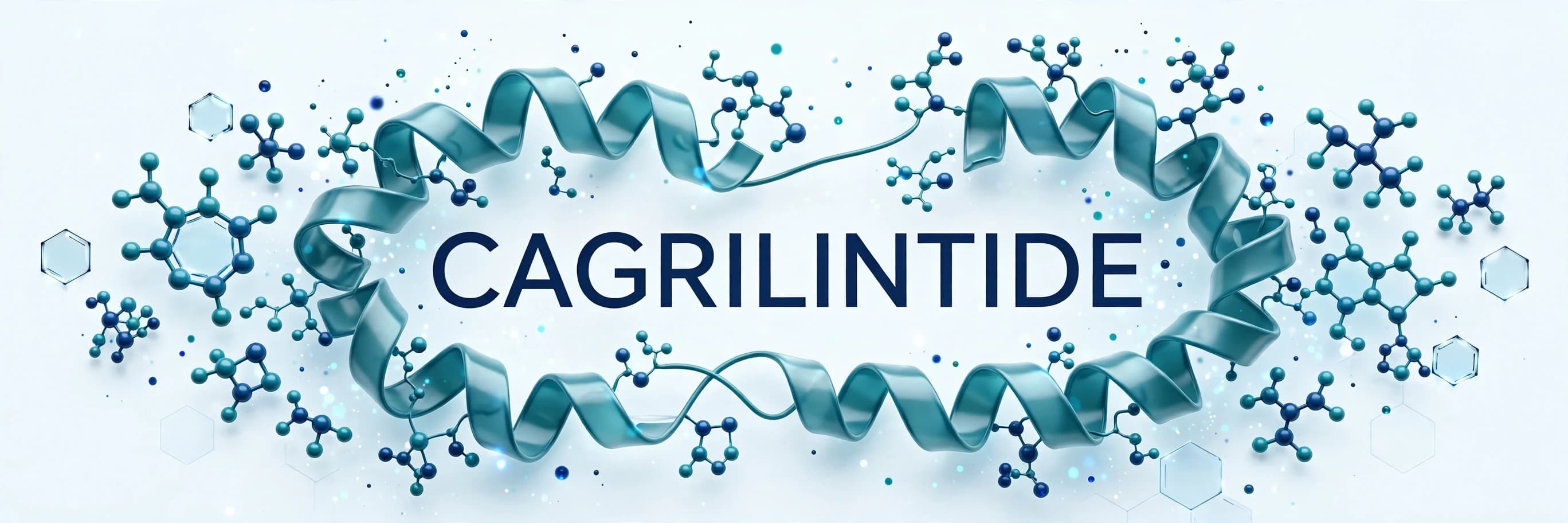
Cagrilintide is an investigational, long-acting analogue of amylin, the pancreatic hormone released alongside insulin after meals. Developed by Novo Nordisk under the earlier codes AM833 and NNC0174-0833, it has become one of the most closely watched molecules in metabolic research for a specific reason: it tests whether the amylin pathway, which is biologically distinct from the incretin pathway behind GLP-1 receptor agonists, can be engaged for a full week at a time by a single engineered peptide. This guide reviews its chemical structure, how its receptors work, what the published trials actually measured, and where the record still runs out.
What Cagrilintide Is: Identity and Chemical Design
Cagrilintide is a synthetic peptide of 37 amino acids, derived from the sequence of human amylin, also known as islet amyloid polypeptide. Native human amylin is a difficult starting point for design. It is cleared quickly, and it has a strong tendency to fold into amyloid fibrils, the same aggregation behaviour that makes amylin deposits a histological feature of the type 2 diabetic pancreas. The medicinal chemistry programme that produced cagrilintide, described by Kruse and colleagues in the Journal of Medicinal Chemistry in 2021, therefore had to solve two problems at once: keep the molecule active at amylin receptors, and stop it behaving like the aggregation-prone native hormone.
The first part of the solution is inherited from pramlintide, the earlier, short-acting amylin analogue. Pramlintide carries proline substitutions at positions 25, 28 and 29, borrowed from the rat amylin sequence, because proline residues interrupt the beta-sheet structure that fibril formation requires. Cagrilintide retains that pramlintide-like proline pattern. Its published sequence also differs from human amylin at a few additional positions, including a glutamate at position 14 and an arginine at position 17, and it ends in a proline amide rather than the native tyrosine. Like amylin itself, the chain is closed by an intramolecular disulfide bridge between its two cysteine residues — a structural feature that is part of the molecule's identity and one of the things analytical testing has to confirm.
The second part of the solution is what makes the compound long-acting. Kruse and colleagues describe cagrilintide as a lipidated analogue: the N-terminal lysine carries a C20 fatty diacid, eicosanedioic acid, attached through a gamma-glutamyl spacer. Fatty-acid side chains of this kind bind reversibly to serum albumin, sheltering the peptide from rapid clearance and breakdown. The finished, acylated molecule weighs approximately 4,409 daltons, substantially more than the roughly 3,900-dalton native hormone, with most of the difference accounted for by the albumin-binding side chain. In the clinical literature this design translated into a half-life measured in days rather than the minutes-scale half-life of native amylin, which is why the human trials below were built around weekly administration intervals.
The Biology Being Copied: Amylin Itself
Amylin is co-secreted with insulin from pancreatic beta cells in response to nutrient intake, but it is not principally a glucose-lowering hormone in its own right. Writing in Cellular and Molecular Life Sciences in 2012, Lutz summarised amylin's best-supported role as a satiation signal: it promotes meal ending, and this effect is thought to be relayed through amylin receptors in the area postrema, a structure at the floor of the fourth ventricle that sits outside the normal blood-brain barrier and is therefore directly exposed to circulating peptides. From the area postrema, the signal is carried onward through the nucleus of the solitary tract and the lateral parabrachial nucleus toward hypothalamic and other forebrain sites, including regions involved in reward-related eating, which is why the amylin literature speaks of both homeostatic and hedonic actions. Amylin also slows gastric emptying and blunts the post-meal rise in glucagon.
Mechanism: Amylin Receptors Are Built From Two Proteins
The receptors cagrilintide acts on have an unusual architecture. An amylin receptor is not a single protein but a complex of two: the calcitonin receptor, a class B G protein-coupled receptor, paired with one of three receptor activity-modifying proteins, or RAMPs. The pairing defines the subtype — calcitonin receptor with RAMP1 forms the AMY1 receptor, with RAMP2 the AMY2 receptor, and with RAMP3 the AMY3 receptor — and each pairing changes the complex's pharmacology and ligand preferences. Pioszak and Hay, reviewing this system in Advances in Pharmacology in 2020, describe the RAMPs as endogenous allosteric modulators of the calcitonin receptor: they are required to move it to the cell surface and they reshape what it responds to once it gets there.
This architecture has a practical consequence. Because the calcitonin receptor sits at the core of every amylin receptor, a ligand can activate the amylin receptor complexes and, to some degree, the calcitonin receptor on its own, and different analogues partition their activity across those targets differently. Fletcher and colleagues addressed exactly this question in the Journal of Pharmacology and Experimental Therapeutics in 2021, profiling cagrilintide — then called AM833 — across 25 measures of binding, activation and receptor regulation, alongside pramlintide, salmon calcitonin, and selective and nonselective comparators. Their conclusion was that cagrilintide is a nonselective agonist of the amylin receptor subtypes and the calcitonin receptor itself, with a profile that did not simply copy any comparator. That nonselectivity is the compound's defining pharmacological trait, and a reason for care with extrapolation: results obtained with a selective agonist such as pramlintide do not automatically describe cagrilintide, and vice versa.
How This Differs From GLP-1 Receptor Agonism
GLP-1 receptor agonists act on a single, well-defined class B receptor expressed in pancreas, gut and brain. Cagrilintide's target system, by contrast, is a family of heterodimeric complexes built around a different receptor, with its best-characterised satiation relay in the area postrema. The two pathways overlap in outcome — both reduce food intake, and GLP-1 agonists also slow gastric emptying — but they are not the same intervention at different strengths. That distinction is the scientific premise of the combination trials below: if amylin and GLP-1 signalling are complementary rather than redundant, engaging both should do more than engaging either alone — a hypothesis the trial data were designed to test, not a conclusion the mechanism alone can supply.
The Clinical Trial Record
Phase 2: Cagrilintide Alone, Dose-Finding
The monotherapy record rests mainly on one trial. Lau and colleagues reported a multicentre, randomised, double-blind, placebo-controlled and active-controlled dose-finding phase 2 study in The Lancet in 2021. It enrolled 706 adults with overweight or obesity who did not have diabetes, across ten countries, and assigned them to one of five once-weekly cagrilintide dose levels, to daily liraglutide as an active comparator, or to placebo, over 26 weeks. On the trial-product estimand, mean bodyweight fell by 6.0 to 10.8 percent across the cagrilintide dose range, against 3.0 percent with placebo, and the highest dose produced a larger reduction than liraglutide (10.8 versus 9.0 percent). Gastrointestinal events were the most common adverse events, reported by 41 to 63 percent of cagrilintide participants against 32 percent on placebo, with nausea the single most frequent one.
Phase 1b and Phase 2: The Combination With Semaglutide
The combination programme began with tolerability and pharmacokinetics. Enebo and colleagues reported a randomised phase 1b trial in The Lancet in 2021 in which 95 adults received escalating weekly cagrilintide alongside a fixed weekly semaglutide regimen for twenty weeks, with safety — treatment-emergent adverse events, again predominantly gastrointestinal and mostly mild or moderate — as the primary question.
The first efficacy test of the combination in type 2 diabetes came from Frias and colleagues, in a 32-week, double-blind, active-controlled phase 2 trial published in The Lancet in 2023 — note the journal, which is sometimes miscited in secondary coverage. Ninety-two adults with type 2 diabetes and a body-mass index of 27 or higher were randomised to the combination, to semaglutide alone, or to cagrilintide alone. At week 32, glycated haemoglobin had fallen by 2.2 percentage points with the combination, 1.8 with semaglutide and 0.9 with cagrilintide; the combination's advantage over cagrilintide alone was statistically clear, while its advantage over semaglutide alone on this endpoint was not. Bodyweight told a different story: mean change was minus 15.6 percent with the combination, against minus 5.1 percent with semaglutide and minus 8.1 percent with cagrilintide, differences reported as significant against both single agents. No level 2 or 3 hypoglycaemia and no fatal adverse events were reported. It was a small trial — thirty or so participants per arm — and the authors framed it as justification for larger, longer phase 3 work.
Phase 3: The REDEFINE Programme and CagriSema
The phase 3 programme tests a fixed combination of cagrilintide and semaglutide, referred to as CagriSema, and its two headline trials were published together in The New England Journal of Medicine in 2025. REDEFINE 1, reported by Garvey and colleagues, randomised 3,417 adults without diabetes who had obesity, or overweight with at least one obesity-related complication, to the combination, to semaglutide alone, to cagrilintide alone, or to placebo, all with lifestyle intervention, for 68 weeks. Estimated mean bodyweight change with the combination was minus 20.4 percent, against minus 3.0 percent with placebo, and participants on the combination were significantly more likely to reach reductions of 5, 20, 25 and 30 percent. Gastrointestinal adverse events affected 79.6 percent of the combination group against 39.9 percent on placebo, described as mainly transient and mild to moderate in severity.
REDEFINE 2, reported by Davies and colleagues in the same journal issue, asked the corresponding question in 1,206 adults with overweight or obesity and type 2 diabetes, randomised to the combination or placebo for 68 weeks. Mean bodyweight change was minus 13.7 percent with the combination against minus 3.4 percent with placebo, and 73.5 percent of the combination group reached a glycated haemoglobin of 6.5 percent or less, against 15.9 percent on placebo. Gastrointestinal events were reported by 72.5 percent of the combination group and 34.4 percent of the placebo group, again mostly transient and mild or moderate. Both trials were funded by Novo Nordisk, the compound's developer — a fact the papers state, and one that belongs in any reading of the results.
What the Evidence Does Not Show
Several limits are as much a part of the record as the headline numbers.
- Cagrilintide is not an approved medicine. As of this writing in October 2026, neither cagrilintide alone nor the CagriSema combination holds a marketing authorisation; everything above comes from investigational trials in screened populations, with structured follow-up that ordinary use would not replicate.
- Most of the large-trial data are about the combination, not the single compound. The only sizable monotherapy dataset is the 26-week phase 2 dose-finding trial. The 68-week phase 3 numbers that dominate coverage describe two peptides given together, and the cagrilintide-alone arms in REDEFINE 1 were sized for comparison within that trial, not as a standalone monotherapy programme.
- Gastrointestinal tolerability is the recurring signal. Nausea, vomiting, diarrhoea, constipation and abdominal pain appear in every trial, at rates well above placebo. The trials characterise most events as transient and mild to moderate, but the frequency itself is a consistent finding, not a footnote.
- Long-term outcomes are not yet in the record. The published trials run to 68 weeks and report weight, glycaemic and safety endpoints. They do not establish cardiovascular outcomes, durability of effect after discontinuation, or safety over the multi-year horizons that chronic metabolic treatment would involve.
- Trial populations were selected. Participants met defined body-mass and health criteria and were excluded for a range of conditions and medications. Effects in populations unlike those enrolled are not described by these papers.
Analytical and Testing Notes for Research Material
Cagrilintide is a demanding analyte, and its structure explains why. A certificate of analysis for research-grade material should be expected to address three separate questions. Identity is a mass spectrometry question: electrospray mass spectrometry should return a molecular mass consistent with the full acylated molecule at approximately 4,409 daltons. That number matters more than usual here, because an unacylated peptide with the correct amino-acid sequence would have the right sequence and the wrong mass — and would not be cagrilintide, since the fatty-diacid side chain is part of the defined structure, not an optional extra.
Purity is a chromatography question, conventionally answered with reversed-phase HPLC reported as a percentage of total peak area, with the chromatogram itself available for inspection. Acylated peptides behave differently on reversed-phase columns from unmodified ones — the lipid side chain increases retention and can broaden peaks if the method is not suited to lipidated analytes — so a purity figure is only as meaningful as the method behind it. Net content is separate from purity: purity states what fraction of the peptide material present is the target molecule, while net peptide content states how much peptide is actually in the vial once water and counter-ions are accounted for. A report that gives purity but not net content leaves the quantity question unanswered, and the two numbers should never be read as interchangeable. A thorough report would also be consistent with the disulfide-bridged structure, since a reduced or incorrectly paired chain is a different molecular species with the same nominal composition.
Stability and Handling: What the Literature Supports
The development paper is itself the best source on this compound's handling character, because instability was the problem the molecule was designed around. Human amylin's tendency to aggregate into amyloid fibrils is documented in the Kruse paper as the central design obstacle, and cagrilintide's substitutions were selected to produce an analogue the authors describe as stable where the native hormone is not. Two careful conclusions follow. First, aggregation behaviour is a property of the sequence, so chemically altered material — a broken disulfide bridge, or a lost acyl chain — cannot be assumed to share the engineered molecule's stability, which is another reason identity testing by mass carries weight here. Second, claims beyond the published record should be treated as ungrounded: the primary literature reports the design rationale and the formulations used under trial conditions, but no general storage specification for research material, so any storage statement for a given batch properly belongs to that batch's own documentation and certificate, not to review articles — including this one.
Limits and Open Questions
The open questions cluster in predictable places. The relative contribution of calcitonin receptor activation versus the three amylin receptor subtypes to the human effects remains unresolved; Fletcher and colleagues mapped the in-vitro profile in detail, but receptor-level attribution in patients is not something the clinical trials were instrumented to measure. Whether the combination's advantage over its components persists beyond 68 weeks is unknown from the published record. The regulatory path is likewise unsettled at the time of writing: phase 3 success is a statement about trial endpoints, not about authorisation or labelling. And the monotherapy question the phase 2 trial opened — what cagrilintide alone can do over longer periods — remains comparatively thinly documented, because development effort has concentrated on the combination. The cagrilintide record is unusually complete for an investigational peptide in its trial reporting, and unusually incomplete, so far, in everything that comes after the trials.
Frequently asked questions
Is Cagrilintide Research Guide: Amylin Analogue Science for human use?
No. All compounds discussed in this guide are strictly for laboratory research use only. Not for human or veterinary use.
Where can I find the Certificate of Analysis?
Certificates of Analysis are available in our COA library. Each batch is third-party tested for purity and identity.
How should research compounds be stored?
Store according to the vial label instructions. Generally, lyophilized compounds should be kept in a cool, dry place away from light. Refer to the specific product documentation for details.
All products are intended strictly for laboratory research and in-vitro use only. Not for human or veterinary consumption, diagnostic, or therapeutic use. Products are not drugs, foods, cosmetics, or dietary supplements and may not be misbranded, misused, or mislabeled.