Peptides and Amino Acids
Introduction to Amino Acids and Peptides
Amino acids are organic molecules that contain both an α-amino group (–NH₂) and an α-carboxyl group (–COOH). Moreover, these groups play a crucial role in the formation of peptide bonds, which link amino acids to form proteins. Additionally, the general structure of amino acids is represented as RCH(NH₂)COOH. As a result, each amino acid’s properties are defined by the chemical nature of its side chain (R group).
There are 20 naturally occurring amino acids involved in protein formation. Their varied side-chain chemistries, such as charge, polarity, and hydrophobicity, create the diversity necessary for biological function.
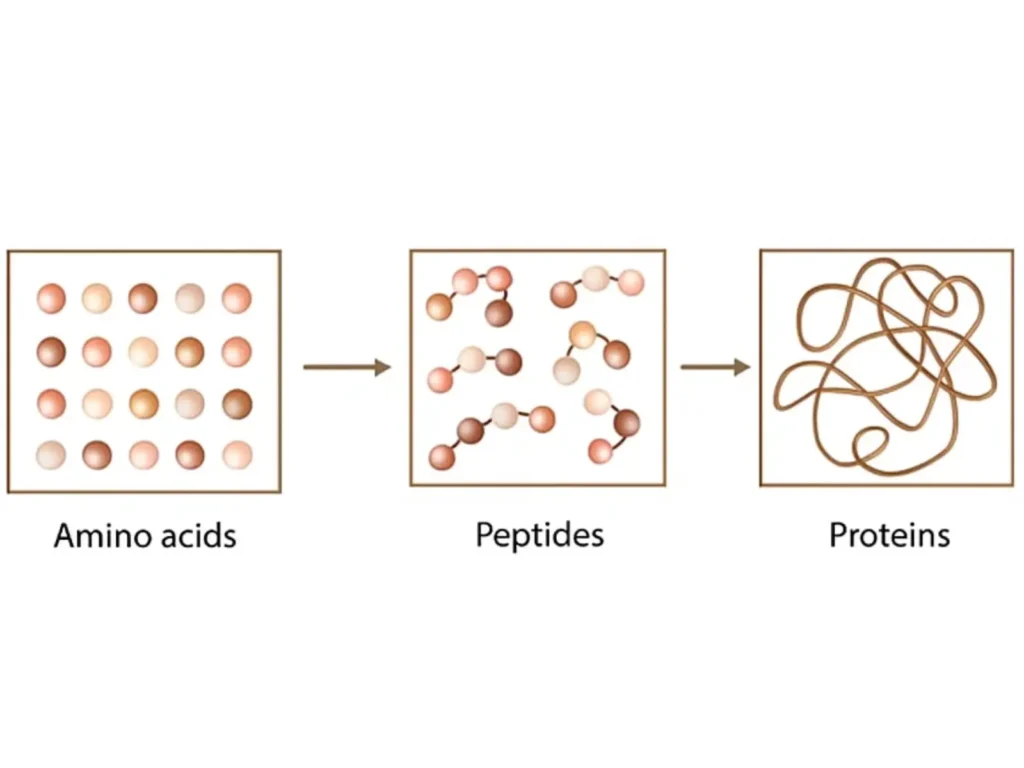
Peptides are linear chains of amino acids connected by amide bonds (peptide bonds) formed through dehydration reactions. Depending on length, they are classified as:
- Oligopeptides: 2–10 amino acid residues
- Polypeptides: more than 10 residues
Typical molecular weights range from 0.2 to 10 kDa. Peptides serve as intermediate functional units between single amino acids and full protein structures.
Peptides vs. Amino Acids: Key Differences
1. Molecular Composition
- Amino acids: Small, independent molecules (75–204 Da) with free amino and carboxyl groups.
- Peptides are chains of amino acids where free amino and carboxyl groups are replaced by peptide bonds (–CO–NH–), creating a continuous backbone.
2. Structural Complexity
- Amino acids: Possess only primary chemical structure.
- Peptides: Have defined sequences and may adopt flexible or partially ordered conformations (e.g., small α-helices or β-turns), though they lack fully stable 3D structures.
3. Functional Role
- Amino acids: Possess only primary chemical structure.
- Peptides: Have defined sequences and may adopt flexible or partially ordered conformations (e.g., small α-helices or β-turns), though they lack fully stable 3D structures.
Amino Acids: The Foundation of Peptide Structure
Natural amino acids are commonly grouped based on their side-chain properties:
- Nonpolar aliphatic: hydrophobic, influencing peptide folding
- Polar uncharged: capable of hydrogen bonding and modifications
- Aromatic: contributes to UV absorption and molecular recognition
- Acidic and basic: define charge distribution, solubility, and isoelectric point
During ribosomal translation, amino acids are delivered by aminoacyl-tRNA and sequentially assembled according to mRNA codons. Their genetically determined order forms the basis for peptide structure and function.
Structural Features and Functional Roles of Peptides
Peptides contain:
- an N-terminal amino group,
- a C-terminal carboxyl group,
- a backbone of repeating amide bonds.
Oligopeptides (2–10 residues): Flexible, linear molecules with diverse functions. Examples include:
- Carnosine: a dipeptide with antioxidant properties
- Enkephalins: pentapeptides involved in regulating pain signals
Polypeptides (>10 residues): May adopt localized secondary structures.
Examples include:
- Thyrotropin-releasing hormone: stability enhanced by cyclization
- Antimicrobial peptides: use amphiphilic helices to disrupt bacterial membranes
Peptides achieve unique functionality by combining reactive side chains with moderate molecular size, enabling precise interactions with biological targets.
Biosynthesis vs. Chemical Synthesis
Amino Acid Biosynthesis: Amino acids are produced through regulated metabolic pathways. For example, glutamate forms via the amination of α-ketoglutarate.
Peptide Biosynthesis
Ribosomal Synthesis:
- Driven by mRNA templates
- Uses tRNA to match codons
- Forms peptide chains step-by-step in the ribosome
- Produces natural peptides and protein precursors
Nonribosomal Synthesis:
- Common in microorganisms
- Uses multi-enzyme complexes
- Incorporates non-standard amino acids
Chemical Synthesis: Researchers produce peptides through stepwise coupling using protective groups. This method is ideal for:
- short peptides (<50 residues)
- high-purity, sequence-specific products
- research reagents and therapeutic development
How Amino Acid Side Chains Shape Peptide Function
The behavior of a peptide is determined by cooperative interactions among its amino acid residues:
- Electrostatic interactions: acidic and basic residues stabilize the structure
- Hydrophobic interactions: nonpolar residues drive folding
- Covalent modifications: phosphorylation or glycosylation can alter activity and solubility
These interactions make peptides powerful tools for various applications. For example, peptides play a key role in biomolecular targeting, signal modulation, and protein–protein interaction studies. In addition, their ability to interact with specific molecules further enhances their effectiveness in these applications.
Terminology: Clear Scientific Definitions
Accurate terminology helps distinguish molecular categories:
- Amino acids: standalone α-amino carboxylic acids
- Peptides: molecules formed by two or more amino acids via peptide bonds
- Amino acid residues: amino acids incorporated into a peptide chain
Correct usage ensures clarity when discussing structural complexity, polymerization, and functional behavior. As a result, it helps maintain accuracy and understanding in these complex topics. Furthermore, this clarity supports more effective communication and reduces the risk of errors.
Important Notice
We provide all articles and product information on this website solely for informational and educational purposes. We design our products exclusively for in vitro research use. In vitro research refers to experiments conducted outside the human body, typically in glassware or controlled laboratory systems. These products are not pharmaceuticals, have not received approval from the U.S. We strictly prohibit introducing these products into the human or animal body under any circumstances.