What Is a Peptide Bond?
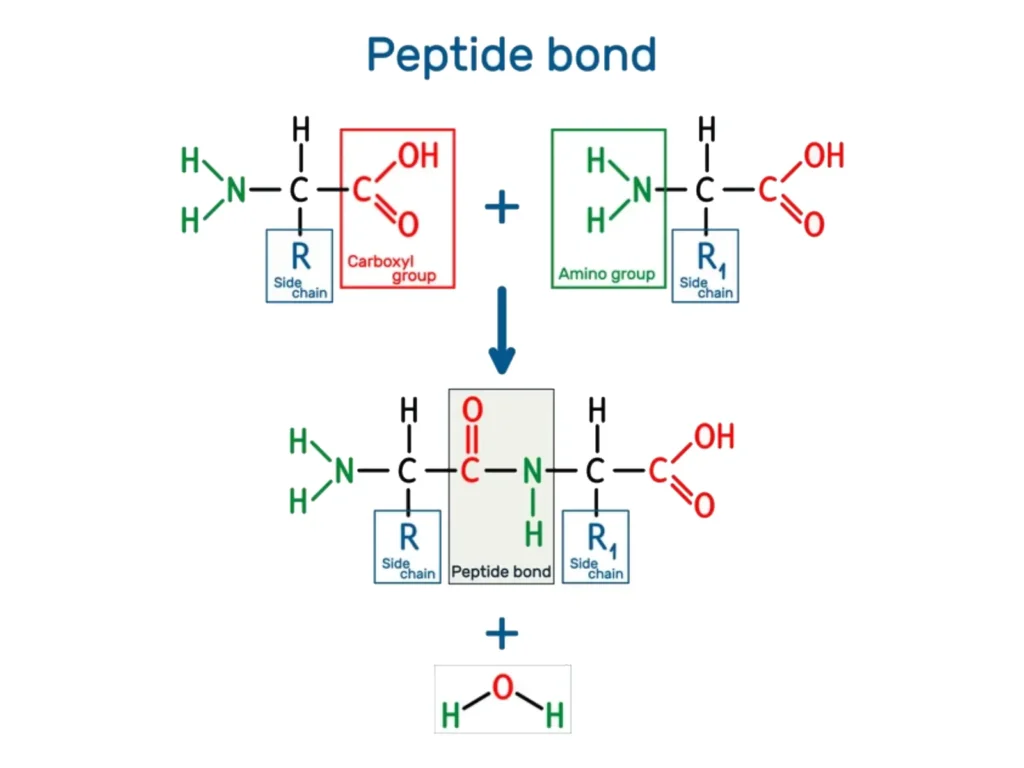
A peptide bond is a key covalent linkage found in proteins. It forms through a dehydration condensation reaction between the α-carboxyl group (α-COOH) of one amino acid and the α-amino group (-NH₂) of the next. Chemically, it is an amide bond.
This connection forms the backbone of a polypeptide chain, linking amino acids from the N-terminus to the C-terminus through repeating peptide bonds. The partial double-bond character between the carbonyl carbon (C=O) and the nitrogen (-NH-) makes the peptide bond rigid and planar. This rigidity plays a key role in how proteins fold into higher-order structures.
How Peptide Bonds Form in Cells
Ribosomes synthesize peptide bonds as tRNA molecules deliver amino acids based on the genetic code from mRNA.
- tRNA anticodons pair with mRNA codons at the ribosome’s P site and A site.
- The amino group of the amino acid at the A site reacts with the carboxyl group of the amino acid at the P site, forming a new -CO-NH- bond and releasing a molecule of water.
- Powered by GTP, the ribosome shifts along the mRNA, extending the peptide chain from N-terminus to C-terminus in a precise, codon-directed sequence.
Structural and Chemical Features of Peptide Bonds
The peptide bond’s conjugated, planar structure creates several notable characteristics:
- The carbonyl oxygen and amide hydrogen typically arrange themselves in a trans configuration, forming a rigid planar unit (ω ≈ 180°).
- This rigidity limits rotation around nearby bonds (φ and ψ angles), encouraging the formation of organized secondary structures like α-helices, β-sheets, and β-turns.
- The amide group can donate or accept hydrogen bonds, helping build the internal hydrogen-bonding networks crucial for protein stability.
- Peptide bonds show characteristic UV absorption at 210–230 nm, a property widely used in protein quantification.
- Although chemically stable in neutral solution, proteases can selectively cleave peptide bonds, enabling regulated protein turnover in cells.
Biological Roles and Research Applications
Peptide bonds play a central role in maintaining the stability and function of the proteome:
- Their covalent stability helps preserve the structure of enzymes and structural proteins.
- Proteases in systems like the ubiquitin–proteasome pathway or lysosomes actively recognize and cleave specific peptide bonds to remove damaged proteins or regulate signaling processes.
In biotechnology and laboratory research:
- Solid-phase peptide synthesis (SPPS) uses controlled activation of amino acids to build peptides one bond at a time.
- Protein sequencing (e.g., the Edman degradation method) relies on selectively cleaving N-terminal peptide bonds.
- Protease inhibitors often mimic peptide bond structures to block enzyme activity, an important approach used in drug design.
Ongoing research into peptide bond structure and function continues to support advancements in protein engineering, synthetic biology, and peptide-based technologies.
Disclaimer
We provide content for educational and informational purposes only. The products mentioned serve strictly for in vitro research and must be used in controlled laboratory environments outside the human body. The U.S. Food and Drug Administration (FDA) has not approved these products for medical use. Do not use them to diagnose, treat, prevent, or cure any disease or medical condition. Do not introduce these products into humans or animals under any circumstances.