Research Guides
NAD+ Research Guide: Coenzyme at the Center of Energy Studies
By NUPEPS Research TeamOctober 18, 2026
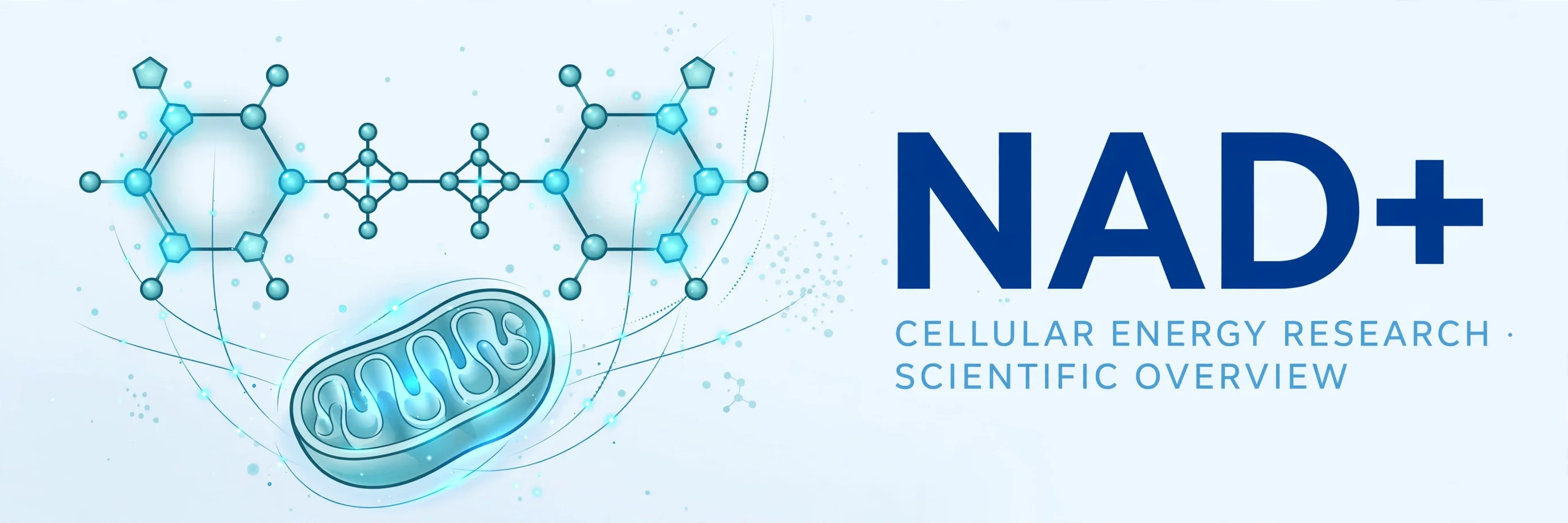
Few molecules appear in as many laboratory conversations as nicotinamide adenine dinucleotide, universally abbreviated NAD+. It is a coenzyme found in every living cell, and it carries two distinct identities in biochemistry: it is an electron carrier that shuttles reducing equivalents through energy metabolism, and it is a consumed substrate for several families of signaling enzymes. That dual role has moved NAD+ from textbook cofactor to one of the most actively studied molecules in metabolism and aging research.
Two observations drive much of the current interest. First, multiple research groups have reported that tissue NAD+ levels decline with age in both animal models and human samples. Second, because sirtuins, PARPs, and CD38 all depend on the same NAD+ pool, changes in its availability can propagate into DNA-damage responses, gene regulation, and mitochondrial function. NAD+ has therefore become a standard variable in laboratory studies of cellular energetics and aging biology. This guide reviews what NAD+ is, the roles it plays in core metabolism, the enzymes that consume it, how cells synthesize it, the published findings that built the field, and how researchers evaluate NAD+ research material in the laboratory.
What Is NAD+?
NAD+ is a dinucleotide: two nucleotides joined through their phosphate groups by a pyrophosphate bond. One nucleotide carries the base adenine; the other carries nicotinamide, a form of vitamin B3. Each half consists of a base, a ribose sugar, and phosphate, and the nicotinamide ring is where the molecule's chemistry happens.
In its oxidized form, NAD+, the nicotinamide ring accepts a hydride ion (two electrons and a proton) and becomes the reduced form, NADH. The NAD+/NADH pair interconverts constantly as metabolism runs, and the ratio between the two forms is widely used in research as an indicator of a cell's redox state. Unlike a peptide, NAD+ is a small-molecule coenzyme, and unlike a purely catalytic cofactor, it is also consumed stoichiometrically by signaling enzymes, a distinction that shapes much of its biology.
- Chemical name: Nicotinamide adenine dinucleotide (oxidized form)
- Molecular formula: C21H27N7O14P2
- Molecular weight: Approximately 663.4 g/mol
- CAS number: 53-84-9
- Redox pair: NAD+ (oxidized) and NADH (reduced)
- Distribution: Cytosolic, mitochondrial, and nuclear pools, each with its own NAD+/NADH balance
Compartmentalization matters for researchers: the mitochondrial NAD+ pool is partly insulated from the cytosolic pool, and nuclear NAD+ feeds directly into chromatin-associated enzymes. Measurements of whole-cell NAD+ therefore average across pools that can behave differently, which is why compartment-aware methods feature prominently in the modern literature.
Core Roles in Cellular Energy Metabolism
The classical role of NAD+ is redox chemistry. Dehydrogenase enzymes use NAD+ as an electron acceptor, oxidizing metabolic fuels and producing NADH, which then donates its electrons to the respiratory chain. This cycle touches nearly every stage of energy metabolism studied in the laboratory.
Glycolysis and the Cytosol
In glycolysis, the enzyme glyceraldehyde-3-phosphate dehydrogenase reduces NAD+ to NADH as it processes glucose-derived intermediates. Cytosolic NAD+ must be continuously regenerated for glycolysis to continue, and cells do this partly through shuttle systems, such as the malate-aspartate and glycerol-phosphate shuttles, which move reducing equivalents into mitochondria.
The Link Reaction and the TCA Cycle
The pyruvate dehydrogenase complex converts pyruvate to acetyl-CoA and reduces NAD+ in the process. Inside the mitochondrial matrix, three steps of the tricarboxylic acid (TCA) cycle, catalyzed by isocitrate dehydrogenase, alpha-ketoglutarate dehydrogenase, and malate dehydrogenase, each generate NADH. Per glucose molecule, these pathways collectively produce the majority of the NADH that feeds oxidative phosphorylation.
Oxidative Phosphorylation
NADH donates its electrons to Complex I of the electron transport chain. The energy released as electrons pass through the complexes pumps protons across the inner mitochondrial membrane, and the resulting gradient drives ATP synthesis. Because NADH supply is a direct input into this machinery, the NAD+/NADH ratio is a meaningful readout in respirometry and mitochondrial-function studies, and it is one reason NAD+ research overlaps so heavily with work on mitochondrial peptides such as those compared in our SS-31 vs MOTS-C comparison.
A related but separate coenzyme, NADP+/NADPH, is generated from NAD+ by NAD kinases and supports reductive biosynthesis and antioxidant systems. Researchers treat the NAD and NADP pools as distinct, and analytical methods increasingly resolve them separately.
NAD+-Consuming Enzymes: Sirtuins, PARPs, and CD38
The second identity of NAD+ is as a substrate that enzymes split, releasing nicotinamide. Three consumer families dominate the research literature, and their competition for a shared pool is a central theme in the field.
Sirtuins
The sirtuins (SIRT1 through SIRT7 in mammals) are NAD+-dependent deacylases. They remove acetyl and other acyl groups from target proteins, including histones, using NAD+ as a co-substrate and generating nicotinamide and O-acetyl-ADP-ribose. Because sirtuin activity requires NAD+, their function is directly sensitive to its availability, which links cellular energy state to gene-expression programs and metabolic regulation. Different sirtuins occupy different compartments: SIRT1, SIRT6, and SIRT7 are primarily nuclear, SIRT2 is cytosolic, and SIRT3, SIRT4, and SIRT5 are mitochondrial.
PARPs
Poly(ADP-ribose) polymerases, principally PARP1 and PARP2, detect DNA strand breaks and respond by building poly(ADP-ribose) chains on target proteins, consuming NAD+ with every unit added. Under heavy DNA damage, PARP activity can draw down cellular NAD+ substantially. The literature documents a competitive dynamic: strong PARP activation can limit the NAD+ available to sirtuins, coupling the DNA-damage response to metabolic signaling.
CD38
CD38 is a membrane glycoprotein with potent NADase activity. It hydrolyzes NAD+ to ADP-ribose and cyclic ADP-ribose, the latter a calcium-mobilizing second messenger. CD38 expression and activity have been reported to rise with age in multiple tissues, and work from the Chini laboratory identified it as a principal driver of age-related NAD+ decline in mice, acting partly through the mitochondrial sirtuin SIRT3. A fourth consumer, the enzyme SARM1, has drawn attention in axon-degeneration research for the same reason: its activation rapidly depletes local NAD+.
Together, these consumers explain why NAD+ availability is treated as a systems variable. Synthesis on one side and consumption by sirtuins, PARPs, CD38, and SARM1 on the other determine the level every NAD+-dependent process must share.
Biosynthesis and the Salvage Pathway
Cells maintain NAD+ through three routes. The de novo pathway builds it from the amino acid tryptophan through the kynurenine pathway, contributing mainly in the liver. The Preiss-Handler pathway starts from nicotinic acid. In most tissues, however, the dominant route is the salvage pathway, which recycles the nicotinamide released by NAD+-consuming enzymes.
Salvage proceeds in two steps. First, the enzyme NAMPT (nicotinamide phosphoribosyltransferase), the rate-limiting step of the pathway, converts nicotinamide to nicotinamide mononucleotide (NMN). Second, NMNAT enzymes (NMNAT1, 2, and 3, located in the nucleus, cytosol, and mitochondria respectively) convert NMN to NAD+. NAMPT expression has been reported to decline with age in several tissues and to oscillate under circadian control, both observations that connect salvage capacity to the age-related decline literature.
Two related intermediates are studied intensively as research tools in this pathway. Nicotinamide riboside (NR) enters salvage through NR kinase enzymes (NRK1 and NRK2), which convert it to NMN. NMN itself is the direct salvage intermediate. Because these compounds feed the pathway at defined enzymatic steps, they are used in laboratory studies to probe how NAD+ pools are built, maintained, and drawn down, and the 2018 review by Yoshino, Baur, and Imai remains a standard map of their biology (cited in full below).
Published Research Highlights
The modern NAD+ field rests on a small set of frequently cited findings. Four are summarized here, each framed as the original authors reported it.
Age-Associated Decline in Human Tissue
Massudi and colleagues measured NAD+ metabolism directly in human skin tissue across age groups and reported a strong negative correlation between NAD+ levels and age in both males and females, alongside increased PARP activity and oxidative DNA damage markers. The study provided early quantitative human evidence for the decline hypothesis.
Citation: Massudi H, et al. "Age-Associated Changes in Oxidative Stress and NAD+ Metabolism in Human Tissue." PLoS ONE. 2012. [PubMed PMID: 22848760](https://pubmed.ncbi.nlm.nih.gov/22848760/)
The Pseudohypoxic State in Aged Mouse Muscle
Gomes and colleagues reported that in aged mouse muscle, declining nuclear NAD+ reduced sirtuin activity and allowed the transcription factor HIF-1alpha to accumulate under normal oxygen conditions, a state the authors termed pseudohypoxia. This disrupted communication between the nuclear and mitochondrial genomes and was accompanied by a specific loss of mitochondrially encoded oxidative phosphorylation subunits. Raising NAD+ levels in old mice restored these markers in a SIRT1-dependent manner, as reported in the study.
Citation: Gomes AP, et al. "Declining NAD+ Induces a Pseudohypoxic State Disrupting Nuclear-Mitochondrial Communication during Aging." Cell. 2013. [PubMed PMID: 24360282](https://pubmed.ncbi.nlm.nih.gov/24360282/)
CD38 as a Driver of Age-Related Decline
Camacho-Pereira and colleagues reported that CD38 protein levels and NADase activity increase in multiple mouse tissues during aging, and that mice lacking CD38 were protected against age-related NAD+ decline and mitochondrial dysfunction, through a mechanism dependent on SIRT3. The work shifted attention from synthesis alone toward consumption as an explanation for falling NAD+ levels.
Citation: Camacho-Pereira J, et al. "CD38 Dictates Age-Related NAD Decline and Mitochondrial Dysfunction through an SIRT3-Dependent Mechanism." Cell Metabolism. 2016. [PubMed PMID: 27304511](https://pubmed.ncbi.nlm.nih.gov/27304511/)
The Biology of NAD+ Intermediates
Yoshino, Baur, and Imai reviewed the evidence on NMN and NR, the two most studied NAD+ intermediates, covering their biosynthetic routes, their behavior in animal models, and the state of early human research. The review is a useful entry point for researchers designing salvage-pathway experiments, and it is careful about the distance between preclinical findings and human evidence.
Citation: Yoshino J, Baur JA, Imai S. "NAD+ Intermediates: The Biology and Therapeutic Potential of NMN and NR." Cell Metabolism. 2018. [PubMed PMID: 29249689](https://pubmed.ncbi.nlm.nih.gov/29249689/)
Read together, these papers outline the field's working model: NAD+ declines with age through some combination of reduced salvage capacity and increased consumption, and the decline matters because NAD+-dependent enzymes sit inside DNA-repair, epigenetic, and mitochondrial pathways.
Research Applications in the Laboratory
In day-to-day laboratory work, NAD+ appears in several distinct roles:
- Enzyme assays: NAD+ and NADH are the working reagents of dehydrogenase assays. NADH absorbs light at 340 nm while NAD+ does not, so formation or consumption of NADH provides a direct spectrophotometric readout of enzyme activity.
- Sirtuin and PARP assays: Cell-free and cell-based assays of deacylase and ADP-ribosyltransferase activity require defined NAD+ input, and results are sensitive to its actual concentration and purity.
- Redox-state measurement: Enzymatic cycling assays, LC-MS metabolomics, and genetically encoded fluorescent sensors are used to quantify NAD+, NADH, and their ratio in cells and tissues, increasingly with compartment resolution.
- Metabolic and aging models: NAD+ metabolism is a measured variable in cell-culture and animal studies of mitochondrial function, DNA damage, and senescence. Researchers working on mitochondria-centered questions often read this literature alongside compound-specific work, such as our MOTS-C research guide.
- Analytical reference: Well-characterized NAD+ serves as a calibration and identity standard for the assays above.
Analytical and Quality Considerations
Because so many assays read out NAD+-dependent activity directly, the identity and purity of the material are experimental variables, not formalities. Two checks are standard. Mass spectrometry should confirm a molecular identity consistent with C21H27N7O14P2 at approximately 663.4 g/mol, and should distinguish NAD+ from NADH, which differs by two mass units. Reversed-phase HPLC is the standard purity method, quantifying NAD+ against related nucleotide impurities and degradation products. UV absorbance provides an orthogonal check: both forms absorb at 260 nm from the adenine ring, while only NADH absorbs at 340 nm, so the absorbance profile helps confirm which redox form is actually in hand.
Material that has partially degraded or that contains the wrong redox form can shift baselines in sirtuin, PARP, and dehydrogenase assays in ways that are easy to misread as biology. For that reason, researchers working with NAD+ look for a batch-specific Certificate of Analysis documenting HPLC purity and mass spectrometry identity for the exact batch supplied, rather than a generic specification sheet. Background on reading these documents is covered in our guide to reading a peptide COA.
NAD+ Research Material at NUPEPS
NUPEPS supplies NAD+ as a lyophilized research material, including NAD+ 500MG, with NAD+ 100MG and NAD+ 1000MG presentations also available for different scales of laboratory work. Each batch is supplied with a Certificate of Analysis documenting purity and identity verification, so the material can be matched to its analytical record before use in an assay.
Conclusion
NAD+ rewards study from two directions at once. As a redox coenzyme, it is woven through glycolysis, the TCA cycle, and oxidative phosphorylation. As a consumed substrate, it sets the operating conditions for sirtuins, PARPs, CD38, and other enzymes involved in DNA repair, gene regulation, and calcium signaling. The salvage pathway, gated by NAMPT, connects the two identities by recycling what the consumers release. The published record, from the human tissue measurements of Massudi and colleagues to the mechanistic mouse work on pseudohypoxia and CD38, explains why this single dinucleotide became a central variable in metabolism and aging research.
For researchers sourcing NAD+ for laboratory use, the practical standard mirrors the science: verify identity by mass spectrometry against the expected 663.4 g/mol dinucleotide, require at least 99% purity by HPLC, and insist on a batch-specific Certificate of Analysis for the material actually supplied. When the readout of an experiment is NAD+-dependent enzyme activity, documented material quality is part of the experimental design.
Frequently asked questions
What is NAD+, and how does it differ from NADH?
NAD+ is nicotinamide adenine dinucleotide, a dinucleotide coenzyme found in every living cell, with molecular formula C21H27N7O14P2, a molecular weight of approximately 663.4 g/mol, and CAS number 53-84-9. In its oxidized form, NAD+, the nicotinamide ring accepts a hydride ion (two electrons and a proton) to become the reduced form, NADH, and the NAD+/NADH ratio is widely used in research as an indicator of a cell's redox state.
Which enzymes consume NAD+, according to the guide?
The guide describes three consumer families dominating the research literature: the sirtuins (SIRT1 through SIRT7), NAD+-dependent deacylases that remove acyl groups from target proteins; the PARPs, principally PARP1 and PARP2, which detect DNA strand breaks and build poly(ADP-ribose) chains; and CD38, a membrane glycoprotein with potent NADase activity. It also notes SARM1, which has drawn attention in axon-degeneration research for rapidly depleting local NAD+.
How do cells replenish NAD+ through the salvage pathway?
Cells maintain NAD+ through three routes — the de novo pathway from tryptophan, the Preiss-Handler pathway from nicotinic acid, and the salvage pathway, which dominates in most tissues. In salvage, the rate-limiting enzyme NAMPT converts nicotinamide to nicotinamide mononucleotide (NMN), and NMNAT enzymes (NMNAT1, 2, and 3, located in the nucleus, cytosol, and mitochondria respectively) then convert NMN to NAD+, recycling the nicotinamide released by NAD+-consuming enzymes.
All products are intended strictly for laboratory research and in-vitro use only. Not for human or veterinary consumption, diagnostic, or therapeutic use. Products are not drugs, foods, cosmetics, or dietary supplements and may not be misbranded, misused, or mislabeled.