Research Guides
Kisspeptin-10 Research Guide: KISS1R Science
By NUPEPS Research TeamOctober 31, 2026
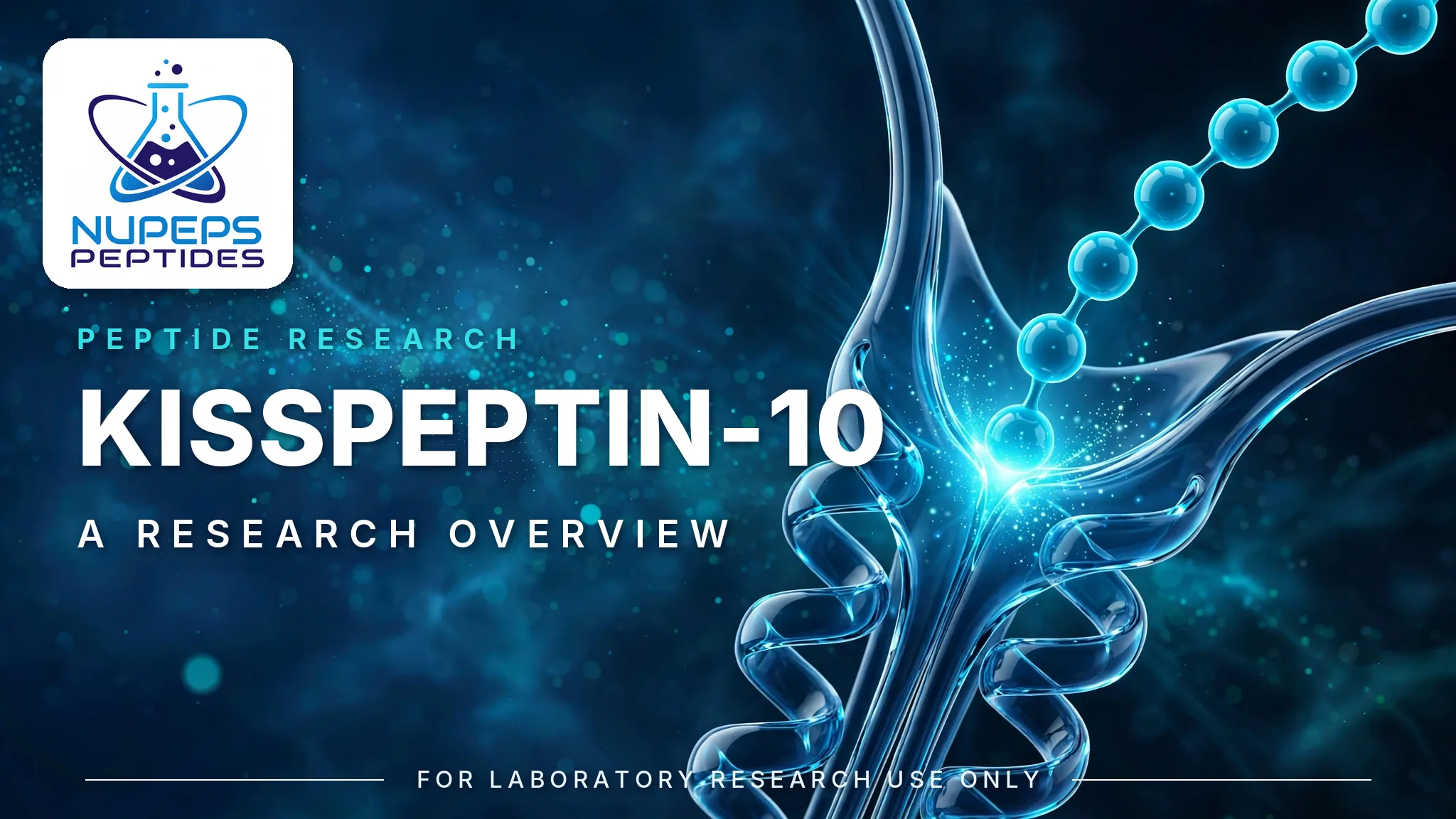
Kisspeptin-10 is a small peptide with an outsized place in reproductive neuroendocrinology. It is the ten-amino-acid fragment shared by every member of the kisspeptin family, and it activates KISS1R — the receptor formerly known as GPR54 — on gonadotropin-releasing hormone (GnRH) neurons, the cells that sit at the top of the reproductive axis. Few research peptides connect so directly to a landmark human genetics story: within two years of the receptor being paired with its ligand, loss-of-function variants in that receptor were shown to prevent puberty in humans, establishing kisspeptin signaling as a required input to the reproductive system rather than a modulatory extra. This guide reviews what kisspeptin-10 is, how it was discovered, the 2003 genetics that defined its role, how it acts within the hypothalamic network governing GnRH release, and how researchers use it today as an experimental probe — plus the analytical checks and limits that frame its evidence base.
What Is Kisspeptin-10?
- Identity: a decapeptide — ten amino acids — corresponding to the C-terminal fragment common to all kisspeptins
- Sequence: Tyr–Asn–Trp–Asn–Ser–Phe–Gly–Leu–Arg–Phe-NH2
- Molecular weight: approximately 1,302.4 Da
- Family: the RF-amide peptide family, named for the arginine–phenylalanine amide motif at the C-terminus
- Gene: encoded by KISS1; the longer kisspeptins are processed from a common precursor protein
- Receptor: KISS1R (formerly GPR54), a G protein-coupled receptor expressed on GnRH neurons
- In the NUPEPS PEPTIDES catalog: Kisspeptin-10 10MG, supplied for laboratory research use
The structural logic of the family is simple. The KISS1 precursor is cut into products of different lengths — kisspeptin-54, kisspeptin-14, and kisspeptin-13 among them — but every product ends in the same ten residues. That shared C-terminal decapeptide carries the receptor-activating core of the molecule, and kisspeptin-10 is exactly that core, nothing more. Two features of it matter for everything that follows. First, the C-terminal phenylalanine is amidated — the sequence ends in Phe-NH2 rather than a free carboxylic acid — and that amide is essential to full activity at the receptor. Second, the terminal Arg–Phe-NH2 pairing is what places the peptide in the RF-amide family, a large group of signaling peptides whose members share that ending and whose receptors tend to read it as a key part of the recognition signal. A synthetic decapeptide that reproduces the sequence but not the amide is therefore not the same reagent, a point the analytical section below returns to.
Discovery: From a Metastasis Suppressor Gene to a Receptor Ligand
Kisspeptin entered the literature by a side door. In the 1990s, melanoma researchers identified a gene whose expression suppressed the spread of tumor cells without preventing the original tumor from growing — a metastasis suppressor. Named KiSS-1, it was studied for years mainly in cancer biology, with no known receptor and no established signaling role. The connection to neuroendocrinology came in 2001, when Kotani and colleagues reported in the Journal of Biological Chemistry that the products of the KiSS-1 gene — which they named kisspeptins — are the natural ligands of GPR54, an orphan G protein-coupled receptor whose natural activator had been unknown. Kotani's group showed that the kisspeptin products activated GPR54 and that the activity was shared across the peptide lengths, residing in the common C-terminal portion of the molecules.
That pairing reframed the gene. A metastasis suppressor turned out to encode the ligands for a receptor expressed in the brain and pituitary, and the obvious next question was what physiological system that receptor served. The answer arrived two years later, and it came not from pharmacology but from human genetics.
2003: The Genetics Turning Point
In 2003, two groups working independently published findings that converged on the same conclusion. de Roux and colleagues, reporting in the Proceedings of the National Academy of Sciences, described patients with hypogonadotropic hypogonadism — a failure of the reproductive axis in which the pituitary gonadotropin signal is absent or low — caused by loss of function of the KiSS1-derived peptide receptor GPR54. In the same year, Seminara and colleagues reported in the New England Journal of Medicine that the GPR54 gene is a regulator of puberty: affected individuals carrying inactivating variants failed to undergo normal pubertal development, and the supporting animal work in the same report pointed the same way. Where the receptor was broken, the reproductive axis did not switch on.
The importance of the 2003 papers is hard to overstate, because human loss-of-function genetics is the strongest evidence biology offers for what a signaling pathway is for. Pharmacology can show what a ligand does when added; genetics shows what fails when it is missing. The 2003 results established that kisspeptin signaling through its receptor is not one of many overlapping inputs to GnRH release but a necessary one — a gate through which the reproductive axis must pass at puberty and on which its continued function depends. Subsequent kisspeptin research, including the human studies below, is built on that foundation.
Mechanism: The Gatekeeper Upstream of GnRH
KISS1R is expressed on GnRH neurons, the small population of hypothalamic cells whose product, GnRH, instructs the pituitary to release luteinizing hormone and follicle-stimulating hormone. When kisspeptin activates KISS1R — a Gq-coupled receptor — GnRH neurons are excited and GnRH secretion increases. Kisspeptin therefore does not act on the gonads, or directly on the pituitary's reproductive output; it acts one level above both, on the neurons that command the axis. That position is why the literature describes kisspeptin as a gatekeeper: it is the upstream signal that determines whether the GnRH system fires.
Where the kisspeptin that reaches GnRH neurons comes from is equally well mapped. In the arcuate nucleus of the hypothalamus, a population of neurons co-expressing kisspeptin, neurokinin B, and dynorphin — known by the acronym KNDy neurons — operates as an interconnected network. The current model of this network, built from anatomical and electrophysiological research, holds that its internal signaling generates the episodic, pulsatile pattern of GnRH release that the pituitary requires, with kisspeptin serving as the network's output signal to the GnRH neurons themselves. Steroid feedback on the reproductive axis is also substantially routed through kisspeptin neurons: in rodent models, arcuate kisspeptin populations mediate negative feedback, while a separate kisspeptin population in the preoptic region participates in the positive feedback that triggers the preovulatory surge. The architecture — kisspeptin neurons as integrators, GnRH neurons as recipients, KISS1R as the point of transfer — is the standard frame in which the field works.
Kisspeptin-10 and the Longer Forms
Researchers encountering the family for the first time often ask why the shortest member is the one most often supplied and studied. The answer follows from the structure described above. Kisspeptin-54, kisspeptin-14, and kisspeptin-13 are longer products of the same precursor, and all of them share the identical C-terminal decapeptide. Structure-activity work from the receptor-pairing era onward established that this ten-residue fragment is the minimal sequence retaining full activity at the receptor — remove residues from the C-terminal end and activity collapses, while the additional N-terminal residues of the longer forms extend the molecule without changing the core that the receptor reads. The longer forms are nonetheless scientifically important: they are the naturally occurring products, and the 54-residue form in particular has been used as the probe in a number of human experimental studies, as the next section describes. For laboratory work aimed at the receptor itself, kisspeptin-10 offers the defined, minimal, fully active fragment — the same pharmacological signal in its shortest form — which is why it became the standard laboratory probe of the family.
Research Uses Today
Contemporary research use of kisspeptins follows directly from their gatekeeper position: because a kisspeptin challenge tests the GnRH neurons themselves, researchers use these peptides experimentally to probe the integrity and responsiveness of the hypothalamic-pituitary-gonadal axis. Two human studies illustrate the approach. Ullah and colleagues, reporting in Andrologia in 2019, examined age-dependent changes in the reproductive axis's responsiveness to kisspeptin-10 in healthy men, using the peptide as an experimental stimulus and the downstream hormone response as the readout of axis function. Abbara and colleagues, reporting in Neuroendocrinology in 2021, used kisspeptin-54 in men with congenital hypogonadotropic hypogonadism and found that the response accurately identified GnRH neuronal dysfunction — that is, the probe could distinguish a defect at the hypothalamic level, because it interrogates the GnRH neurons directly. Work of this kind also connects to broader research areas, including reproductive-health and hormonal-regulation studies and the wider field of hypothalamic peptide signaling in which compounds such as PT-141 are also investigated.
One experimental consideration recurs throughout this literature and shapes how studies are designed: desensitization. Under continuous exposure, the response to kisspeptin diminishes — the receptor system adapts and downstream hormone release falls rather than being sustained. The pattern of exposure is therefore itself a variable: pulsatile and continuous designs do not measure the same physiology, and results do not transfer directly between them. Readers of kisspeptin studies should note the exposure pattern as carefully as the peptide used. In animal research, kisspeptins are also used to map the circuitry described above — the KNDy network, steroid feedback pathways, and pubertal activation of the axis — where controlled systems allow questions human probe studies cannot address.
Analytical Verification
Three standard checks apply to kisspeptin-10, each with a molecule-specific reading. Identity by mass spectrometry should confirm the decapeptide at approximately 1,302.4 Da. For this peptide, however, the mass check carries an extra burden: the C-terminal amide is essential to activity, and the corresponding free-acid form — identical in sequence but ending in a carboxylic acid — differs in mass by roughly one dalton and is not an equivalent reagent. Identity confirmation should therefore establish amidation explicitly, not merely a mass in the right neighborhood. Purity by HPLC quantifies the intact decapeptide against related impurities, including truncated sequences missing N-terminal residues, which are a realistic synthesis and degradation product for a peptide of this size. Net peptide content completes the specification, because lyophilized material includes counter-ion and water mass that a purity percentage alone does not disclose. As with any peptide certificate of analysis, the informative document is the one that reports all three — identity, purity, and content — for the specific lot in hand.
Limits and Open Questions
The limits of the kisspeptin literature should be stated as plainly as its strengths. The human evidence consists of experimental probe studies: small, short investigations in which a kisspeptin is administered as a research stimulus and hormone responses are measured. Those studies establish what the pathway does and whether it is intact; they are not treatment trials, and they do not establish therapeutic benefit for any condition. No kisspeptin product is an approved medicine. Open questions remain at every level of the system — the precise dynamics of the KNDy network in humans, how kisspeptin signaling changes across the lifespan and in disorders of the axis, and whether the pathway's gatekeeper position can be translated into clinical tools that survive validation. What the published record does support is the standing of kisspeptin-10 as a well-defined research reagent: the minimal active fragment of a genetically validated signaling system, with a known receptor, a known sequence, and a clear analytical specification. The material supplied by NUPEPS PEPTIDES is for laboratory research use only, and the science summarized here is the basis on which researchers use it.
Frequently asked questions
Is Kisspeptin-10 Research Guide: KISS1R Science for human use?
No. All compounds discussed in this guide are strictly for laboratory research use only. Not for human or veterinary use.
Where can I find the Certificate of Analysis?
Certificates of Analysis are available in our COA library. Each batch is third-party tested for purity and identity.
How should research compounds be stored?
Store according to the vial label instructions. Generally, lyophilized compounds should be kept in a cool, dry place away from light. Refer to the specific product documentation for details.
All products are intended strictly for laboratory research and in-vitro use only. Not for human or veterinary consumption, diagnostic, or therapeutic use. Products are not drugs, foods, cosmetics, or dietary supplements and may not be misbranded, misused, or mislabeled.