Research Guides
GHK-Cu vs SNAP-8: Cosmetic Research Compared
By NUPEPS Research TeamNovember 20, 2026
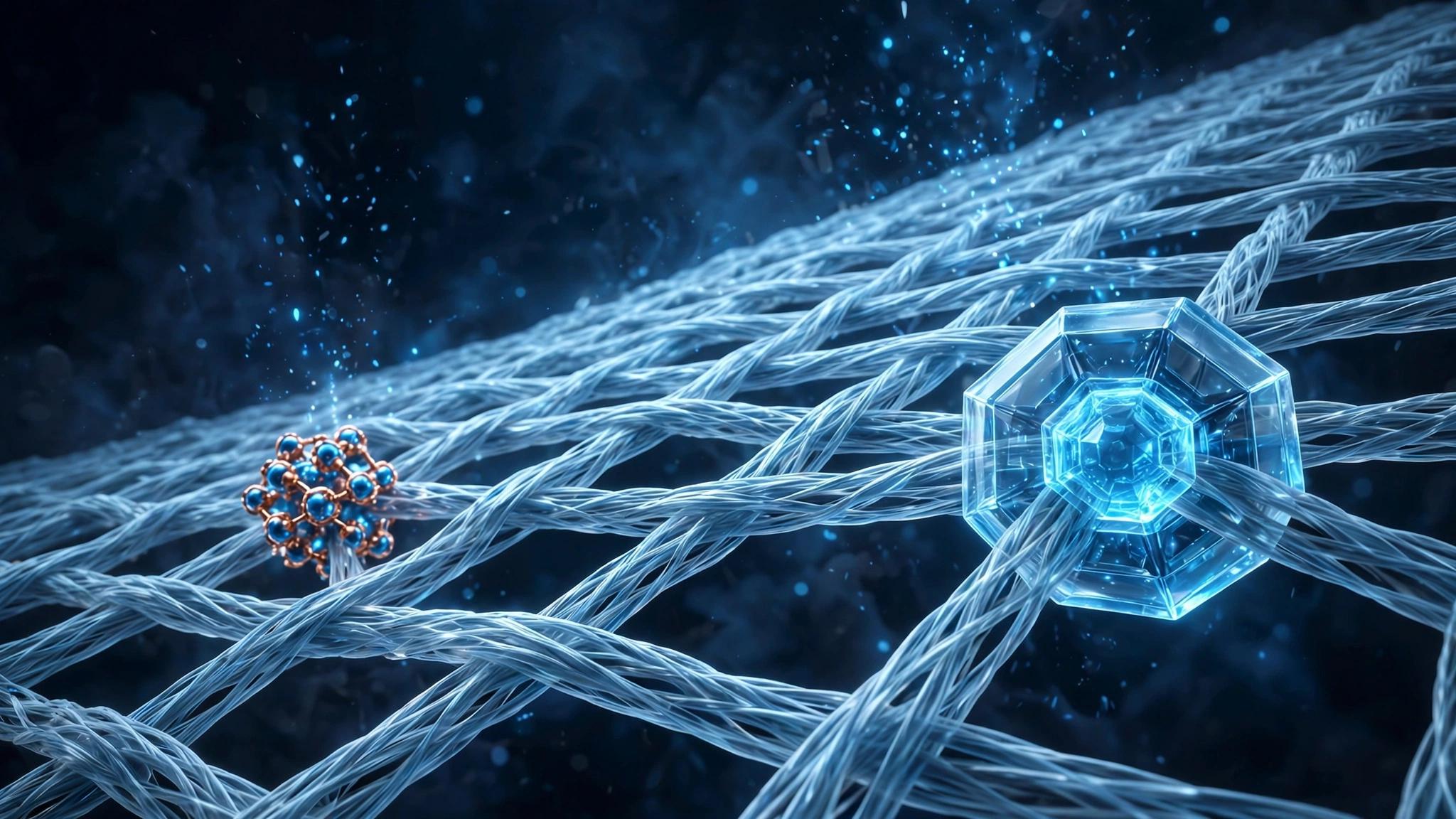
GHK-Cu and SNAP-8 answer different laboratory questions. GHK-Cu is a copper tripeptide studied around extracellular-matrix signalling and gene expression in fibroblast systems. SNAP-8 is an octapeptide copying part of SNAP-25, studied around SNARE-complex assembly and neurotransmitter-release models. Their mechanisms share almost no overlap in published research.
The second contrast is evidence depth, and it is just as sharp. GHK-Cu carries a multi-decade record across cell cultures, animal models, gene-expression datasets and human research settings. SNAP-8 carries a much thinner record, built mainly on developer cell assays, formulation work and reviews discussing its peptide family.
That asymmetry should shape how a laboratory reads every section below. Findings from one compound cannot transfer to the other, and findings from a related family member cannot transfer to SNAP-8 itself. Identity, mechanism and record belong to each molecule separately.
What Identities Separate These Two Compounds?
GHK-Cu is the copper(II) complex of glycyl-L-histidyl-L-lysine, a tripeptide first reported from human plasma in the nineteen seventies. The free peptide weighs about three hundred and forty daltons, and the specified research material is the copper complex, not the uncomplexed peptide alone in isolation.
SNAP-8 is acetyl octapeptide-3, a synthetic eight-residue peptide with an acetyl cap at one end and an amide at the other. Its sequence copies the opening segment of SNAP-25 and extends a shorter related fragment by two residues, alanine and aspartate, at its end.
Size alone separates their laboratory handling questions. GHK-Cu is a very small metallopeptide whose copper ion is part of its defined identity. SNAP-8 is roughly three times heavier, carries no metal ion, and depends on terminal caps that are part of its defined structure.
Origin separates them further. GHK occurs naturally in human plasma, saliva and urine, and its reported plasma levels decline with age in the review literature. SNAP-8 has no natural occurrence; it was designed as a synthetic cosmetic research ingredient by its developer.
NUPEPS PEPTIDES lists the two compounds separately for distinct research programmes in its catalogue: GHK-Cu 50MG and GHK-Cu 100MG for copper-peptide work, and SNAP-8 10MG for SNARE-mimic work, each supplied strictly as laboratory research material for in vitro study only.
How Do the Two Compounds Compare Side by Side?
| Feature | GHK-Cu | SNAP-8 |
|---|---|---|
| Identity | Copper(II) complex of glycyl-L-histidyl-L-lysine; copper tripeptide-1 | Acetyl octapeptide-3; synthetic octapeptide |
| Size | Tripeptide, about 340 daltons as free peptide; complex about 402 daltons | Octapeptide, about 1,075.2 grams per mole, formula C41H70N16O16S |
| Sequence basis | Gly-His-Lys, a naturally occurring plasma peptide sequence | Ac-Glu-Glu-Met-Gln-Arg-Arg-Ala-Asp-NH2, copying the SNAP-25 opening segment |
| Mechanism studied | Extracellular-matrix signalling, collagen-pathway and gene-expression modulation in fibroblast systems | Competitive SNAP-25 mimicry, SNARE-complex interference and release-model inhibition |
| Model systems | Fibroblast cultures, rodent wound models, gene-expression datasets, human research settings | Chromaffin-cell release assays, formulation systems, multi-ingredient product research |
| Evidence depth | Deep: five decades, multiple independent groups, primary studies and major reviews | Thin: mainly developer data and family reviews; no standalone controlled human study located |
| Verification check | Mass spectrometry for the copper complex mass, plus copper-aware batch documentation | Mass spectrometry for the full capped octapeptide mass near 1,075.2 grams per mole |
Read row by row, the table shows two compounds that belong in different experimental conversations. One is a metal complex studied as a signalling molecule in matrix biology. The other is a capped fragment studied as a competitor inside a protein assembly at nerve terminals.
How Is GHK-Cu Studied in Matrix and Gene-Expression Research?
The earliest GHK-Cu findings came from fibroblast cultures, the workhorse system for extracellular-matrix research. In that system, researchers measured how the copper complex changed collagen synthesis by existing cells, separating a signalling effect on synthesis from any simple change in cell number during culture.
Maquart and colleagues reported in nineteen eighty-eight that the tripeptide-copper complex stimulated collagen synthesis in fibroblast cultures at very low concentrations, with the strongest response in the nanomolar range. That short report became one of the most frequently cited primary findings in the entire copper-peptide literature.
Later work widened the matrix picture beyond collagen alone. Reviews summarise reported effects on glycosaminoglycans, decorin and the metalloproteinases that remodel matrix, together with their inhibitors. The consistent theme is regulation in both directions, synthesis and breakdown, rather than a single one-way increase in output.
A separate research layer is genomic. Using gene-expression datasets, reviewers reported that GHK influences expression across thousands of human genes, spanning pathways linked to tissue remodelling, antioxidant defence and inflammation. Breadth of that scale makes GHK-Cu a systems-level probe, not a single-pathway tool for laboratories.
The copper ion is central to how researchers interpret that breadth. GHK binds copper tightly for a peptide of its size, and one long-standing framework treats the complex as a copper-handling molecule whose metal delivery helps explain its activity across otherwise separate cellular systems studied.
Citations: Pickart L, Thaler MM. Tripeptide in human serum which prolongs survival of normal liver cells and stimulates growth in neoplastic liver. Nature New Biology. 1973. PMID: 4349963. Maquart FX, et al. Stimulation of collagen synthesis in fibroblast cultures by the tripeptide-copper complex glycyl-L-histidyl-L-lysine-Cu2+. FEBS Letters. 1988. PMID: 3169264. DOI: 10.1016/0014-5793(88)80509-X.
How Is SNAP-8 Studied in SNARE and Release Research?
SNAP-8 research begins at the nerve terminal, where three proteins assemble into the SNARE complex that drives vesicle fusion. SNAP-25 and syntaxin sit in the cell membrane, synaptobrevin sits in the vesicle membrane, and their assembly releases neurotransmitter contents in the model systems studied.
SNAP-8 was designed to compete inside that assembly. Because its sequence copies part of SNAP-25, the fragment can occupy the position the full protein would take, and a complex built around the fragment completes vesicle fusion less efficiently in cell-based release assays reported.
The foundational demonstration belongs to the shorter family member, not to SNAP-8 itself. Blanes-Mira and colleagues showed in two thousand and two that the six-residue fragment interfered with SNARE formation and stability and inhibited neurotransmitter release in cell systems, at much lower efficacy than botulinum toxin.
SNAP-8 extends that design by two residues, on the reasoning that a longer copy covers more of the natural binding surface and should compete more strongly. Developer-reported chromaffin-cell assays describe stronger release inhibition for the octapeptide, but no independent laboratory has published a replicated head-to-head comparison.
Two properties keep the mechanism claim narrow and honest. The fragment does not cleave or destroy SNAP-25, so its action in a model is competitive and reversible rather than enzymatic. Its size and water-loving character also make delivery through intact skin a separate unresolved question.
Citations: Blanes-Mira C, et al. A synthetic hexapeptide (Argireline) with antiwrinkle activity. International Journal of Cosmetic Science. 2002. PMID: 18498523. DOI: 10.1046/j.1467-2494.2002.00153.x. Note: this paper studied the six-residue fragment, not SNAP-8 itself.
How Do Their Model Systems Differ in Practice?
GHK-Cu models ask what a signalling peptide does to cells that build tissue scaffolding. Fibroblast cultures measure matrix output, rodent wound chambers measure connective-tissue accumulation in living tissue, and expression datasets measure transcript changes across the genome in the cell systems profiled by researchers.
SNAP-8 models ask a narrower physical question: whether a competing fragment changes a protein assembly step. Chromaffin cells provide the standard release readout, because their vesicle machinery mirrors the neuronal system while remaining workable in culture for repeated, controlled laboratory measurement across conditions.
Why Is the Evidence Depth So Uneven Between Them?
Time explains part of the gap. GHK was reported in nineteen seventy-three and characterised through the following decades by several research groups working independently. SNAP-8 arrived a generation later as a second-generation commercial ingredient, and its published footprint has remained small ever since its introduction.
Independence explains another part. The GHK-Cu record includes primary work from groups unconnected to its discoverer, including the Reims fibroblast programme, alongside reviews by the originating group. The SNAP-8 record leans heavily on its developer, which limits how far its strongest claims can travel.
Human research settings widen the gap further, and the distinction must stay precise. GHK-Cu preparations have a documented history in controlled human cosmetic research settings. SNAP-8 has no standalone controlled human study; its human figures come from developer material and multi-ingredient product research only.
NUPEPS PEPTIDES keeps the neighbouring comparisons separate for exactly this reason: GHK-Cu vs AHK-Cu weighs two copper tripeptides against each other, while SNAP-8 vs Argireline weighs two SNAP-25 mimics. This guide crosses those families without borrowing evidence across them.
Citations: Pickart L, Vasquez-Soltero JM, Margolina A. GHK peptide as a natural modulator of multiple cellular pathways in skin regeneration. BioMed Research International. 2015. PMID: 26236730. DOI: 10.1155/2015/648108. Pickart L, Margolina A. Regenerative and protective actions of the GHK-Cu peptide in the light of the new gene data. International Journal of Molecular Sciences. 2018. PMID: 29986520. DOI: 10.3390/ijms19071987.
What Does the Published Evidence Not Show?
The evidence does not show a head-to-head result. No published study located for this draft tested GHK-Cu and SNAP-8 in the same model, at matched conditions, with a shared readout. Any direct ranking of effect between them would therefore be invention, not synthesis of literature.
The evidence also does not transfer sideways within families. The two thousand and two SNARE paper studied a six-residue fragment, and the two thousand and thirteen controlled human study in this family studied that same shorter fragment. Neither result is evidence about the eight-residue SNAP-8 molecule itself.
For GHK-Cu, breadth is not the same as certainty. Much of its review literature comes from one research lineage with a long-standing programme interest, its strongest primary findings sit in cell and animal models, and broad gene modulation does not establish a specific outcome anywhere.
For SNAP-8, the most repeated human figure in secondary sources traces to developer material rather than peer-reviewed work, where the strongest individual result is often quoted without the smaller group average beside it. A careful laboratory cites that figure as developer data, or not at all.
Citations: Wang Y, et al. The anti-wrinkle efficacy of argireline, a synthetic hexapeptide, in Chinese subjects: a randomized, placebo-controlled study. American Journal of Clinical Dermatology. 2013. PMID: 23417317. Note: this study examined the shorter fragment; its findings do not transfer to SNAP-8.
How Should a Laboratory Choose Between Them?
Start from the model, not from the catalogue category both compounds happen to share. A fibroblast, matrix or gene-expression question belongs to the GHK-Cu literature, because that is where its comparators, expected behaviours and interpretive frameworks were actually generated over five decades of published work.
A SNARE-assembly, vesicle-fusion or release-assay question belongs to the SNAP-25 mimic literature, where SNAP-8 is the longer fragment available for study. The single-compound guide What Is SNAP-8? sets out that design logic, its assay record and its limits in full detail for researchers.
Then weigh the citation burden the work must carry. A programme needing peer-reviewed primary studies behind its material choice finds that support behind GHK-Cu. A programme built on SNAP-8 should state plainly that key performance claims rest on developer-reported assays awaiting independent replication elsewhere.
How Do Researchers Verify Each Material Before an Experiment?
Verification starts with mass spectrometry, and here the two compounds demand distinct checks. GHK-Cu must match the expected mass of the copper complex, roughly four hundred and two daltons, confirming both the tripeptide and its bound copper together in a single identity measurement.
SNAP-8 must instead match the full capped octapeptide mass near one thousand and seventy-five point two grams per mole. That measurement confirms the acetyl cap, the terminal amide and all eight residues together, and separates the octapeptide cleanly from its shorter family relative.
Purity and quantity are assessed by analytical chromatography, most commonly reversed-phase HPLC, reported for the specific batch supplied. NUPEPS PEPTIDES publishes batch Certificates of Analysis at nupeps.com/coas and tests every batch for purity, quantity and sterility only, with no additional testing categories claimed.
A certificate that is not tied to the exact batch in hand does not meet the working standard for either compound. Matching the batch identifier on the material to the batch identifier on its certificate is the step that connects published identity to supplied material.
What Questions Do Researchers Ask Most Often?
Are GHK-Cu and SNAP-8 studied for the same laboratory purpose?
No. GHK-Cu is studied around extracellular-matrix signalling and gene expression in fibroblast and related systems. SNAP-8 is studied around SNARE-complex competition and neurotransmitter-release models at nerve terminals. They share a catalogue category, not a mechanism, a model system or an evidence base.
Which compound has the deeper published record?
GHK-Cu, by a wide margin. Its record spans five decades, several independent groups, primary studies in cell and animal models, gene-expression analyses and major reviews. SNAP-8 has a thinner record built mainly on developer assays, formulation discussion and family-level reviews in the literature.
Does the foundational SNARE paper provide evidence about SNAP-8 itself?
No. The two thousand and two Blanes-Mira paper studied the six-residue fragment that SNAP-8 was later extended from. It establishes the family mechanism and the design rationale for the longer molecule, but its measurements belong to the shorter peptide and cannot be cited as SNAP-8 results.
Why does the copper ion matter for GHK-Cu verification?
Because the specified material is the complex, not the free peptide. Material that has lost its copper, or that carries unrelated copper contamination, is not the defined compound even when its peptide portion measures pure. Mass spectrometry against the complex mass checks that distinction directly.
Has any study compared GHK-Cu and SNAP-8 directly?
No published head-to-head study was located for this draft. The two compounds have never, in the record reviewed here, been tested in one shared model with one shared readout. Comparisons between them are therefore structural and evidential, describing different mechanisms and different depths of literature.
How can a researcher check a batch before starting work?
Request the batch-specific Certificate of Analysis and confirm three things: mass spectrometry identity against the expected mass for that compound, chromatographic purity for that batch, and reported quantity and sterility. NUPEPS PEPTIDES publishes its batch certificates at nupeps.com/coas for that checking process.
What Should a Laboratory Take From This Comparison?
GHK-Cu and SNAP-8 are a study in contrasts that a shared category label tends to hide. One is a small copper complex with a deep, multi-model record in matrix and gene-expression research. The other is a larger designed fragment with a narrow, developer-led release-assay record.
Whichever compound an experiment calls for, the sourcing standard is identical: identity confirmed against the correct expected mass, purity and quantity verified for the specific batch, and sterility reported in that batch record. This article is educational material about research compounds, not medical advice.
Frequently asked questions
Is GHK-Cu vs SNAP-8: Cosmetic Research Compared for human use?
No. All compounds discussed in this guide are strictly for laboratory research use only. Not for human or veterinary use.
Where can I find the Certificate of Analysis?
Certificates of Analysis are available in our COA library. Each batch is third-party tested for purity and identity.
How should research compounds be stored?
Store according to the vial label instructions. Generally, lyophilized compounds should be kept in a cool, dry place away from light. Refer to the specific product documentation for details.
All products are intended strictly for laboratory research and in-vitro use only. Not for human or veterinary consumption, diagnostic, or therapeutic use. Products are not drugs, foods, cosmetics, or dietary supplements and may not be misbranded, misused, or mislabeled.