Comparisons
Epitalon vs Pinealon: Two Bioregulator Peptides Compared
By NUPEPS Research TeamNovember 2, 2026
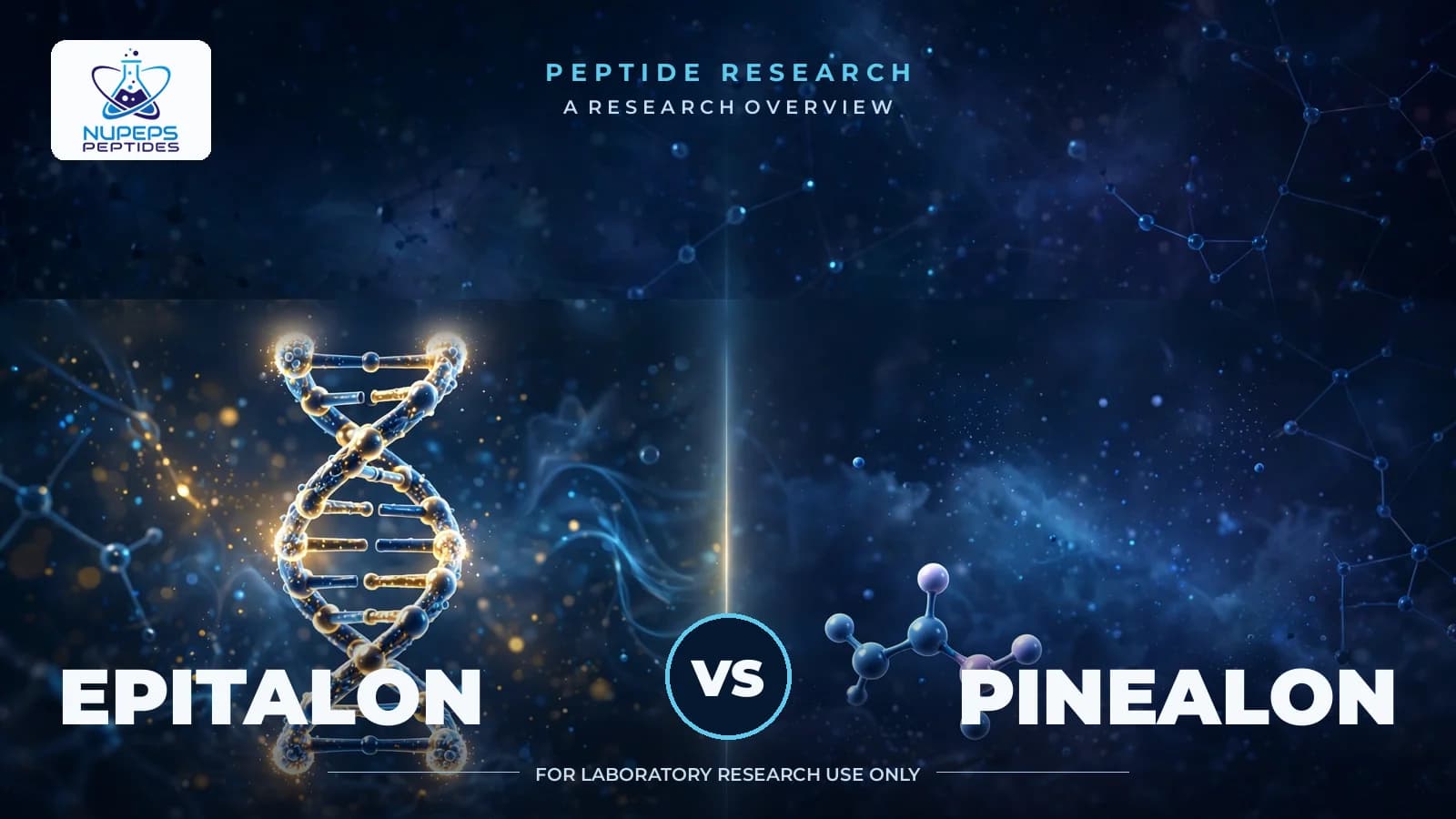
Epitalon and Pinealon are routinely shelved together, and it is easy to see why: both are tiny synthetic peptides from the same Russian research program, both are classed as "bioregulators," and their names differ by little more than a syllable. Underneath the resemblance, they are different molecules with different origins, different chemistry, and different bodies of literature — one a four-residue peptide modeled on a pineal extract and studied for telomerase and aging biology, the other a three-residue peptide derived from brain-cortex preparations and studied for neuronal gene regulation. This comparison works through the two side by side: their shared framework, their structures, the research each one actually carries, and the analytical points that separate them in the laboratory — including the naming trap that catches almost everyone the first time.
The Short Answer
Epitalon is a tetrapeptide — Ala–Glu–Asp–Gly (AEDG) — synthesized to reproduce the activity of Epithalamin, a pineal-gland extract. Its headline research association is a 2003 report that it activated telomerase in cultured human cells, and its literature sits in aging and longevity biology. Pinealon is a tripeptide — Glu–Asp–Arg (EDR) — that emerged from work on brain-cortex polypeptide preparations. Its literature sits in neuroscience: neuronal gene expression, signaling through MAPK/ERK pathways, and neuroprotection in models of brain stress. And the trap: despite what its name suggests, Pinealon is not the pineal peptide of the pair. Epitalon is.
Side by Side
- Class: both are short peptide bioregulators from the Khavinson program — Epitalon a tetrapeptide, Pinealon a tripeptide
- Sequence: Epitalon, Ala–Glu–Asp–Gly (AEDG); Pinealon, Glu–Asp–Arg (EDR)
- Molecular weight: Epitalon approximately 390.35 Da; Pinealon approximately 418.40 Da
- Source extract: Epitalon modeled on Epithalamin (pineal gland); Pinealon derived from brain-cortex preparations in the Cortexin lineage
- Headline research area: Epitalon — telomerase activity and aging biology; Pinealon — neuronal gene expression and neuroprotection
- Charge at neutral pH: Epitalon net negative (two acidic side chains, no basic residue); Pinealon mixed (the same acidic pair, ending in basic arginine)
- Literature depth: Epitalon — roughly 25 years of accumulated work; Pinealon — a much smaller body of studies
- In the NUPEPS PEPTIDES catalog: Epitalon 50MG and Pinealon 20MG, supplied for laboratory research use
The Shared Framework: The Khavinson Bioregulators
Both peptides come from one research logic, developed over decades by Vladimir Khavinson and colleagues at the St. Petersburg Institute of Bioregulation and Gerontology. The program began from tissue extracts — preparations from animal organs that appeared to carry biological activity — and asked whether short peptide sequences within them were responsible. Where a candidate sequence was identified, it was synthesized as a single defined molecule and studied on its own. The pineal extract Epithalamin yielded the tetrapeptide Epitalon (also written Epithalon). Brain-cortex preparations in the Cortexin lineage yielded, among others, the tripeptide Pinealon. The framework's proposed mechanism is also shared: these ultrashort peptides are hypothesized to interact with DNA and chromatin and thereby influence gene expression in the tissues they are associated with — a regulatory model quite different from receptor-driven hormone signaling. What the framework does not make them is interchangeable: each sequence was tied to a different tissue and a different set of experiments, and the literatures that grew from them diverged accordingly.
Structure and Chemistry: Three Residues Against Four
The structural comparison is unusually legible, because the two sequences nearly overlap. Epitalon runs Ala–Glu–Asp–Gly; Pinealon runs Glu–Asp–Arg. The Glu–Asp acidic pair sits at the center of both. Around it, the differences are decisive. Epitalon flanks the pair with two small, uncharged residues — alanine before, glycine after — leaving the molecule net negatively charged at neutral pH. Pinealon drops the flanks and ends the chain in arginine, a strongly basic residue, giving a shorter molecule with a mixed charge profile and a higher mass despite having one fewer residue (418.40 Da against Epitalon's 390.35 Da — arginine is heavy). In the originating group's own modeling, that terminal arginine is treated as functionally important: it is the feature proposed to govern how EDR-type peptides associate with DNA and are carried into cells, including in work on amino-acid transporters as a route of entry. Whether or not a given laboratory works within that model, the charge contrast is a hard chemical fact, and it shows up practically — in chromatographic behavior, in solubility handling, and in how each peptide is expected to interact with the surfaces and solvents of a laboratory workflow.
Research Profiles: Telomeres Against Neurons
Epitalon's literature is the larger of the two, accumulated over roughly twenty-five years, and its center of gravity is aging biology. The anchor finding is a 2003 report from the originating group that the peptide switched on telomerase — the enzyme that maintains telomere length — in cultured human somatic cells, a result that fixed Epitalon's identity in the field and still frames most discussion of it. Around that anchor sit studies in gerontology models, circadian and melatonin-related neuroendocrine questions reflecting the peptide's pineal origin, and a small number of human pilot observations from the same research lineage. A fuller account is given in this site's existing guide to Epitalon and telomere research.
Pinealon's literature is smaller and points the other way — into the brain. The published work concentrates on neurons: regulation of gene expression in neuronal cells, antioxidant and anti-apoptotic effects in models of oxidative stress, signaling through the MAPK/ERK pathway, and studies in Alzheimer's-disease models and other settings of brain injury and stress. Where Epitalon asks questions about cellular aging, Pinealon asks questions about neuronal survival — which is why, despite the shared framework and the confusing name, the two are complements in a bioregulator catalog rather than substitutes. A laboratory studying telomere biology reaches for AEDG; a laboratory studying neuronal gene expression reaches for EDR; an experiment designed for one cannot be run with the other.
One further contrast follows from the two profiles and is worth stating for catalog readers: the compounds also differ in how they are positioned within this site's own coverage. Epitalon already carries a dedicated guide to its telomere research, reflecting its larger literature; Pinealon appears here for the first time, in this comparison, reflecting its smaller one. That asymmetry is itself information — the depth of coverage tracks the depth of the published record behind each sequence, not the framework's enthusiasm for it.
The Evidence, Stated Plainly for Both
A fair comparison has to apply the same standard to both sides, and the standard here is caution. Neither peptide is an approved medicine. For both, the great majority of the data is preclinical — cell culture and animal models — and for both, the literature is concentrated in a single research lineage: the institute that created them and the journals, many of them Russian-language or specialist gerontology publications, in which that lineage publishes. Independent replication by unaffiliated groups is limited for Epitalon and thinner still for Pinealon, and neither compound carries large, modern, randomized human trials. Epitalon's telomerase report, Pinealon's neuroprotection findings — each is best read as a documented result from one program awaiting the broader confirmation that would settle it. That is not a dismissal; it is the accurate description of where this corner of peptide science stands, and it is the context in which both reagents are supplied: for laboratory research that tests, extends, or challenges the existing record.
Analytical Verification
The verification picture for ultrashort peptides has its own character. Identity by mass spectrometry should confirm Epitalon at approximately 390.35 Da and Pinealon at approximately 418.40 Da — masses far enough apart that the two cannot be confused with each other, but small enough that a single-residue deletion or addition product lands close by: a des-Ala Epitalon impurity, for instance, differs by only 71 Da and must be resolved, not assumed away. Purity by HPLC therefore carries unusual weight for molecules of this size, quantifying the full-length defined sequence against truncated and extended synthesis products that share most of its chemistry. Net peptide content completes the specification, and matters proportionally more here than for large peptides, because counter-ion and water mass is a larger fraction of a 400-dalton molecule's vial weight. As with any peptide certificate of analysis, the informative document reports identity, purity, and content for the specific lot in hand.
Frequently Asked Questions
Is Pinealon the pineal peptide? No — despite the name. Pinealon derives from brain-cortex preparations and is studied in neuroscience. The pineal-derived peptide of the pair is Epitalon, modeled on the pineal extract Epithalamin.
Are Epitalon and Pinealon interchangeable? No. They differ in sequence (AEDG vs EDR), source tissue, charge profile, and research literature — telomerase and aging biology on one side, neuronal gene expression and neuroprotection on the other.
Which has more research behind it? Epitalon, by a wide margin — roughly twenty-five years of accumulated studies against Pinealon's much smaller body of work. For both, however, the evidence is predominantly preclinical and concentrated in the originating research program.
How is identity confirmed for a specific lot? By mass spectrometry against the expected mass (approximately 390.35 Da for Epitalon, 418.40 Da for Pinealon), together with HPLC purity and a stated net peptide content — the three-part specification described in our guide to reading a peptide COA.
Frequently asked questions
Is Epitalon vs Pinealon: Two Bioregulator Peptides Compared for human use?
No. All compounds discussed in this guide are strictly for laboratory research use only. Not for human or veterinary use.
Where can I find the Certificate of Analysis?
Certificates of Analysis are available in our COA library. Each batch is third-party tested for purity and identity.
How should research compounds be stored?
Store according to the vial label instructions. Generally, lyophilized compounds should be kept in a cool, dry place away from light. Refer to the specific product documentation for details.
All products are intended strictly for laboratory research and in-vitro use only. Not for human or veterinary consumption, diagnostic, or therapeutic use. Products are not drugs, foods, cosmetics, or dietary supplements and may not be misbranded, misused, or mislabeled.