Research Guides
What Is Kisspeptin-10? KISS1R and GnRH Research Guide
By NUPEPS Research TeamNovember 12, 2026
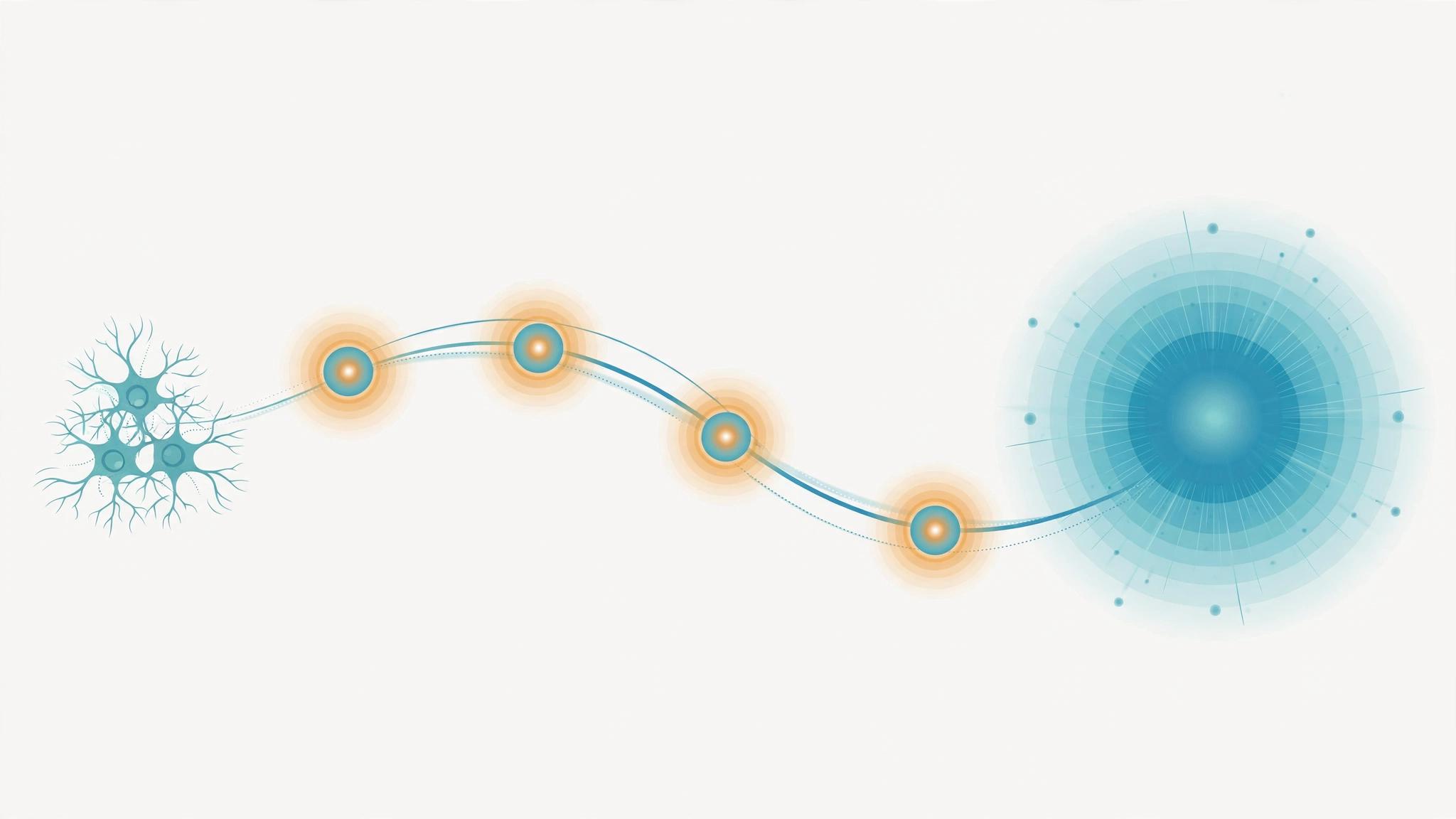
Kisspeptin-10 is a ten-amino-acid peptide that forms the shared C-terminal end of every kisspeptin produced from the KISS1 gene. It is the shortest kisspeptin fragment that fully activates the kisspeptin receptor, KISS1R, and through that receptor it sits one step above gonadotropin-releasing hormone (GnRH) in the signaling chain that controls the reproductive axis.
That position is what makes kisspeptin-10 scientifically important. In 2003, two independent groups showed that loss-of-function mutations in KISS1R prevent normal puberty, establishing kisspeptin signaling as the upstream gatekeeper of the hypothalamic-pituitary-gonadal axis. This guide reviews what kisspeptin-10 is, how it acts at KISS1R, how the pulse-generating neuron network around it works, what the published research record actually shows, and how laboratories verify the material they work with.
What Is Kisspeptin-10, Exactly?
Kisspeptin-10 is the minimal active piece of a larger precursor. The KISS1 gene encodes a 145-amino-acid precursor protein that is processed into several C-terminal fragments: kisspeptin-54, kisspeptin-14, kisspeptin-13, and kisspeptin-10. All four share the same final ten residues, and that shared decapeptide is sufficient for full receptor activation.
- Also written as: KP-10; the C-terminal decapeptide of metastin
- Length: 10 amino acids, C-terminally amidated
- Sequence: Tyr-Asn-Trp-Asn-Ser-Phe-Gly-Leu-Arg-Phe-NH2 (YNWNSFGLRF-NH2)
- Molecular weight: Approximately 1,302.4 g/mol
- Molecular formula: C63H83N17O14
- CAS number: 374675-21-5
- Parent molecule: The KISS1 gene product (145-amino-acid precursor)
- Class: KISS1R (GPR54) agonist; RF-amide family peptide
The C-terminal Arg-Phe-NH2 motif places kisspeptin in the RF-amide peptide family, and the amide group is not decorative: removing it sharply reduces receptor binding. For researchers, the practical consequence is that kisspeptin-10 delivers the full signaling activity of the much larger kisspeptin-54 in a molecule small enough to synthesize, characterize, and standardize precisely.
Where Does Kisspeptin Come From?
The KISS1 gene was first identified in the 1990s in Hershey, Pennsylvania, in research on metastasis suppression, which is why its longest product is also called metastin. The reproductive role came later and changed the field: in 2003, Seminara and colleagues and, independently, de Roux and colleagues reported that inactivating mutations in the kisspeptin receptor caused idiopathic hypogonadotropic hypogonadism, a failure to enter puberty.
Citation: Seminara SB, et al. The GPR54 gene as a regulator of puberty. New England Journal of Medicine. 2003. [PubMed PMID: 14573733](https://pubmed.ncbi.nlm.nih.gov/14573733/)
That genetic evidence did what pharmacology alone could not: it proved the pathway is necessary, not merely active. Activating mutations reported afterward, associated with precocious puberty, completed the picture from the other direction. Kisspeptin neurons are concentrated in two hypothalamic regions, the arcuate nucleus and the anteroventral periventricular nucleus, and they project directly onto GnRH neurons.
How Does Kisspeptin-10 Work at KISS1R?
Kisspeptin-10 binds KISS1R, formerly called GPR54, a Gq/11-coupled receptor expressed on GnRH neurons. Receptor activation stimulates phospholipase C, generating inositol trisphosphate and diacylglycerol, which raise intracellular calcium and activate protein kinase C. The GnRH neuron depolarizes and releases GnRH in a pulse into the portal circulation.
GnRH then acts at the pituitary, which releases luteinizing hormone and follicle-stimulating hormone, and those gonadotropins act at the gonads. Kisspeptin-10 therefore works two steps above the sex steroids and one step above GnRH itself. A consistent experimental finding underlines the point: kisspeptin does not stimulate gonadotropin release from isolated pituitary tissue, because its target sits in the hypothalamus.
Sustained exposure produces the opposite pattern over time, as KISS1R desensitizes and internalizes through beta-arrestin pathways. That contrast, brief pulses activating the axis while continuous exposure dampens it, is central to how researchers design experiments with this peptide, and it mirrors the pulsatile logic of the axis itself.
What Are KNDy Neurons and Why Do They Matter?
Many arcuate kisspeptin neurons co-express two other signaling peptides, neurokinin B and dynorphin, and are known collectively as KNDy neurons. The current model of pulse generation assigns each co-transmitter a role: neurokinin B provides stimulatory feedback that synchronizes the network, kisspeptin carries the output signal to GnRH neurons, and dynorphin provides the inhibitory signal that terminates each pulse.
This network model explains a clinical observation that single-molecule models could not: mutations affecting neurokinin B signaling produce a similar reproductive phenotype to KISS1R mutations. For laboratory research, the KNDy framework turns kisspeptin-10 from a simple agonist into a probe for studying how a neuronal network generates a hormonal rhythm.
How Do the Kisspeptin Forms Compare?
| Form | Length | Relationship to kisspeptin-10 | Reported half-life |
|---|---|---|---|
| Kisspeptin-54 | 54 amino acids | Longest processed form; ends with the kisspeptin-10 sequence | Longer than kisspeptin-10; the form used in most controlled human physiology studies |
| Kisspeptin-14 | 14 amino acids | Intermediate fragment sharing the same C-terminus | Short |
| Kisspeptin-13 | 13 amino acids | Intermediate fragment sharing the same C-terminus | Short |
| Kisspeptin-10 | 10 amino acids | The minimal fully active fragment | Approximately 4 minutes in human plasma |
Read as a set, the four forms answer a structure-activity question: how much of the precursor does the receptor actually read? The answer the literature gives is the last ten residues. Kisspeptin-10's very short half-life limits it as anything other than a research tool, but for receptor pharmacology and network studies that brevity is often the point.
What Has the Published Research Found?
The human record for kisspeptin consists mainly of small physiology studies rather than therapeutic trials. In healthy volunteers, kisspeptin administration raises luteinizing hormone rapidly, with downstream changes in follicle-stimulating hormone and sex steroids, confirming in humans the axis position first mapped in animal work. Most controlled studies used kisspeptin-54, the longer form, rather than kisspeptin-10.
Animal and in vitro work remains the deeper literature: GnRH neuron electrophysiology, pulse-frequency studies, and developmental work on puberty onset all use kisspeptin peptides as defined inputs to the axis. The honest summary is narrow. Kisspeptin signaling is necessary for normal reproductive function, kisspeptin-10 fully activates its receptor, and no kisspeptin product is an approved medicine in any indication.
How Is Kisspeptin-10 Used in Laboratory Research Today?
Kisspeptin-10 has no drug approval, and its present-day role is as a research compound. Laboratories use it in several defined ways:
- Axis pharmacology: probing how KISS1R activation drives GnRH release in hypothalamic cell and tissue models.
- Pulse-network studies: testing the KNDy model of pulse generation with a defined, short-acting input signal.
- Receptor characterization: a reference agonist for binding, signaling, and desensitization assays at KISS1R.
- Structure-activity work: the minimal scaffold against which longer forms and analogs are compared.
In each role, the experimental variable is signaling behavior, so the identity and purity of the material are part of the experimental design rather than an afterthought, which leads directly to the verification question below.
How Do Researchers Verify Kisspeptin-10 Material?
Two analytical checks are standard for a peptide of this size. Mass spectrometry should confirm a molecular identity consistent with the amidated decapeptide at approximately 1,302.4 g/mol, distinguishing intact kisspeptin-10 from the non-amidated acid form, which is inactive by comparison and differs in mass. Reversed-phase HPLC is the standard purity method, quantifying the main peak against deletion sequences and other synthesis-related impurities.
Because a single missing residue in a ten-residue peptide removes a tenth of the molecule, researchers look for a batch-specific Certificate of Analysis documenting HPLC purity and mass spectrometry identity for the exact batch supplied. NUPEPS PEPTIDES publishes batch Certificates of Analysis for its research materials, available at nupeps.com/coas, and our guide to reading a peptide COA explains how to check one line by line. NUPEPS PEPTIDES tests every batch for purity, quantity, and sterility.
Kisspeptin-10 Research Material at NUPEPS PEPTIDES
NUPEPS PEPTIDES supplies kisspeptin-10 as a lyophilized research material, Kisspeptin-10 10MG, for laboratory and in vitro research use only. Each batch is accompanied by its Certificate of Analysis, so the material can be matched to its analytical record before it enters an experiment. Kisspeptin-10 is supplied strictly as a research chemical; it is not a drug, and it is not for human or veterinary use.
Frequently Asked Questions
What is kisspeptin-10 made of?
Kisspeptin-10 is a synthetic copy of the final ten amino acids shared by all kisspeptins processed from the KISS1 gene product: Tyr-Asn-Trp-Asn-Ser-Phe-Gly-Leu-Arg-Phe, with an amide group at the C-terminus. That decapeptide is the shortest fragment that retains full activity at the kisspeptin receptor, KISS1R.
Is kisspeptin-10 the same as GnRH?
No. GnRH is a separate decapeptide released by hypothalamic neurons into the portal blood, where it acts on the pituitary. Kisspeptin-10 acts one step earlier: it binds KISS1R on those same GnRH neurons and prompts them to release GnRH in pulses, which is why kisspeptin is described as the axis gatekeeper.
Why is kisspeptin-10 used in research instead of kisspeptin-54?
Because it is the minimal fully active fragment. Kisspeptin-10 delivers the complete KISS1R signal in a small, precisely characterizable molecule, which suits receptor assays and network studies. Its plasma half-life of roughly four minutes is too short for most other settings, which is why longer kisspeptin-54 appears in most controlled human physiology studies.
Is kisspeptin-10 an approved drug?
No. No kisspeptin product holds a marketing authorization from the FDA, the EMA, or any other major regulator for any indication. Kisspeptin-10 is sold only as a research chemical for laboratory and in vitro use, and the human literature consists of small physiology studies, not therapeutic trials.
How can a researcher check kisspeptin-10 quality before an experiment?
Ask for the batch-specific Certificate of Analysis and check two things: mass spectrometry identity matching the expected molecular weight of about 1,302.4 g/mol for the amidated peptide, and HPLC purity of at least 99 percent for the batch actually supplied. A generic specification sheet that is not tied to the batch is not a substitute.
Conclusion
Kisspeptin-10 is the minimal key to one of the best-validated switches in endocrinology: ten residues that carry the full KISS1R signal, backed by human genetic evidence that the pathway it activates is required for puberty and reproductive function. Its minutes-long half-life makes it a laboratory instrument rather than anything else, and within that role it remains a precise probe of GnRH pulse biology.
For laboratories sourcing kisspeptin-10 today, the standard that matches its literature is documentation: identity confirmed by mass spectrometry, purity of at least 99 percent by HPLC, and a Certificate of Analysis issued for the specific batch in hand. Material verified that way can be used with confidence in the experiments the compound was characterized for. This article is educational material about a research compound and is not medical advice.
Frequently asked questions
Is What Is Kisspeptin-10? KISS1R and GnRH Research Guide for human use?
No. All compounds discussed in this guide are strictly for laboratory research use only. Not for human or veterinary use.
Where can I find the Certificate of Analysis?
Certificates of Analysis are available in our COA library. Each batch is third-party tested for purity and identity.
How should research compounds be stored?
Store according to the vial label instructions. Generally, lyophilized compounds should be kept in a cool, dry place away from light. Refer to the specific product documentation for details.
All products are intended strictly for laboratory research and in-vitro use only. Not for human or veterinary consumption, diagnostic, or therapeutic use. Products are not drugs, foods, cosmetics, or dietary supplements and may not be misbranded, misused, or mislabeled.