Research Guides
What Is Ipamorelin? Complete Research Guide
4 de outubro de 2026
## Introduction
Among growth hormone secretagogues studied in laboratory settings, ipamorelin occupies a distinctive position. Described in the published literature as the first selective growth hormone secretagogue, it was developed through a deliberate chemistry program aimed at producing a compound that stimulates growth hormone (GH) release through the ghrelin receptor while minimizing activity on other hormonal axes. This selectivity — particularly its lack of effect on adrenocorticotropic hormone (ACTH) and cortisol at GH-releasing concentrations — is the central theme of the ipamorelin research literature.
This guide reviews ipamorelin's chemical structure, its mechanism of action at the ghrelin receptor (GHSR-1a), and what published preclinical studies have reported. All discussion is framed around laboratory research; ipamorelin is a research compound and is not approved for human or veterinary use.
## What Is Ipamorelin? Chemical Structure
Ipamorelin (development code NNC 26-0161; CAS 170851-70-4) is a synthetic pentapeptide with the amino acid sequence **Aib-His-D-2-Nal-D-Phe-Lys-NH2**, where Aib is alpha-aminoisobutyric acid and D-2-Nal is D-2-naphthylalanine. Its molecular formula is C₃₈H₄₉N₉O₅, with a molecular weight of approximately 711.85 g/mol.
The compound emerged from a medicinal chemistry program at Novo Nordisk that systematically modified the growth hormone-releasing peptide (GHRP) scaffold. Notably, ipamorelin was identified within a series of compounds lacking the central Ala-Trp dipeptide of GHRP-1 — a structural departure that proved critical to its selectivity profile. The incorporation of the non-natural amino acids Aib and D-2-naphthylalanine contributes to its potency at the target receptor while the overall pentapeptide framework keeps the molecule compact relative to larger GH-axis peptides.
In laboratory supply, ipamorelin is typically provided as a lyophilized powder, with identity and purity verified by high-performance liquid chromatography (HPLC) and mass spectrometry, consistent with standard research-peptide quality documentation.
## Mechanism of Action: The Ghrelin Receptor (GHSR-1a)
Ipamorelin acts as an agonist at the growth hormone secretagogue receptor type 1a (GHSR-1a), more commonly known as the ghrelin receptor. This receptor is expressed in the anterior pituitary and hypothalamus, where it serves as the endogenous target of ghrelin, the stomach-derived hormone involved in GH regulation.
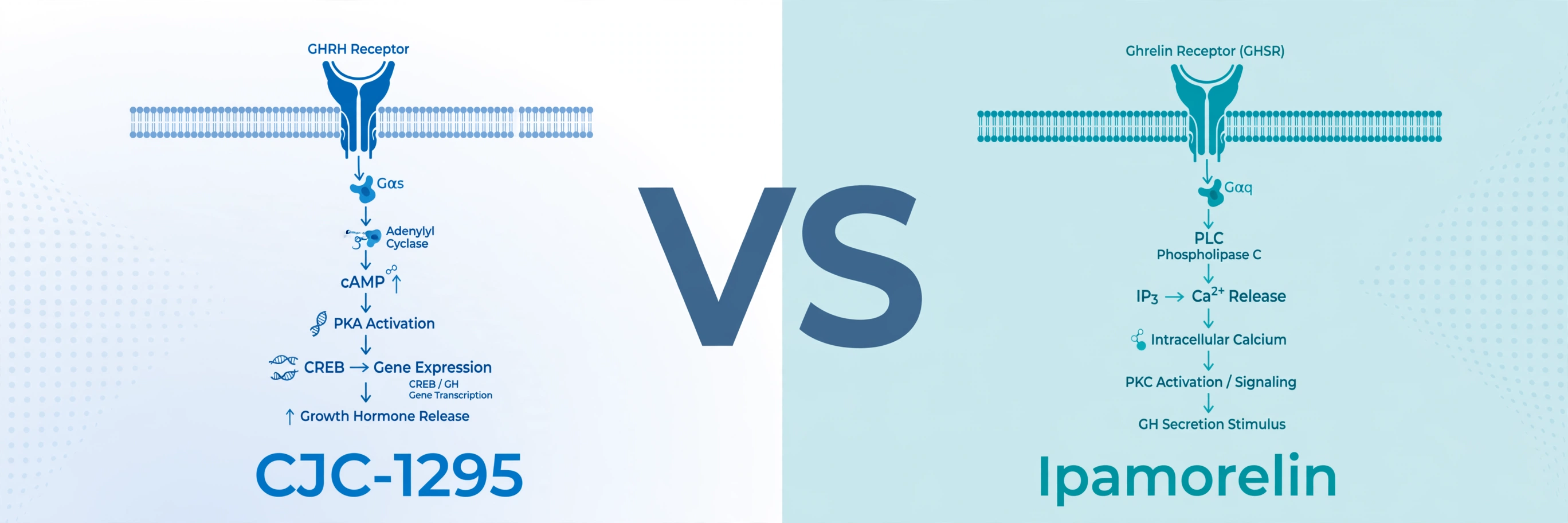
When ipamorelin binds GHSR-1a on pituitary somatotrophs, it triggers intracellular signaling that culminates in the release of stored growth hormone into circulation. Pharmacological profiling with GHRP and GHRH antagonists has demonstrated that ipamorelin stimulates GH release via the GHRP-like receptor pathway, consistent with other compounds in this class.
What distinguishes ipamorelin mechanistically is what it does *not* do. In the foundational characterization study, researchers tested ipamorelin's effects on a panel of pituitary and adrenal hormones in swine. While the related compounds GHRP-6 and GHRP-2 increased plasma ACTH and cortisol, ipamorelin did not release ACTH or cortisol at levels significantly different from those observed following GHRH stimulation — and this held true even at doses more than 200-fold higher than the ED₅₀ for GH release. None of the secretagogues tested affected FSH, LH, prolactin, or TSH plasma levels.
This selectivity is the defining pharmacological feature of ipamorelin and the reason it is frequently described as the first *selective* growth hormone secretagogue.
## What the Research Shows: Published Preclinical Findings
### Potency and Efficacy of GH Release
The original characterization by Raun and colleagues (1998) established ipamorelin's GH-releasing credentials across multiple experimental systems. In vitro, ipamorelin released GH from primary rat pituitary cells with potency and efficacy similar to GHRP-6. In anesthetized rats, it released GH with potency and efficacy comparable to GHRP-6. In conscious swine, ipamorelin released GH with an ED₅₀ of approximately 2.3 nmol/kg — again closely comparable to GHRP-6, though GHRP-2 displayed higher potency with lower efficacy in the same model.
> **Citation:** Raun K, Hansen BS, Johansen NL, Thøgersen H, Madsen K, Ankersen M, Andersen PH. "Ipamorelin, the first selective growth hormone secretagogue." *European Journal of Endocrinology*. 1998;139(5):552-561. [PubMed PMID: 9849822](https://pubmed.ncbi.nlm.nih.gov/9849822/)
### Effects on Bone Formation Under Glucocorticoid Exposure
A 2001 study by Andersen and colleagues investigated whether ipamorelin could counteract the catabolic effects of glucocorticoids on skeletal muscle and bone in adult rats. Groups of 8-month-old female rats received methylprednisolone alone, ipamorelin alone, or the combination for three months. The maximum tetanic tension of the calf muscles increased significantly, and the periosteal bone formation rate increased four-fold, in animals receiving both glucocorticoid and ipamorelin compared with glucocorticoid alone. The authors concluded that the decrease in muscle strength and bone formation observed in glucocorticoid-treated rats was counteracted by simultaneous administration of the GH secretagogue.
> **Citation:** Andersen NB, Malmlöf K, Johansen PB, Andreassen TT, Ørtoft G, Oxlund H. "The growth hormone secretagogue ipamorelin counteracts glucocorticoid-induced decrease in bone formation of adult rats." *Growth Hormone & IGF Research*. 2001;11(5):266-272. [PubMed PMID: 11735244](https://pubmed.ncbi.nlm.nih.gov/11735244/)
### Longitudinal Bone Growth
Johansen and colleagues (1999) examined ipamorelin's effects on longitudinal bone growth rate, body weight, and GH release in adult female rats. Ipamorelin was administered subcutaneously three times daily for 15 days at doses of 0, 18, 90, and 450 µg/day. Longitudinal bone growth rate in the proximal tibia metaphysis increased dose-dependently from 42 µm/day in the vehicle group to 44, 50, and 52 µm/day in the treatment groups. A pronounced dose-dependent effect on body weight gain was also observed. Notably, treatment did not affect total IGF-I levels, IGF binding proteins, or serum markers of bone formation and resorption in this study.
> **Citation:** Johansen PB, Nowak J, Skjaerbaek C, Rasmussen P, Andreassen TT. "Ipamorelin, a new growth-hormone-releasing peptide, induces longitudinal bone growth in rats." *Growth Hormone & IGF Research*. 1999;9(2):106-113. [PubMed PMID: 10373343](https://pubmed.ncbi.nlm.nih.gov/10373343/)
### Pharmacokinetic Notes
Published pharmacokinetic evaluations have characterized ipamorelin's absorption and disposition, including investigations of nasal absorption alongside other peptidyl GH secretagogues. The compound's relatively short reported half-life (approximately 2 hours in some summaries) means that in research settings, GH release occurs as discrete pulses that return to baseline within a few hours — a profile that preserves the pulsatile pattern of endogenous GH secretion rather than producing sustained elevation.
## Ipamorelin vs Other GH-Axis Compounds
Understanding ipamorelin's place in GH-axis research requires comparing it with the other major compound classes:
**Vs GHRP-6 and GHRP-2:** These earlier ghrelin-receptor agonists are potent GH secretagogues but also stimulate ACTH and cortisol release. Ipamorelin's defining advantage in the literature is its selectivity — comparable GH-releasing efficacy without the accompanying cortisol elevation, even at very high multiples of the effective dose.
**Vs GHRH analogs (CJC-1295, tesamorelin, sermorelin):** GHRH analogs act through a different receptor (the GHRH receptor) and mimic the hypothalamic releasing hormone rather than ghrelin. They tend to produce a more prolonged GH elevation. In research, the two classes are often studied in combination — for example, pairing a GHRH analog with ipamorelin — to investigate synergistic GH release through the two complementary pathways. For a detailed head-to-head, see our [CJC-1295 vs Ipamorelin comparison](/insights/cjc-1295-vs-ipamorelin).
**Vs MK-677 (ibutamoren):** MK-677 is a non-peptide, orally active ghrelin-receptor agonist with a much longer half-life, producing sustained rather than pulsatile GH elevation. Ipamorelin's shorter-acting, pulse-preserving profile represents a different experimental paradigm.
## Research Applications
In the laboratory, ipamorelin is studied across several domains:
- **GH-axis pharmacology:** Receptor binding, signaling bias at GHSR-1a, and structure-activity relationships within the GHRP scaffold.
- **Bone biology:** Longitudinal growth models and glucocorticoid-interaction studies, following the Andersen and Johansen findings.
- **Comparative secretagogue research:** Head-to-head studies against GHRP-6, GHRP-2, and GHRH analogs to map selectivity differences.
- **Pulsatile vs sustained GH paradigms:** Investigating how discrete GH pulses versus continuous elevation differentially affect downstream endpoints.
- **Analytical chemistry:** Method development for peptide quantification, impurity profiling, and stability assessment of pentapeptide secretagogues.
## Frequently Asked Questions
### What receptor does ipamorelin act on?
Ipamorelin is an agonist of the growth hormone secretagogue receptor type 1a (GHSR-1a), also known as the ghrelin receptor, expressed in the anterior pituitary and hypothalamus.
### How is ipamorelin different from GHRP-6?
Both are ghrelin-receptor agonists that stimulate GH release with similar potency, but ipamorelin does not significantly increase ACTH or cortisol — even at doses 200-fold above its GH-releasing ED₅₀ — whereas GHRP-6 does. This selectivity is ipamorelin's defining published characteristic.
### What is ipamorelin's chemical structure?
Ipamorelin is a pentapeptide: Aib-His-D-2-Nal-D-Phe-Lys-NH2 (molecular formula C₃₈H₄₉N₉O₅, ~711.85 g/mol, CAS 170851-70-4). It was developed by modifying the GHRP scaffold, notably omitting the central Ala-Trp dipeptide of GHRP-1.
### Is ipamorelin studied in combination with other compounds?
Yes. In research settings, ghrelin-receptor agonists like ipamorelin are frequently studied alongside GHRH analogs (such as CJC-1295 or tesamorelin) to investigate combined stimulation of the two complementary GH-release pathways.
### What is the purity of research-grade ipamorelin?
Reputable suppliers provide ipamorelin at ≥99% purity verified by HPLC with mass spectrometry identity confirmation, accompanied by a batch-specific Certificate of Analysis. [Browse the COA library](/coas) for examples of published certificates.
## Conclusion
Ipamorelin's place in the research literature rests on a single, well-documented distinction: it was the first growth hormone secretagogue shown to release GH with selectivity comparable to GHRH itself — potent GH stimulation without meaningful ACTH or cortisol elevation. The published preclinical record spans receptor pharmacology, bone-growth models, and glucocorticoid-interaction studies, giving researchers a defined evidence base for comparative GH-axis work.
For researchers sourcing ipamorelin for laboratory use, verify ≥99% purity by HPLC, mass spectrometry identity confirmation, and a batch-specific Certificate of Analysis from an accredited laboratory.
---
**Internal link suggestions:**
- Product: [Ipamorelin 10MG](/product/ipamorelin-10mg)
- Related guide: [CJC-1295 vs Ipamorelin](/insights/cjc-1295-vs-ipamorelin)
- COA library: [Browse certificates](/coas)
For laboratory research use only. Not for human or veterinary use.
Todos os produtos são destinados estritamente para pesquisa de laboratório e uso in- vitro apenas. Não para consumo humano ou veterinário, diagnóstico ou uso terapêutico. Os produtos não são medicamentos, alimentos, cosméticos ou suplementos dietéticos e não podem ser mal marcados, mal utilizados ou mal rotulados.