Aplicativos
Peptide Synthesis: How Research Peptides Are Made and Characterized
Por NUPEPS9 de outubro de 2026
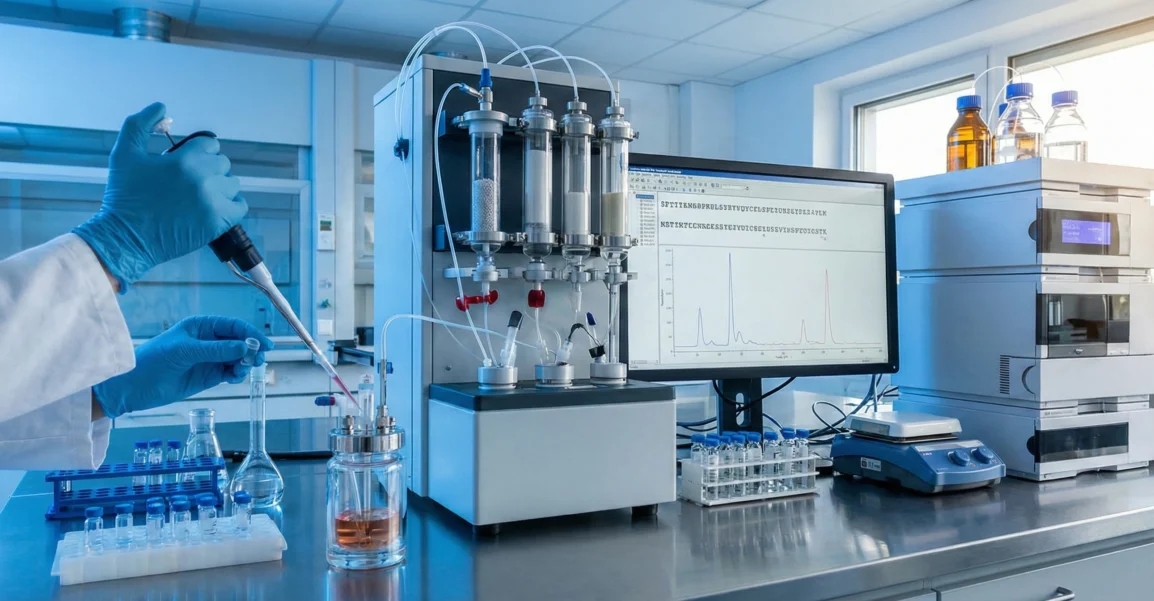
Peptide synthesis is the process of assembling amino acids into a defined sequence connected by peptide bonds. It enables scientists to produce materials for studying molecular interactions, biological signaling, and relationships between structure and function.
For laboratory research, constructing the sequence is only part of the process. Purification, analytical testing, and clear documentation help researchers evaluate whether the resulting material is suitable for their experiments.
O que é um Bond de Peptide?
A peptide bond is an amide linkage between amino acids. Repeated formation of these bonds creates a peptide chain with a defined sequence.
The order of amino acids matters. Changing a single amino acid, modifying a chain end, or introducing a structural constraint can influence a peptide's properties. Researchers therefore need to identify the exact sequence and modifications relevant to their study.
Solid-Phase Peptide Synthesis
Solid-phase peptide synthesis, commonly abbreviated SPPS, assembles a peptide while its growing chain remains attached to an insoluble support called a resin.
Robert Bruce Merrifield developed this approach to simplify peptide construction. Keeping the chain attached to a solid support allows excess reagents and soluble by-products to be washed away between stages. His work earned the 1984 Nobel Prize in Chemistry.
In conventional SPPS, assembly generally proceeds from the peptide's C-terminal end toward its N-terminal end. Protecting groups help control which chemical groups participate in each reaction.
At a conceptual level, the process involves:
- Attaching the starting amino acid to a suitable resin.
- Removing a temporary protecting group to expose the next reaction site.
- Coupling the next protected amino acid.
- Repeating the cycle until the sequence is assembled.
- Releasing the peptide and removing the appropriate protecting groups.
The resulting crude material typically requires purification and characterization before use. The specific chemistry depends on the sequence, resin, and protecting-group strategy.
Other Approaches to Peptide Production
Solid-phase synthesis is not the only way to produce peptides.
Solution-phase synthesis performs reactions with the participating materials dissolved in solution. It may be useful for particular sequences, fragments, or production strategies.
Fragment ligation joins separately prepared peptide segments. This can help address challenges associated with assembling longer or more complex sequences.
Biological production uses cellular or enzymatic systems. The appropriate method depends on the target material, required modifications, and production objectives.
No single approach is ideal for every peptide.
Why Synthesis Can Be Challenging
Peptide assembly must maintain sequence accuracy while limiting unwanted reactions. Incomplete coupling, chemical side reactions, and aggregation can complicate production.
These challenges make purification and testing essential. A completed synthesis does not automatically establish that the material has the intended identity, purity, or quantity.
Purification and Analytical Testing
Chromatography separates components in a mixture and helps researchers isolate or assess the desired peptide. Mass spectrometry provides complementary information about molecular mass and can help identify synthesis products and by-products.
These methods answer different questions:
- Chromatographic analysis — Separation and purity under the specified analytical conditions
- Mass spectrometry — Whether measured mass is consistent with the intended material
- Peptide-content measurement — The amount of peptide, using an appropriate quantitative method
- Additional testing — Specific attributes required by the intended experiment
A high chromatographic purity result alone does not establish vial quantity, sterility, or suitability for human use.
Why Batch Documentation Matters
A certificate of analysis should be evaluated in relation to the tested sample. Researchers should review the product identification, lot information, analytical methods, report date, and results.
Documentation is most useful when it matches the supplied material. A report for another lot or a historical sample should not automatically be treated as evidence for a current batch.
Understanding Research Applications
Synthetic peptides give researchers access to defined molecular sequences for controlled investigations. Interpreting an experiment requires attention to the material tested, its characterization, and the study design.
Results from an isolated assay or cell model should not be assumed to demonstrate effects in humans. Similarly, findings about one sequence do not automatically apply to a related fragment, modified peptide, or blend.
The NUPEPS PEPTIDES Perspective
NUPEPS PEPTIDES encourages researchers to evaluate peptide materials through accurate specifications, relevant batch documentation, and careful interpretation of scientific evidence.
Understanding synthesis helps explain why sequence identity, purification, and analytical results must be considered together. Reliable research depends on knowing what material is being investigated and what its documentation actually demonstrates.
Research-use notice: NUPEPS PEPTIDES products are intended strictly for laboratory and in-vitro research. They are not intended for human or veterinary consumption, diagnostic use, or therapeutic use.
Leituras adicionais
Perguntas frequentes
Is Peptide Synthesis: How Research Peptides Are Made and Characterized for human use?
No. All compounds discussed in this guide are strictly for laboratory research use only. Not for human or veterinary use.
Where can I find the Certificate of Analysis?
Certificates of Analysis are available in our COA library. Each batch is third-party tested for purity and identity.
How should research compounds be stored?
Store according to the vial label instructions. Generally, lyophilized compounds should be kept in a cool, dry place away from light. Refer to the specific product documentation for details.
Todos os produtos são destinados estritamente para pesquisa de laboratório e uso in- vitro apenas. Não para consumo humano ou veterinário, diagnóstico ou uso terapêutico. Os produtos não são medicamentos, alimentos, cosméticos ou suplementos dietéticos e não podem ser mal marcados, mal utilizados ou mal rotulados.