Peptide Information
Tirzepatide vs Retatrutide: Dual vs Triple Agonist Research Profiles
5 octobre 2026
By the NUPEPS Research Team · September 2026
At a Glance
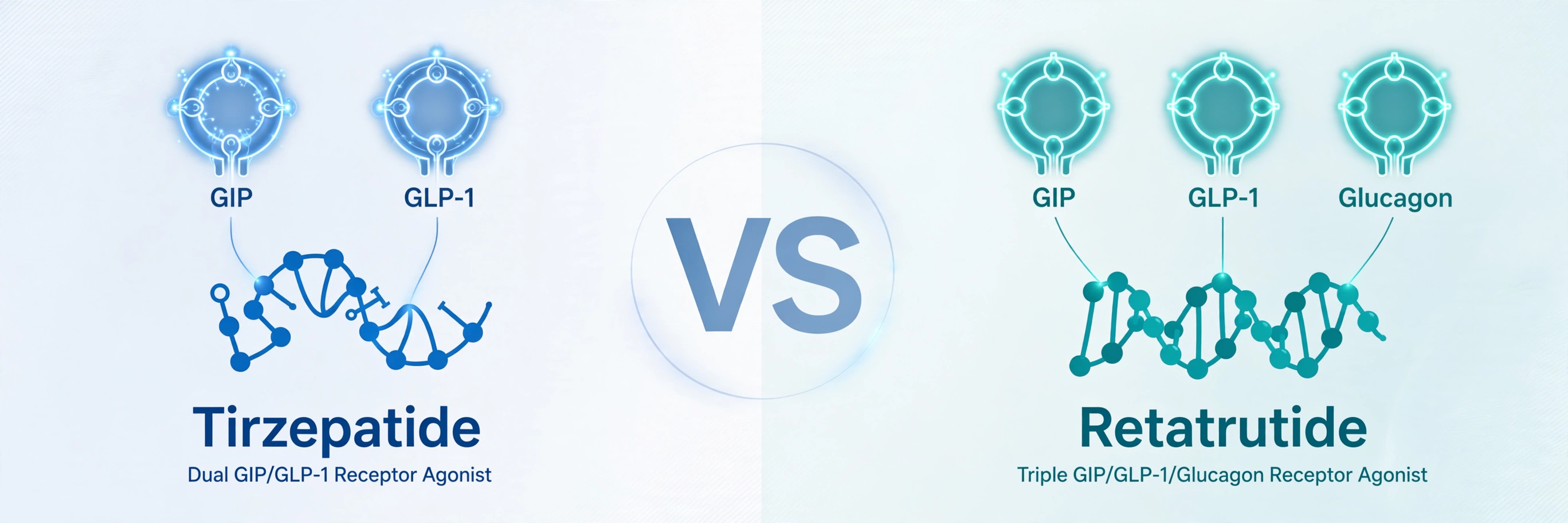
Tirzepatide and retatrutide are the two most-studied multi-receptor incretin peptides in metabolic research: a dual GIP/GLP-1 agonist and a triple GIP/GLP-1/glucagon agonist, both built on a GIP backbone by the same discovery program. The difference between them is a single receptor pathway — glucagon — and the research question it opens. This guide compares the two strictly on their pharmacology and the published record.
Scope note: Tirzepatide is an FDA-approved prescription medicine; retatrutide is an investigational compound with no marketing authorization. Nupeps research materials are sold for in vitro and analytical research only — for laboratory research use only, not for human or veterinary use.
What Are Tirzepatide and Retatrutide?
Tirzepatide (developed as LY3298176) is a 39-amino-acid synthetic peptide that agonizes two receptors: GIP and GLP-1. It was the first dual incretin agonist to reach the market — FDA-approved as a prescription medicine beginning in 2022.
Retatrutide (developed as LY3437943) is a 39-amino-acid synthetic peptide that agonizes three receptors: GIP, GLP-1, and glucagon. It remains investigational, with phase 3 programs ongoing and no regulatory submission completed as of this writing.
How Do Dual and Triple Agonism Differ?
- Dual (tirzepatide): GIP + GLP-1 receptors. Two incretin axes: glucose-dependent insulin secretion, slowed gastric emptying, appetite regulation via central pathways.
- Triple (retatrutide): GIP + GLP-1 + glucagon receptors. Everything above, plus glucagon-receptor agonism, associated in the literature with increased energy expenditure and hepatic fat reduction.
What Did the Landmark Trials Report?
SURMOUNT-1 — tirzepatide (NEJM 2022)
In 2,539 adults with obesity, once-weekly tirzepatide for 72 weeks produced mean weight changes of −15.0% (5 mg), −19.5% (10 mg), and −20.9% (15 mg) versus −3.1% with placebo.
Retatrutide phase 2 (NEJM 2023)
In 338 adults with obesity, once-weekly retatrutide for 48 weeks produced least-squares mean weight changes of −8.7% (1 mg), −17.1% (4 mg), −22.8% (8 mg), and −24.2% (12 mg) versus −2.1% with placebo.
Important caveat: these figures come from different trials with different durations and designs — they are not head-to-head comparisons.
What Is the Regulatory Status of Each?
- Tirzepatide: FDA-approved prescription medicine.
- Retatrutide: investigational. No marketing authorization as of 2026.
Questions fréquentes
What is the difference between tirzepatide and retatrutide?
The number of receptor pathways: tirzepatide agonizes GIP and GLP-1 (dual); retatrutide agonizes GIP, GLP-1, and glucagon (triple).
Is retatrutide approved?
No. As of 2026, retatrutide is investigational with no marketing authorization. Tirzepatide is an FDA-approved prescription medicine.
Are these compounds available as research materials?
Nupeps supplies research-grade tirzepatide (NP-II) and retatrutide (NP-III) strictly for laboratory research use — not for human or veterinary use.
Key Takeaways
Tirzepatide and retatrutide come from the same discovery program and the same GIP-backbone design — separated by a single receptor pathway. For laboratories, the same fundamentals apply: verified identity, documented purity, and disciplined handling from vial to assay.
Research Use Only disclaimer: All Nupeps products are sold strictly for laboratory and in vitro research use only — not for human or veterinary use. This article summarizes published scientific literature for research reference; it does not constitute medical advice.
All products are intended strictly for laboratory research and in-vitro use only. Not for human or veterinary consumption, diagnostic, or therapeutic use. Products are not drugs, foods, cosmetics, or dietary supplements and may not be misbranded, misused, or mislabeled.