Peptidinformation
Tirzepatide vs Retatrutide: Dual vs Triple Agonist Research Profiles
5. Oktober 2026
Vom NUPEPS Forschungsteam · September 2026
Auf einen Blick
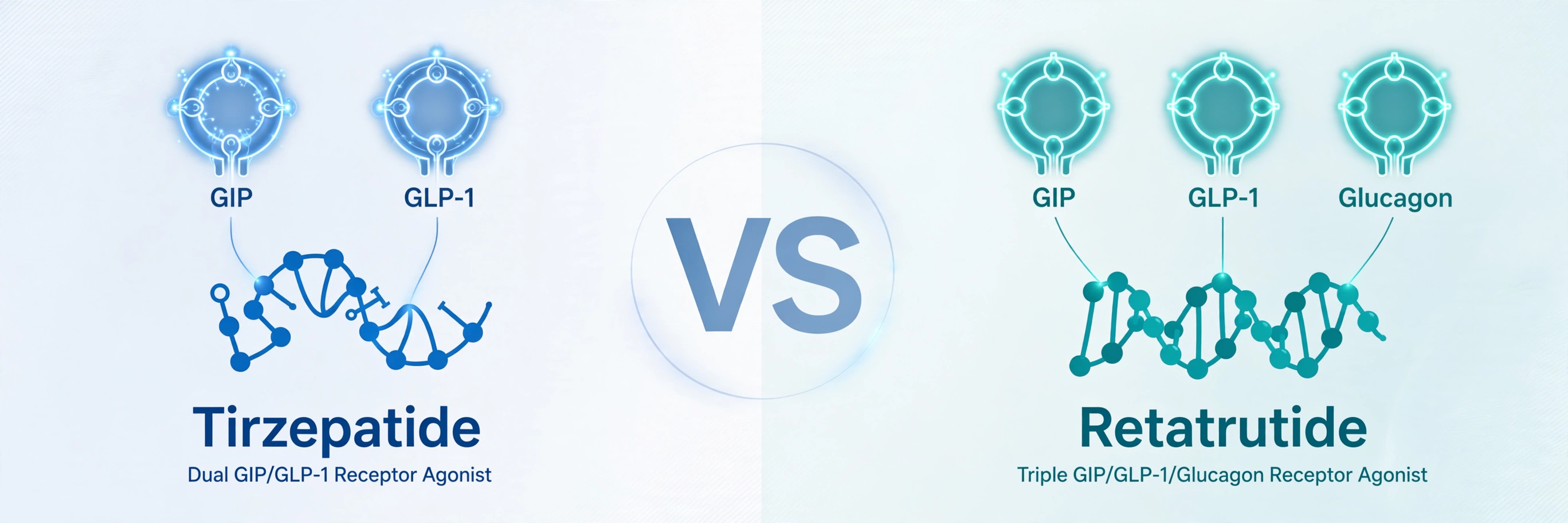
Tirzepatide and retatrutide are the two most-studied multi-receptor incretin peptides in metabolic research: a dual GIP/GLP-1 agonist and a triple GIP/GLP-1/glucagon agonist, both built on a GIP backbone by the same discovery program. The difference between them is a single receptor pathway — glucagon — and the research question it opens. This guide compares the two strictly on their pharmacology and the published record.
Anmerkung zum Geltungsbereich: Tirzepatide is an FDA-approved prescription medicine; retatrutide is an investigational compound with no marketing authorization. Nupeps research materials are sold for in vitro and analytical research only — for laboratory research use only, not for human or veterinary use.
What Are Tirzepatide and Retatrutide?
Tirzepatide (developed as LY3298176) is a 39-amino-acid synthetic peptide that agonizes two receptors: GIP and GLP-1. It was the first dual incretin agonist to reach the market — FDA-approved as a prescription medicine beginning in 2022.
Retatrutide (developed as LY3437943) is a 39-amino-acid synthetic peptide that agonizes three receptors: GIP, GLP-1, and glucagon. It remains investigational, with phase 3 programs ongoing and no regulatory submission completed as of this writing.
How Do Dual and Triple Agonism Differ?
- Dual (tirzepatide): GIP + GLP-1 receptors. Two incretin axes: glucose-dependent insulin secretion, slowed gastric emptying, appetite regulation via central pathways.
- Triple (retatrutide): GIP + GLP-1 + glucagon receptors. Everything above, plus glucagon-receptor agonism, associated in the literature with increased energy expenditure and hepatic fat reduction.
What Did the Landmark Trials Report?
SURMOUNT-1 — tirzepatide (NEJM 2022)
In 2,539 adults with obesity, once-weekly tirzepatide for 72 weeks produced mean weight changes of −15.0% (5 mg), −19.5% (10 mg), and −20.9% (15 mg) versus −3.1% with placebo.
Retatrutide phase 2 (NEJM 2023)
In 338 adults with obesity, once-weekly retatrutide for 48 weeks produced least-squares mean weight changes of −8.7% (1 mg), −17.1% (4 mg), −22.8% (8 mg), and −24.2% (12 mg) versus −2.1% with placebo.
Important caveat: these figures come from different trials with different durations and designs — they are not head-to-head comparisons.
What Is the Regulatory Status of Each?
- Tirzepatide: FDA-approved prescription medicine.
- Retatrutide: investigational. No marketing authorization as of 2026.
Häufig gestellte Fragen
What is the difference between tirzepatide and retatrutide?
The number of receptor pathways: tirzepatide agonizes GIP and GLP-1 (dual); retatrutide agonizes GIP, GLP-1, and glucagon (triple).
Is retatrutide approved?
No. As of 2026, retatrutide is investigational with no marketing authorization. Tirzepatide is an FDA-approved prescription medicine.
Are these compounds available as research materials?
Nupeps supplies research-grade tirzepatide (NP-II) and retatrutide (NP-III) strictly for laboratory research use — not for human or veterinary use.
Schlüssel zum Mitnehmen
Tirzepatide and retatrutide come from the same discovery program and the same GIP-backbone design — separated by a single receptor pathway. For laboratories, the same fundamentals apply: verified identity, documented purity, and disciplined handling from vial to assay.
Nur Haftungsausschluss für Forschungszwecke: All Nupeps products are sold strictly for laboratory and in vitro research use only — not for human or veterinary use. This article summarizes published scientific literature for research reference; it does not constitute medical advice.
Alle Produkte sind ausschließlich für die Laborforschung und in-vitro-Anwendung bestimmt. Nicht für den menschlichen oder tierärztlichen Verzehr, diagnostische oder therapeutische Verwendung. Produkte sind keine Medikamente, Lebensmittel, Kosmetika oder Nahrungsergänzungsmittel und dürfen nicht falsch gekennzeichnet, missbraucht oder falsch gekennzeichnet werden.