Peptide Comparisons
TB-500 vs GHK-Cu: Tissue Repair Research Compared
5. Oktober 2026
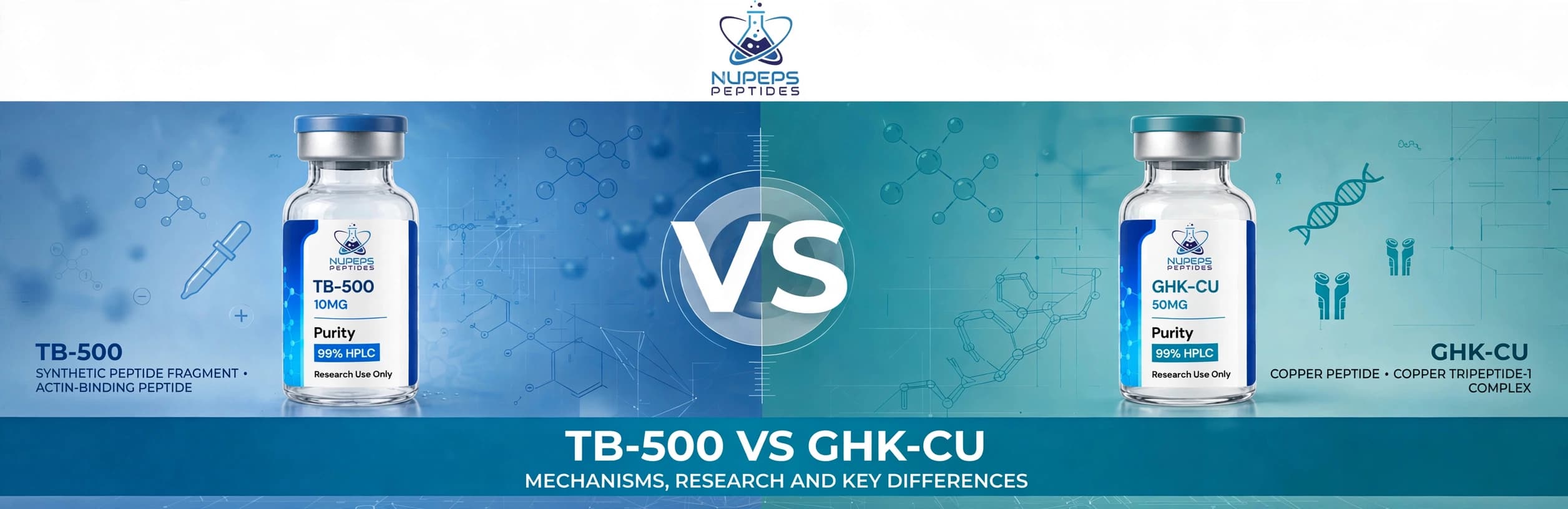
TB-500 and GHK-Cu are two of the most frequently studied peptides in tissue-repair literature — yet they belong to entirely different molecular families and are investigated through different biological mechanisms. TB-500 is a synthetic fragment of the actin-regulating protein thymosin beta-4, studied in cell-migration and cytoskeletal research models. GHK-Cu is a copper-bound tripeptide first identified in human plasma, studied in fibroblast gene-expression, collagen-pathway, and skin-remodeling research.
This guide compares their structures, mechanisms, and published research areas so laboratory researchers can understand what distinguishes these two compounds in the scientific literature. All NUPEPS PEPTIDES products are sold strictly for laboratory research use only.
TB-500: The Thymosin Beta-4 Fragment
TB-500 is the synthetic fragment of thymosin beta-4 encompassing its central actin-binding domain — the region of the 43-amino-acid parent protein most directly implicated in cytoskeletal regulation. In cell biology, thymosin beta-4 functions as a G-actin sequestering protein, controlling the availability of actin monomers for filament assembly. TB-500 is studied as the minimal sequence retaining this regulatory activity.
Because the fragment is far simpler to synthesize and characterize than the full-length protein, it became the workhorse reagent for thymosin-pathway research, while the intact protein is reserved for studies requiring the complete molecule. Laboratories use TB-500 in scratch-wound assays, endothelial migration models, and comparative studies against full-length thymosin beta-4.
What the published research shows
In a widely cited preclinical study, Malinda and colleagues examined thymosin beta-4 in a rat full-thickness wound model and reported increased reepithelialization, greater wound contraction, and increased collagen deposition and angiogenesis in treated wounds versus controls. The study also found that the peptide stimulated keratinocyte migration in Boyden chamber assays (PubMed 10469335).
A particularly relevant finding for TB-500 specifically comes from Philp et al., who investigated how thymosin beta-4 regulates matrix metalloproteinase (MMP) expression during wound repair. Their analysis showed increased MMP-1, MMP-2, and MMP-9 expression in keratinocytes, endothelial cells, and fibroblasts — and critically, the central actin-binding domain (amino acids 17–23), the region TB-500 is derived from, carried all of the activity for metalloproteinase induction (PubMed 16607611). This finding directly connects the fragment's studied activity to extracellular matrix remodeling, a central process in tissue-repair models.
GHK-Cu: The Copper Tripeptide
GHK (glycyl-L-histidyl-L-lysine) is a tripeptide first identified as a plasma factor whose levels decline with age — a finding that launched decades of investigation into copper-peptide biology. When complexed with copper, GHK becomes GHK-Cu, a molecule studied for its ability to modulate gene-expression patterns in dermal fibroblasts, including genes associated with collagen production, matrix metalloproteinases, and antioxidant defenses.
In wound-healing models, researchers have examined its influence on the successive phases of tissue repair, from inflammatory signaling through remodeling. What distinguishes GHK-Cu in the literature is the breadth of its published data: few research peptides have been characterized across as many cell types and endpoints.
What the published research shows
One of the foundational studies, Maquart et al. (1988), reported that the GHK-Cu complex stimulated collagen synthesis in fibroblast cultures, with effects beginning at picomolar concentrations and maximizing at nanomolar levels — independent of any change in cell number (PubMed 3169264).
Pickart's 2008 review of the human tripeptide GHK and tissue remodeling compiled the compound's studied activities: chemoattraction of repair cells, anti-inflammatory actions, increased synthesis of collagen, elastin, metalloproteinases, and growth factors, and increased proliferation of fibroblasts and keratinocytes. The review also noted controlled studies on aged skin examining elasticity, firmness, and photodamage endpoints (PubMed 18644225).
Side-by-Side Comparison
- Structure — Synthetic peptide fragment (central actin-binding domain) — Glycyl-L-histidyl-L-lysine complexed with Cu²⁺
- Primary molecular target — G-actin / cytoskeletal regulation — Fibroblast gene expression, copper-dependent pathways
- Key studied mechanism — Actin monomer sequestration, cell migration — Collagen synthesis modulation, MMP regulation, antioxidant gene pathways
- Main research models — Scratch-wound assays, endothelial migration, dermal wound models — Fibroblast cultures, skin-remodeling models, wound-healing models
- Endogenous origin — Fragment of an endogenous protein — Endogenous peptide (plasma levels decline with age)
- NUPEPS PEPTIDES format — TB-500 10MG — GHK-Cu 50MG
Key Differences for Researchers
1. Different molecular classes. TB-500 is a fragment of a larger actin-binding protein; GHK-Cu is a small copper-chelated tripeptide. They share no structural homology and are not interchangeable reagents.
2. Different levels of biological action. TB-500 is studied at the level of cytoskeletal dynamics — how cells move and how actin filaments assemble. GHK-Cu is studied at the level of gene expression and extracellular matrix composition — what fibroblasts produce and how tissue remodels.
3. Overlapping but distinct research questions. Both compounds appear in wound-healing literature, but they are typically investigated for different aspects of the repair process: TB-500 for cell migration and early-phase dynamics, GHK-Cu for collagen-pathway modulation and remodeling-phase endpoints.
4. The fragment-versus-complex distinction matters analytically. TB-500's activity has been mapped to a specific amino-acid region (residues 17–23 of thymosin beta-4) in MMP-induction studies. GHK-Cu's activity depends on copper complexation — the uncomplexed tripeptide and the copper chelate are distinct chemical entities in the literature.
5. Both are available as high-purity research materials. NUPEPS PEPTIDES supplies TB-500 10MG und GHK-Cu 50MG, each verified at ≥99% purity by HPLC and mass spectrometry with batch-specific Certificates of Analysis — the documentation standard required for reproducible comparative research.
Analytical Considerations for Comparative Research
When laboratories study TB-500 and GHK-Cu side by side, analytical characterization requirements differ in ways that reflect each compound's chemistry.
For TB-500, the critical analytical question is sequence fidelity within the actin-binding region. Because the fragment's studied activity has been mapped to a specific amino-acid stretch (residues 17–23 of the parent protein), identity confirmation by mass spectrometry and purity assessment by HPLC are the standard documentation. Truncation variants or synthesis byproducts in this region would be analytically distinguishable and could confound comparative results against full-length thymosin beta-4.
For GHK-Cu, characterization extends beyond peptide sequence to metal complexation. The copper(II) chelate is a distinct chemical entity from the free tripeptide, and published research attributes the compound's studied biological activity to the complexed form. Analytical documentation for GHK-Cu as a research material therefore includes confirmation of copper complexation alongside sequence and purity data — a requirement without parallel in TB-500 analytics.
Storage and handling considerations also diverge. As a copper-containing complex, GHK-Cu research material is subject to the stability considerations of metal-peptide chelates, while TB-500 follows the standard handling profile of synthetic peptide fragments. Both NUPEPS PEPTIDES formats ship as lyophilized material with storage guidance of −20°C desiccated, and every batch is third-party tested for purity, quantity, and sterility.
These analytical distinctions matter because comparative tissue-repair studies are only interpretable when each compound's identity and quality are independently verified. Batch-specific Certificates of Analysis — documenting HPLC purity data and mass spectrometry identity confirmation from an ISO/IEC 17025 accredited laboratory — provide the traceability that published research standards expect.
Häufig gestellte Fragen
What is the main structural difference between TB-500 and GHK-Cu?
TB-500 is a synthetic peptide fragment derived from the central actin-binding domain of thymosin beta-4, a 43-amino-acid protein. GHK-Cu is a tripeptide (glycyl-L-histidyl-L-lysine) complexed with a copper(II) ion. They belong to unrelated molecular families.
Do TB-500 and GHK-Cu act through the same mechanism?
No. Published research describes TB-500's studied activity in terms of actin regulation and cell migration, while GHK-Cu is studied for fibroblast gene-expression modulation, collagen synthesis pathways, and copper-dependent signaling. Their mechanisms do not overlap.
Which compound has more published research?
Both are extensively published, but in different domains. Thymosin beta-4/TB-500 literature concentrates on wound-healing models, angiogenesis, and cell migration. GHK-Cu literature spans fibroblast biology, skin remodeling, gene-expression profiling, and copper-peptide physiology across several decades.
Is TB-500 the same as thymosin beta-4?
No. TB-500 is a synthetic fragment encompassing the central actin-binding region of thymosin beta-4 — not the full 43-amino-acid protein. Research on the full protein and research on the fragment are related but distinct bodies of literature.
Why is copper important in GHK-Cu research?
The tripeptide GHK has high affinity for copper(II) ions, and the complexed form (GHK-Cu) is the entity most studied in the literature. Analytical characterization of GHK-Cu as a research material includes confirmation of copper complexation alongside sequence and purity verification.
Are these products for human use?
No. All NUPEPS PEPTIDES products, including TB-500 10MG und GHK-Cu 50MG, are strictly for laboratory research use only — not for human or veterinary consumption, diagnostic, or therapeutic use.
References
- Malinda KM et al. "Thymosin beta4 accelerates wound healing." J Invest Dermatol. 1999;113(3):364-8. PubMed 10469335
- Philp D et al. "Thymosin beta4 promotes matrix metalloproteinase expression during wound repair." J Cell Physiol. 2006;207(1):31-40. PubMed 16607611
- Maquart FX et al. "Stimulation of collagen synthesis in fibroblast cultures by the tripeptide-copper complex glycyl-L-histidyl-L-lysine-Cu2+." FEBS Lett. 1988;238(2):343-6. PubMed 3169264
- Pickart L. "The human tri-peptide GHK and tissue remodeling." J Biomater Sci Polym Ed. 2008;19(8):969-88. PubMed 18644225
Alle Produkte sind ausschließlich für die Laborforschung und in-vitro-Anwendung bestimmt. Nicht für den menschlichen oder tierärztlichen Verzehr, diagnostische oder therapeutische Verwendung. Produkte sind keine Medikamente, Lebensmittel, Kosmetika oder Nahrungsergänzungsmittel und dürfen nicht falsch gekennzeichnet, missbraucht oder falsch gekennzeichnet werden.