
Research Guides
SS-31 vs MOTS-C: Two Mitochondrial Peptides, Two Research Angles
By NUPEPS14. Oktober 2026
Auf einen Blick
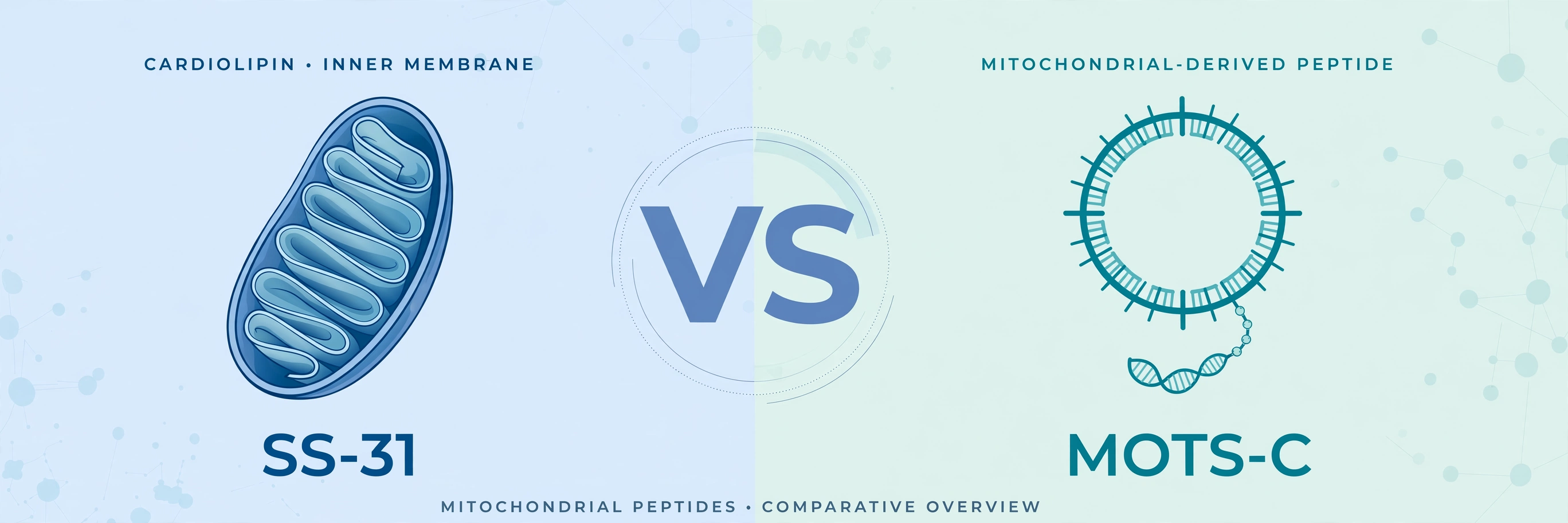
Vergleich: SS-31 (cardiolipin-binding tetrapeptide) vs MOTS-C (mitochondrial-derived signaling peptide)
SS-31: 4-amino-acid synthetic aromatic-cationic peptide (D-Arg-Dmt-Lys-Phe-NH₂); MW ~640 Da; CAS 736992-21-5; binds cardiolipin in the inner mitochondrial membrane
MOTS-C: 16-amino-acid peptide (Met-Arg-Trp-Gln-Glu-Met-Gly-Tyr-Ile-Phe-Tyr-Pro-Arg-Lys-Leu-Arg); MW ~2,174 Da; CAS 1627580-64-6; encoded in mitochondrial DNA (12S rRNA region)
Primary interaction: SS-31 → a membrane lipid (cardiolipin); MOTS-C → the folate–methionine cycle, with downstream AMPK activation
Hauptunterschied: SS-31 is a structural story — membrane architecture and electron transport organization. MOTS-C is a signaling story — a mitochondria-encoded messenger that switches on a metabolic program
Origin: SS-31: designed in a laboratory (Szeto–Schiller series, first described 2004). MOTS-C: an endogenous peptide encoded by the mitochondrial genome (first characterized 2015)
Rechtsstatus: Elamipretide, the pharmaceutical formulation of SS-31, received FDA accelerated approval for Barth syndrome in September 2025 — not extending to research-grade SS-31. MOTS-C has no approval. Both NUPEPS materials are research-use-only
Forschungsangebot: SS-31 10 mg and MOTS-C 10 mg lyophilized research materials, for laboratory research use only
SS-31 and MOTS-C are the two most frequently compared mitochondrial research peptides — and the comparison is instructive precisely because they share so little beyond the organelle. SS-31 is a synthetic molecule engineered to accumulate inside mitochondria and bind a structural lipid. MOTS-C is a peptide the mitochondrial genome itself encodes, which leaves the mitochondrion and carries a metabolic signal to the rest of the cell. One works on the membrane; the other works through a pathway. For full background on each compound, see our SS-31 research guide and our MOTS-C research guide.
Anmerkung zum Geltungsbereich: Neither research-grade SS-31 nor MOTS-C is an approved drug. NUPEPS products are sold for in vitro and analytical research only — not for human or veterinary use. Nothing here constitutes medical advice, and no therapeutic claims are made.
What Are SS-31 and MOTS-C?
SS-31 (also known in pharmaceutical development as elamipretide) is a synthetic tetrapeptide from the Szeto–Schiller (SS) series, identified at Cornell University by Hazel Szeto and Peter Schiller. Its sequence — D-Arg-Dmt-Lys-Phe-NH₂ — alternates basic and aromatic residues, a pattern that lets the molecule cross cell membranes and concentrate in mitochondria at levels reported to exceed 1,000-fold relative to the cytosol (Zhao et al., 2004; Szeto, 2006). Its D-amino acids and dimethyltyrosine (Dmt) residue were built in to resist proteolytic degradation. SS-31's defining feature is its target: not a protein receptor, but cardiolipin, a phospholipid found almost exclusively in the inner mitochondrial membrane.
MOTS-C (Mitochondrial Open Reading Frame of the 12S rRNA-c) is a 16-amino-acid peptide encoded by a short open reading frame inside the mitochondrial genome's 12S rRNA gene (Lee et al., 2015). It belongs to the small class of mitochondria-derived peptides, sometimes called mitokines. Because the mitochondrial genetic code would read parts of this sequence as stop signals, the peptide is understood to be translated in the cytosol using the standard genetic code. Unlike SS-31, MOTS-C is endogenous: detected in human plasma, it circulates systemically, and its levels have been reported to decline with age and rise transiently after exercise (Lee et al., 2015; Reynolds et al., 2021).
Wie unterscheiden sich ihre Mechanismen?
The cleanest way to contrast the two compounds is by asking a simple question: where does the peptide act, and what does it touch?
- SS-31 → cardiolipin, inside the mitochondrion. Fluorescence and NMR studies indicate that SS-31's basic residues interact electrostatically with cardiolipin's phosphate head groups while its aromatic residues associate with the lipid's fatty-acid tails (Szeto and Birk, 2014). The proposed consequences are structural: cardiolipin is protected against peroxidation, the cristae — the folded inner-membrane structures housing the electron transport chain — keep their architecture, and respiratory complexes retain their supercomplex organization. Biophysical work supports a membrane-level mechanism: SS-31 binds cardiolipin-containing bilayers and alters their surface electrostatics (Mitchell et al., 2020), and cross-linking mass spectrometry maps its protein contacts to cardiolipin-dependent inner-membrane proteins (Chavez et al., 2020). In short, SS-31's mechanism concerns the physical platform on which oxidative phosphorylation runs.
- MOTS-C → the folate–methionine cycle, then AMPK. MOTS-C does not bind a membrane or a classical receptor. According to Lee et al. (2016), it inhibits steps in the one-carbon folate–methionine cycle, causing upstream accumulation of AICAR; AICAR's monophosphate form (ZMP) allosterically activates AMPK, the cell's central energy-sensing kinase. Critically, this route does not require ATP depletion — MOTS-C switches on the AMPK program as a signal rather than as an energy emergency. Downstream of AMPK, the literature describes that kinase's standard metabolic program: glucose uptake via GLUT4 translocation, fatty-acid oxidation, mitochondrial biogenesis signaling, and mTORC1 suppression. A second arm takes MOTS-C out of the cytosol entirely: under metabolic stress it translocates to the nucleus and participates in adaptive gene-expression responses (Kim et al., 2019).
So the directional logic is opposite. SS-31 is imported into the mitochondrion and acts on its innermost membrane. MOTS-C is a message from the mitochondrion — encoded there, but acting in the cytosol, the nucleus, and, via the circulation, in distant tissues. In the field's shorthand: SS-31 is studied as a membrane-stabilizing tool; MOTS-C as a metabolic-signaling tool.
SS-31 vs MOTS-C: Side-by-Side Comparison
- Molecule class. SS-31: Synthetic aromatic-cationic tetrapeptide. MOTS-C: Mitochondria-derived signaling peptide (mitokine).
- Origin. SS-31: Designed (Szeto–Schiller series, Cornell). MOTS-C: Endogenous; encoded in mitochondrial DNA.
- Length / sequence. SS-31: 4 aa — D-Arg-Dmt-Lys-Phe-NH₂. MOTS-C: 16 aa — Met-Arg-Trp-Gln-Glu-Met-Gly-Tyr-Ile-Phe-Tyr-Pro-Arg-Lys-Leu-Arg.
- Approx. molecular weight. SS-31: ~640 Da. MOTS-C: ~2,174 Da.
- CAS number. SS-31: 736992-21-5. MOTS-C: 1627580-64-6.
- Primary interaction partner. SS-31: Cardiolipin (inner mitochondrial membrane lipid). MOTS-C: Folate–methionine cycle enzymes (pathway-level).
- Principal downstream axis. SS-31: Cristae architecture, respiratory supercomplex organization, cytochrome c electron transfer. MOTS-C: AICAR/ZMP accumulation → AMPK activation; nuclear translocation under stress.
- Site of action. SS-31: Inner mitochondrial membrane. MOTS-C: Cytosol, nucleus, systemic circulation.
- First characterized. SS-31: 2004 (Zhao et al.). MOTS-C: 2015 (Lee et al.).
- Human evidence base. SS-31: Pharmaceutical formulation in clinical programs; accelerated FDA approval (Barth syndrome, 2025) for the drug product only. MOTS-C: Observational plasma correlations; one small early-phase trial; no completed randomized controlled trials.
- NUPEPS research material. SS-31: SS-31 10MG (also 50MG). MOTS-C: MOTS-C 10MG (also 20MG, 40MG).
Was hat die veröffentlichte Forschung berichtet? Schlüsselstudien
The two literatures differ in age and depth: SS-31's begins in 2004 and includes pharmaceutical development; MOTS-C's begins in 2015 and is predominantly preclinical.
SS-31 — selected studies:
- Zhao et al. (2004) — the foundational paper in the Journal of Biological Chemistry describing the SS peptide series and their selective concentration in the inner mitochondrial membrane.
- Birk et al. (2013) — in the Journal of the American Society of Nephrology, SS-31 protected cristae structure in a kidney ischemia model, with ATP recovering within one hour of reperfusion — the study most often cited for the structural mechanism.
- Siegel et al. (2013) — in Aging Cell, SS-31 rapidly improved mitochondrial energetics and ATP production capacity in aged mice; no measurable change was seen in young, healthy mice, which the authors read as selectivity for already-declined mitochondria.
- Chavez et al. (2020) — chemical cross-linking mass spectrometry in PNAS mapped the SS-31 interactome in mouse heart mitochondria, finding contacts concentrated among cardiolipin-dependent inner-membrane proteins.
MOTS-C — selected studies:
- Lee et al. (2015) — the founding characterization in Cell Metabolism: identification of the mitochondrial open reading frame, detection in human plasma, age-associated decline, and metabolic effects in diet-induced obesity models attributed to AMPK activation.
- Lee et al. (2016) — mechanistic follow-up detailing MOTS-C's regulation of the folate–methionine cycle and purine biosynthesis, the basis of the AICAR/ZMP model of AMPK activation.
- Kim et al. (2019) — in Cell Metabolism, MOTS-C translocated to the nucleus under metabolic stress and participated in adaptive gene-expression responses.
- Reynolds et al. (2021) — in Nature Communications, MOTS-C was identified as an exercise-induced, mitochondrially encoded regulator; acute exercise elevated circulating MOTS-C in humans, and administration in aged mice was associated with improved physical capacity measures.
Read side by side, the records answer different questions. The SS-31 literature centers on whether preserving membrane structure preserves function — measured in ATP recovery, cristae morphology, and respiratory efficiency. The MOTS-C literature centers on whether a mitochondrial signal can reprogram cell metabolism — measured in AMPK phosphorylation, metabolic flux, and gene expression. Neither record should be read as evidence about the other compound.
Are SS-31 and MOTS-C Studied Together?
They appear in the same research conversations — particularly in mitochondrial aging biology — because they bracket the organelle's two modes of decline and response. A laboratory examining aged tissue might characterize cristae ultrastructure and respiratory supercomplex integrity (SS-31's territory) alongside AMPK signaling and metabolic flexibility (MOTS-C's territory): two readouts describing different layers of the same system — the membrane hardware and the signaling software, so to speak.
That complementarity is conceptual, not interchangeable. SS-31 cannot report on folate-cycle signaling, and MOTS-C cannot report on cardiolipin organization. Each is used as a probe for its own layer of mitochondrial biology, and each record should be evaluated on its own terms.
Which One Do Researchers Choose?
The choice is made at the study-design stage, and it follows from the experimental question:
- If the question is structural — cristae morphology, cardiolipin oxidation state, respiratory supercomplex assembly, electron transfer through cytochrome c, ATP recovery after an ischemic or oxidative insult in isolated mitochondria, permeabilized fibers, or tissue models — SS-31 is the compound whose literature supports that design. Its assays are respirometry, membrane-potential measurement, ultrastructural imaging, and lipid-oxidation analysis.
- If the question is signaling — AMPK pathway activation, folate–methionine cycle flux, glucose uptake in cultured cells, exercise-responsive circulating factors, stress-induced nuclear gene expression — MOTS-C is the relevant tool. Its assays are kinase phosphorylation panels, metabolomics of one-carbon intermediates, transporter translocation studies, and transcriptomics.
- If the question is aging biology broadly, both appear in the literature — SS-31 in work on membrane-level mitochondrial decline (Siegel et al., 2013), MOTS-C in work on the age-associated decline of an endogenous signal (Lee et al., 2015; Reynolds et al., 2021). Even here, they are chosen for different endpoints, not as substitutes.
The shortest accurate summary: choose by readout.
SS-31 and MOTS-C in the Laboratory
Both materials are supplied as lyophilized powders and call for the same baseline discipline as any research peptide, with one practical difference: their identity checks look nothing alike. Mass spectrometry should confirm ~640 Da for SS-31 — including its non-standard Dmt residue — versus ~2,174 Da for MOTS-C's 16-residue sequence. Reversed-phase HPLC remains the standard purity method for both; NUPEPS reports ≥99% purity on batch-specific Certificates of Analysis. Lyophilized vials are stored at −20 °C, protected from light and moisture. Because the two are so often discussed together, confirming which vial is in hand — and matching it to its own batch COA — matters more than usual.
SS-31 and MOTS-C at NUPEPS
NUPEPS supplies research-grade SS-31 10MG und MOTS-C 10MG as lyophilized research materials, each with a batch-specific Certificate of Analysis documenting purity (≥99%) and identity verification. SS-31 is also available in a 50MG presentation, and MOTS-C in 20MG and 40MG. All materials are for research use only.
Häufig gestellte Fragen
What is the main difference between SS-31 and MOTS-C?
SS-31 is a synthetic tetrapeptide that accumulates inside mitochondria and binds cardiolipin, a structural lipid of the inner membrane — its mechanism is architectural. MOTS-C is a peptide encoded by the mitochondrial genome that acts as a signaling molecule, inhibiting steps in the folate–methionine cycle and thereby activating AMPK — its mechanism is informational.
Is SS-31 a signaling peptide like MOTS-C?
No. SS-31 is not known to act through a receptor or a signaling cascade. The published mechanism is a physical interaction with a membrane lipid and the structural consequences that follow for cristae and respiratory complexes (Szeto and Birk, 2014; Mitchell et al., 2020). MOTS-C, by contrast, is classified in the literature as a mitochondria-derived signaling peptide, or mitokine.
Which compound has more published research?
SS-31, by years: its literature begins in 2004 and includes pharmaceutical clinical development, while MOTS-C was first characterized in 2015. MOTS-C's literature is younger, heavily preclinical, and — on the human side — observational apart from one small early-phase trial.
Does the FDA approval of elamipretide apply to research-grade SS-31 or to MOTS-C?
No, on both counts. The September 2025 accelerated approval covers a specific pharmaceutical formulation of elamipretide (marketed as Forzinity) for Barth syndrome. Research-grade SS-31 is a separate material with no regulatory approval, and MOTS-C has no FDA approval of any kind. Both are supplied strictly for laboratory research.
Can SS-31 and MOTS-C be used interchangeably in a study?
No. They differ in sequence, size (4 vs 16 amino acids), origin (synthetic vs genome-encoded), interaction partner (a lipid vs a metabolic pathway), and site of action (inner membrane vs cytosol and nucleus). An experimental design built for one does not transfer to the other.
What analytical documentation accompanies NUPEPS SS-31 and MOTS-C?
Each batch of both compounds includes a Certificate of Analysis reporting HPLC purity (≥99%) and mass spectrometry identity confirmation, matched to the specific lot supplied.
References
- Zhao K, et al. "Cell-permeable peptide antioxidants targeted to inner mitochondrial membrane inhibit mitochondrial swelling, oxidative cell death, and reperfusion injury." J Biol Chem. 2004;279(33):34682-34690.
- Szeto HH. "Cell-permeable, mitochondrial-targeted, peptide antioxidants." AAPS J. 2006;8(2):E277-E283.
- Birk AV, et al. "The mitochondrial-targeted compound SS-31 re-energizes ischemic mitochondria by interacting with cardiolipin." J Am Soc Nephrol. 2013;24(8):1250-1261.
- Siegel MP, et al. "Mitochondrial-targeted peptide rapidly improves mitochondrial energetics and skeletal muscle performance in aged mice." Aging Cell. 2013;12(5):833-841.
- Szeto HH, Birk AV. "Serendipity and the discovery of novel compounds that restore mitochondrial plasticity." Clin Pharmacol Ther. 2014;96(6):672-683.
- Mitchell W, et al. "The mitochondria-targeted peptide SS-31 binds lipid bilayers and modulates surface electrostatics as a key component of its mechanism of action." J Biol Chem. 2020;295(21):7452-7465.
- Chavez JD, et al. "Chemical crosslinking mass spectrometry analysis of the mitochondrial SS-31 interactome." Proc Natl Acad Sci USA. 2020;117(26):15363-15373.
- Lee C, et al. "The mitochondrial-derived peptide MOTS-c promotes metabolic homeostasis and reduces obesity and insulin resistance." Cell Metab. 2015;21(3):443-454.
- Lee C, et al. "MOTS-c regulates the folate-methionine cycle and de novo purine biosynthesis." J Am Chem Soc. 2016.
- Kim SJ, et al. "MOTS-c nuclear translocation and adaptive stress response." Cell Metab. 2019.
- Reynolds JC, et al. "MOTS-c is an exercise-induced mitochondrial-encoded regulator of age-dependent physical decline and muscle homeostasis." Nat Commun. 2021;12:470.
Schlüssel zum Mitnehmen
SS-31 and MOTS-C define the two poles of mitochondrial peptide research. SS-31 is a designed molecule that goes to the inner membrane and works on structure — cardiolipin, cristae, and the electron transport chain's physical platform. MOTS-C is the genome's own molecule that leaves the mitochondrion and works through signal — the folate cycle, AMPK, and stress-responsive gene expression. Choosing between them is choosing a layer of biology to interrogate. Neither is an approved medicine as supplied for research, and both demand the same starting discipline: verified identity, batch-documented purity, and a design matched to the published record.
Weitere Informationen: SS-31 Research Guide · MOTS-C Research Guide
Nur Haftungsausschluss für Forschungszwecke: All NUPEPS products, including SS-31 and MOTS-C, are sold strictly for laboratory and in vitro research use only — not for human or veterinary use. They are not intended for the diagnosis, treatment, cure, or prevention of any disease. This article summarizes published scientific literature for research reference; it does not constitute medical or scientific advice.
Häufige Fragen
Ist SS-31 vs MOTS-C: Two Mitochondrial Peptides, Two Research Angles für den menschlichen Gebrauch bestimmt?
No. All compounds discussed in this guide are strictly for laboratory research use only. Not for human or veterinary use.
Where can I find the Certificate of Analysis?
Certificates of Analysis are available in our COA library. Each batch is third-party tested for purity and identity.
How should research compounds be stored?
Store according to the vial label instructions. Generally, lyophilized compounds should be kept in a cool, dry place away from light. Refer to the specific product documentation for details.
Alle Produkte sind ausschließlich für die Laborforschung und in-vitro-Anwendung bestimmt. Nicht für den menschlichen oder tierärztlichen Verzehr, diagnostische oder therapeutische Verwendung. Produkte sind keine Medikamente, Lebensmittel, Kosmetika oder Nahrungsergänzungsmittel und dürfen nicht falsch gekennzeichnet, missbraucht oder falsch gekennzeichnet werden.