Peptide Comparisons
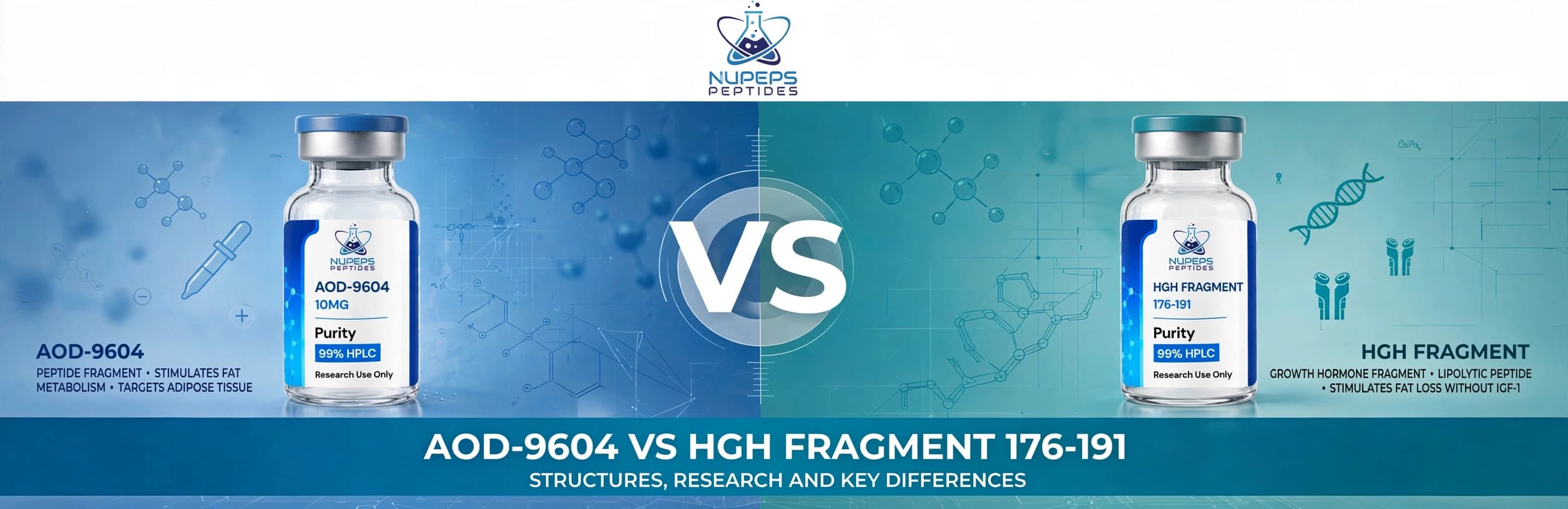
AOD-9604 vs HGH Fragment 176-191: Fat Metabolism Research Compared
5 ottobre 2026
Introduction
Within human growth hormone (hGH) lies a short C-terminal stretch — residues 176–191 — that attracted sustained research attention because it appeared to carry the hormone's fat-mobilizing (lipolytic) activity while leaving its growth-promoting effects behind. Two research compounds emerged from that region: HGH Fragment 176–191, the unmodified peptide corresponding exactly to that sequence, and AOD-9604, a modified analogue built on the same scaffold with an added N-terminal tyrosine and other stabilizing changes.
Because both compounds trace to the same domain, they are sometimes treated as interchangeable in casual discussion. The published literature, however, treats them as distinct molecules with distinct pharmacologic profiles, and the comparative reading is richer for keeping them separate. This guide compares the two fragments head-to-head: their structures, what the published research reports about each, the proposed signaling pathways, and which research questions each is best suited to address. All discussion is framed around laboratory and published preclinical research; both compounds are research materials and are not approved for human or veterinary use.
AOD-9604: The Modified Lipolytic Domain Analogue
AOD-9604 (also written AOD9604) is a synthetic analogue of the lipolytic domain of human growth hormone, developed in Australia through a program aimed at isolating the fat-metabolism properties of hGH from its growth-related effects. It comprises the 176–191 C-terminal region with an added N-terminal tyrosine residue, giving a 16-amino-acid peptide of approximately 1,815 Da that retains the intramolecular disulfide bond between the two cysteine residues.
The most cited characterization comes from Ng and colleagues, who studied daily oral treatment with AOD9604 at 500 µg/kg body weight for 19 days in obese Zucker rats. Treated animals showed a greater than 50% reduction in body weight gain compared with controls (15.8 ± 0.6 g versus 35.6 ± 0.8 g), alongside increased lipolytic activity in adipose tissue. Critically, euglycemic clamp techniques showed no adverse effect on insulin sensitivity — in contrast to chronic treatment with intact hGH. The authors concluded that the analogue of the hGH lipolytic domain showed potential as an orally usable agent for obesity research.
Citation: Ng FM, Sun J, Sharma L, Libinaka R, Jiang WJ, Gianello R. "Metabolic studies of a synthetic lipolytic domain (AOD9604) of human growth hormone." Hormone Research. 2000;53(6):274-278. PubMed PMID: 11146367
A follow-up program by Heffernan and colleagues examined chronic treatment (14 days via mini-osmotic pumps) with hGH or AOD9604 in obese (ob/ob) and lean mice, using in vitro assays to test receptor mediation. Both hGH and AOD9604 significantly reduced body weight gain in obese mice, associated with increased in vivo fat oxidation and elevated plasma glycerol — an index of lipolysis. Unlike hGH, AOD9604 did not induce hyperglycemia or reduce insulin secretion. The in vitro work established two defining properties: AOD9604 does not compete for the hGH receptor, and it does not induce cell proliferation, unlike hGH. The authors concluded that fragments of hGH can act through pathways novel to traditional hGH-stimulated signaling.
Citation: Heffernan MA, Thorburn AW, Fam B, Summers R, Conway-Campbell B, Waters MJ, Ng FM. "Increase of fat oxidation and weight loss in obese mice caused by chronic treatment with human growth hormone or a modified C-terminal fragment." International Journal of Obesity and Related Metabolic Disorders. 2001;25(10):1442-1449. PubMed PMID: 11673763
A second Heffernan study probed the mechanism further, focusing on the beta-3 adrenergic receptor (β3-AR) — the major lipolytic receptor in adipocytes. Both hGH and AOD9604 increased the repressed levels of β3-AR RNA in obese mice to levels comparable with lean mice. The importance of the pathway was tested in β3-AR knockout mice: chronic treatment failed to change body weight or increase lipolysis in the knockouts. However, in an acute experiment, AOD9604 still increased energy expenditure and fat oxidation even in the knockout animals — suggesting at least one additional, β3-AR-independent mechanism contributes to its metabolic effects.
Citation: Heffernan MA, Fam B, Summers R, Thorburn AW, Ng FM. "The effects of human GH and its lipolytic fragment (AOD9604) on lipid metabolism following chronic treatment in obese mice and beta(3)-AR knock-out mice." Endocrinology. 2001;142(12):5182-5189. PubMed PMID: 11713213
Taken together, the AOD-9604 literature describes a compound with dissociated pharmacology: lipolytic and fat-oxidation activity in obese animal models, no hGH-receptor binding, no proliferative signaling, preserved insulin sensitivity, and a partially β3-AR-dependent mechanism with an additional acute pathway.
AOD-9604 10MG is supplied by NUPEPS PEPTIDES as a lyophilized research reference material with batch-specific HPLC and mass spectrometry verification.
HGH Fragment 176–191: The Unmodified C-Terminal Fragment
HGH Fragment 176–191 is the peptide corresponding exactly to residues 176–191 of the human growth hormone sequence — Leu-Arg-Ile-Val-Gln-Cys-Arg-Ser-Val-Glu-Gly-Ser-Cys-Gly-Phe — with the native intramolecular disulfide bond between the two cysteine residues (positions 182 and 189 in hGH numbering). Its molecular weight is approximately 1,669 Da, making it slightly smaller than AOD-9604, which carries the extra N-terminal tyrosine.
Where AOD-9604 is a designed analogue with its own dedicated research program, Fragment 176–191 is best understood as the reference structure — the naturally occurring domain from which the analogue was derived. Much of the mechanistic literature on the hGH lipolytic domain (lipid mobilization without GH-receptor engagement) applies to the 176–191 region as a structural concept, while the headlined preclinical findings — the Zucker rat study, the ob/ob mouse studies, the β3-AR knockout experiments — were conducted specifically with AOD9604.
This distinction matters for research design. Studies using the unmodified fragment investigate the native domain's properties: its conformation, its receptor interactions (or lack thereof), and its baseline lipolytic activity. Studies using AOD-9604 investigate what the medicinal-chemistry modifications add — oral bioavailability characteristics, metabolic stability, and whether the modified scaffold retains, improves, or alters the domain's lipolytic signaling.
HGH Fragment 176–191 10MG is supplied by NUPEPS PEPTIDES as a lyophilized research reference material with batch-specific HPLC and mass spectrometry verification.
Head-to-Head Comparison
- Sequence — Tyr-Leu-Arg-Ile-Val-Gln-Cys-Arg-Ser-Val-Glu-Gly-Ser-Cys-Gly-Phe — Leu-Arg-Ile-Val-Gln-Cys-Arg-Ser-Val-Glu-Gly-Ser-Cys-Gly-Phe
- Length / MW — 16 amino acids, ~1,815 Da — 15 amino acids, ~1,669 Da
- Disulfide bond — Retained (Cys–Cys) — Retained (Cys–Cys)
- Key modification — Added N-terminal tyrosine; designed for stability — None — native sequence
- hGH receptor binding — No competition for the hGH receptor (published in vitro data) — Not characterized as an hGH-receptor ligand
- Proliferative signaling — No cell proliferation via hGH receptor (published data) — Not reported to drive proliferative pathways
- Published preclinical program — Dedicated: obese Zucker rats, ob/ob mice, β3-AR knockout mice — Primarily as reference structure; headline studies used AOD9604
- Reported lipolytic activity — Increased fat oxidation, plasma glycerol; increased adipose lipolytic activity — Investigated as the native lipolytic domain
- Insulin sensitivity — Preserved in published chronic-treatment studies (unlike intact hGH) — Studied within the same dissociated-pharmacology framework
- Proposed mechanism — Partially β3-AR-dependent; additional acute β3-AR-independent pathway — Studied as baseline for the domain's signaling
Key Differences Explained
Analogue versus native fragment. The single most important distinction is one of identity. AOD-9604 is an engineered molecule — the 176–191 scaffold plus deliberate modifications. HGH Fragment 176–191 is the unmodified domain itself. Every comparative reading of the literature should start here, because the published metabolic findings (weight-gain reduction, fat oxidation, glycerol elevation) were generated with AOD9604 specifically, not with the unmodified fragment.
Dissociated pharmacology. The central research concept for both compounds is dissociation: separating hGH's lipolytic activity from its growth-promoting, hyperglycemic, and proliferative effects. The published AOD9604 data support this dissociation directly — lipolysis and fat oxidation without hGH-receptor binding, without cell proliferation, and without the insulin-sensitivity deterioration seen with intact hGH.
The β3-adrenergic thread. Both compounds sit in a literature centered on adipocyte β3-adrenergic signaling. Chronic AOD9604 treatment restored repressed β3-AR expression in obese mice toward lean-mouse levels, and knockout experiments showed the chronic weight and lipolysis effects required an intact β3-AR pathway — while acute energy-expenditure effects persisted without it. This two-pathway picture (chronic β3-AR-dependent, acute β3-AR-independent) is the most detailed mechanistic account in the fragment literature.
Why the comparison matters experimentally. Because the only structural difference is the modification set, pairing the two compounds in a study design isolates the contribution of those modifications: does the added tyrosine and the analogue scaffold change receptor engagement, stability, or signaling relative to the native domain? That is the research question the comparison exists to answer.
Which Is Studied for What?
Choose AOD-9604 for research questions about:
- The dedicated preclinical literature: obese Zucker rat and ob/ob mouse metabolic models
- β3-adrenergic pathway involvement in fragment-induced lipolysis (including knockout-model comparisons)
- Dissociated hGH pharmacology — lipolysis without GH-receptor binding or proliferative signaling
- Modified-fragment design: what analogue engineering adds to the native domain
Choose HGH Fragment 176–191 for research questions about:
- The native 176–191 domain as a reference structure
- Baseline lipolytic-domain properties without analogue modifications
- Head-to-head analogue-vs-native comparisons isolating the effect of the modifications
- Structure–activity mapping of the hGH C-terminal region
Study both when:
- Dissecting which effects belong to the domain itself versus the analogue modifications
- Comparing stability, conformation, or signaling between native and modified scaffolds
- Building a complete structure–activity picture of the hGH lipolytic region
Domande frequenti
Are AOD-9604 and HGH Fragment 176–191 the same compound?
No. HGH Fragment 176–191 is the unmodified peptide matching residues 176–191 of human growth hormone. AOD-9604 is a modified analogue built on that same region, with an added N-terminal tyrosine and other design changes. They are related but distinct molecules.
What is the structural difference between them?
AOD-9604 is a 16-amino-acid peptide (~1,815 Da) comprising the 176–191 region plus an N-terminal tyrosine. HGH Fragment 176–191 is the native 15-amino-acid sequence (~1,669 Da) with no modifications. Both retain the intramolecular disulfide bond between the two cysteine residues.
Do either of them bind the growth hormone receptor?
Published in vitro work found that AOD9604 does not compete for the hGH receptor and does not induce cell proliferation through it — unlike intact hGH. This non-interaction with the classical GH receptor is central to the "dissociated pharmacology" concept in the literature.
What did the published animal research report?
In obese Zucker rats, 19 days of AOD9604 treatment reduced body weight gain by more than 50% versus controls and increased adipose lipolytic activity, with insulin sensitivity preserved. In obese ob/ob mice, 14 days of treatment reduced weight gain, increased in vivo fat oxidation, and elevated plasma glycerol, without the hyperglycemia seen with intact hGH.
Which fragment has the larger published research program?
AOD-9604. The headline preclinical studies — the Zucker rat work, the ob/ob mouse studies, and the β3-AR knockout experiments — were conducted with AOD9604 specifically. The unmodified Fragment 176–191 serves primarily as the native reference structure in this literature.
Conclusione
AOD-9604 and HGH Fragment 176–191 are two sides of the same research story: one is the engineered analogue with a dedicated preclinical literature, the other is the native domain it was built from. The published data describe dissociated pharmacology — lipolytic and fat-oxidation activity without hGH-receptor engagement, proliferative signaling, or insulin-sensitivity deterioration — with a partially β3-adrenergic mechanism and an additional acute pathway. The most informative research treats them as a pair: the analogue for its documented effects, the native fragment as the baseline against which the modifications are judged.
For researchers sourcing either compound, verify ≥99% purity by HPLC, mass spectrometry identity confirmation, and a batch-specific Certificate of Analysis from an accredited laboratory.
For laboratory research use only. Not for human or veterinary use.
Tutti i prodotti sono destinati esclusivamente alla ricerca di laboratorio e all'uso in vitro. Non destinato al consumo umano o veterinario, alla diagnosi o all'uso terapeutico. I prodotti non sono farmaci, alimenti, cosmetici o integratori alimentari e non possono essere contrassegnati, maltrattati o contrassegnati.